
TL;DR
We explain how IIT-JAM coaching for exam speed turns previous papers into staged timed practice, an error log, and an attempt-order test. We also show which elements capable self-studiers can reproduce, when recurring data calls for feedback, and how our preparation system supports a measurable next step.
The official JAM format gives candidates three hours to complete a computer-based paper. That makes speed less about rushing every calculation and more about making clean decisions before time leaks away.
IIT-JAM coaching for exam speed works when it turns previous papers into a timed feedback system. Students practise recognising a question, choosing a method, calculating accurately, and abandoning low-value attempts separately before combining them in full mocks. Past papers show exam style, while structure adds pacing targets, error diagnosis, progressive limits, and feedback on recurring slow habits.
We will show what structured practice adds, how to build a timed ladder, and when a strong self-studier can reproduce the same system independently.
How Does IIT-JAM Coaching for Exam Speed Differ from Past Papers?
Previous papers are essential evidence of question style, topics, and the pressure of a full paper. But solving one at a time, without a clock or a review method, can conceal whether the real delay came from rereading, choosing an expensive method, slow algebra, or staying too long with one question.
| Practice Element | Previous Papers Alone | Structured Practice System |
|---|---|---|
| Sequencing | Often solved as complete papers | Moves from topic drills to mixed sets, sectional tests, and full papers |
| Timing | Usually records only total score or finish time | Tracks time by question and by bottleneck |
| Feedback | Checks the final answer | Diagnoses the reason for delay and assigns a corrective drill |
| Error Diagnosis | Labels work right, wrong, or slow | Separates knowledge, arithmetic, rereading, method choice, and abandonment |
| Progression | Repeats similar papers | Tightens time limits only when accuracy is stable |
The important difference is not that coaching magically makes someone faster. It gives practice a job. A recognition drill asks whether you can name a valid route quickly. A calculation drill supplies the route first, so you can measure execution rather than method choice. A full mock then checks whether those smaller improvements survive realistic pressure.
We use this sequence because practice spread across sessions has a measurable advantage over massed practice in mathematics, according to a maths meta-analysis. If your previous papers feel productive but your timing is flat, pair them with a past-paper guide and start measuring the stage that is actually slow.
Which Bottlenecks Make Capable Candidates Slow?
A candidate can understand a topic and still lose time before the first useful line appears on paper. We separate speed into four stages because each needs a different fix. More questions alone can strengthen the wrong skill if you do not know which stage broke down.
Recognition: Can You Identify the Question Type?
Recognition is the moment you see a prompt and identify the topic, cue, or likely route. When this is slow, students often reread a familiar problem several times because they have not connected its wording to a usable method.
Build small mixed sets of ten to twelve prompts. Before calculating, write the likely method or representation. The goal is not to guess perfectly. It is to make the first decision visible enough to review.
Method Choice: Can You Select the Shortest Valid Route?
Knowing several methods is useful only when you can choose a valid one under pressure. A study of multistep mathematical problems found that testing pressure can alter strategy choice and reduce accuracy when students move toward less effective approaches. Pressure research supports practising the decision itself, not only the final calculation.
Use first-two-lines drills here. Give yourself the question, choose a route, and write only the first valid setup. If the setup wanders, the next task is method selection, not a faster timer.
Calculation: Can You Execute Without Avoidable Work?
Calculation slowness shows up as repeated expansions, unnecessary substitutions, sign errors, or long manual arithmetic that a virtual calculator could handle after the method is chosen. Separate these from knowledge gaps so you do not waste revision time on a concept you already understand.
Our speed diagnostic can help you distinguish a calculation bottleneck from a recognition or setup bottleneck.
Persistence: Can You Flag and Return?
Late abandonment is often the most expensive habit. If you cannot identify a viable route within your planned threshold, flag the question and protect time for higher-certainty marks. Return only after the easier work is secure.
This is especially important because MCQs carry negative marking, while MSQs and NAT questions do not. The best threshold is personal, so test it in several mocks rather than borrowing somebody else’s rule.
How Does a Timed-Practice Ladder Build Speed Safely?
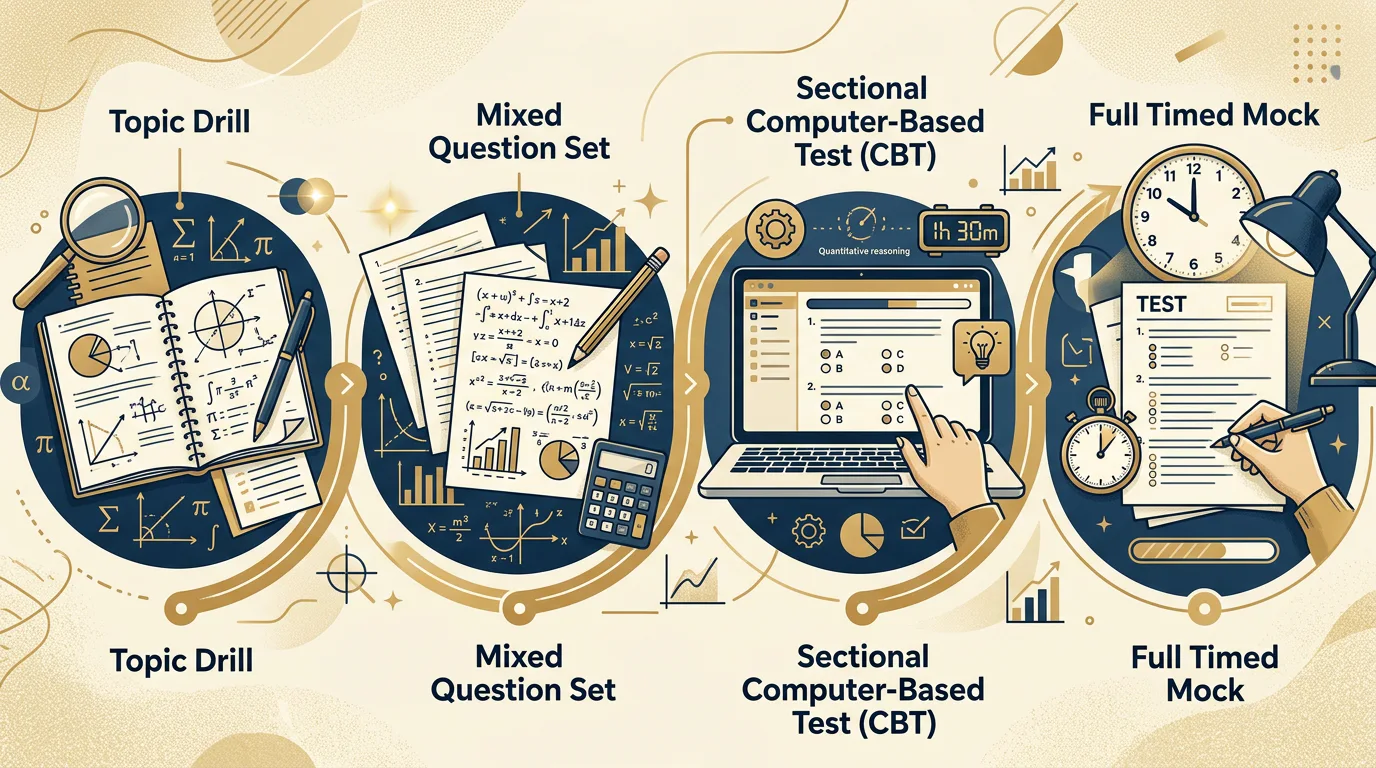
We build speed from narrow practice to realistic paper conditions. Each stage has a different purpose, and moving forward too early often produces faster but less accurate work. For the transition from scattered drills to measured practice, use our structured-practice guide.
Stage One: Topic Drills
Start with one topic and one bottleneck. Time recognition, the first valid setup, or execution, but not all three at once. This makes the result actionable: a slow recognition time needs cue practice, while a correct but slow solution needs cleaner working.
Stage Two: Mixed Sets
Next, mix nearby topics. A mixed set removes the comfort of knowing what chapter every question belongs to, so it tests recognition and method choice together. Keep an error log beside the timer and revisit weak routes after a gap rather than repeating them immediately.
Stage Three: Sectional Tests
Use short section-style tests to practise pacing and answer entry. The current format includes MCQ, MSQ, and NAT questions, so candidates need to rehearse selection, complete option checking, numerical entry, and calculator use in conditions that feel like the real interface.
Stage Four: Full Papers
Full papers are where attempt order, stamina, and skip decisions come together. They are a test of the system, not the only way to build it. Compare your mock environment with our test realism guide before treating its score as a reliable readiness signal.
How Should You Choose an Attempt Order?
A useful attempt order balances easy marks, confidence, and the risk of spending too long on one attractive problem. It should not be a rigid rule about question numbers. Instead, it should be a tested routine based on what your own timing record shows.
Begin with a quick pass for questions where you can see a viable route. Then return to questions that need more setup, and leave uncertain items for a final decision pass. The official marking rules make this distinction meaningful because an incorrect MCQ loses marks, while unattempted questions receive zero.
| Pass | Candidate Action | What To Record | Exit Rule |
|---|---|---|---|
| Secure | Answer questions with an immediate viable route | Confidence and expected time | Flag when the route is unclear |
| Build | Return to questions that need a workable setup | Planned versus actual time | Stop at your tested time cap |
| Decide | Revisit flags and check submissions | Remaining time and mark risk | Avoid blind answers |
Your first full mock may expose that you are too cautious, too persistent, or too quick to abandon a valid route. Use our time-management guide to test one adjustment at a time, then judge it by the next paper instead of by how sensible it sounded.
What Should a Mock Review Reveal Beyond the Score?
A score tells you what happened. A reviewed mock tells you what to practise next. We want every long or incorrect question to produce a specific next drill, otherwise the next paper repeats the same uncertainty with a different set of numbers.
| Question Or Set | Planned Time | Actual Time | Accuracy | Error Tag | Next Corrective Drill |
|---|---|---|---|---|---|
| Mixed method set | 20 minutes | 20 minutes | Low | Method switching | Prompt-to-method cards |
| Numerical set | 18 minutes | 31 minutes | Mixed | Arithmetic and rereading | Route-given execution drill |
| Flagged questions | 15 minutes | 28 minutes | Low | Late abandonment | Skip-and-return rehearsal |
Tag every issue consistently: knowledge gap, arithmetic mistake, rereading, method switching, interface entry, or late abandonment. A 2023 meta-analysis found that explanatory feedback had the strongest effect among feedback types studied in technology-rich learning settings. Feedback evidence is why we focus on a reason and a next action, not just a solution key.
Seek outside feedback when two consecutive timed sets show the same bottleneck and your assigned drill changes neither time nor accuracy. At that point, a fresh reviewer may spot a false assumption, an overlong method, or a pattern you have normalised. Use our mock calibration guide to keep score confidence separate from genuine pacing evidence.
How SBTech Math Supports Speed Practice
At SBTech Math, we build IIT-JAM preparation around observable decisions, not vague promises of faster work. Our learners can use concept lessons to repair weak routes, timed sets to test whether those routes appear quickly, and review tools to convert each mock into a next action. We encourage candidates to keep self-study at the center: watch selectively, practise deliberately, and bring recurring bottlenecks to us when a log shows that solo corrections are not changing them. That approach keeps support proportional to the problem. If recognition is slow, the next set should train recognition. If calculations are careless, the next set should protect accuracy before pressure rises. If attempt order is wasteful, the next mock should test a different rule. Use these criteria to decide what should remain independent and what deserves feedback before you commit more time. Explore our current preparation options in the SBTech Math course store.
FAQs on IIT-JAM Coaching for Exam Speed
Do I Need Coaching?
No. Self-study can reproduce much of the system when your timed log identifies one bottleneck, the chosen drill improves it, and full-paper pacing measurably changes.
Why Am I Accurate at Home but Slow in a Mock?
Home accuracy can hide rereading, indecision, slow recognition, or late abandonment. Timed mixed sets expose these delays because they require choices before a solution path feels comfortable.
How Many Full Papers Should I Take Before Changing My Timing Strategy?
Use full papers after shorter timed sets identify the problem. Change one pacing rule at a time, then measure the next mock for a genuine improvement.