


TL;DR
At SBTech Math, we use past papers to build IIT-JAM time management only when students simulate the full exam, log decisions, and retest targeted drills. This guide shows what PYQs reveal, what they hide, how to diagnose slow mocks, and when paid feedback adds a function disciplined self-analysis cannot supply.
The official IIT-JAM pattern gives candidates 180 minutes for 60 questions, across MCQ, MSQ, and NAT formats. That makes pacing a decision problem, not simply a speed problem.
We find IIT-JAM time management improves when past papers are unfamiliar, attempted under full exam conditions, and reviewed question by question. They reveal patterns and your own pace, but they cannot identify why you hesitated or overspent time. Paid support is worthwhile only when it diagnoses, drills, and retests those decisions.
In this guide, we separate what PYQs can teach from what they cannot, then give you a full-paper protocol, an attempt log, a pacing diagnosis, and a practical test for outside help.
Can Past Papers Improve IIT-JAM Time Management?
Past papers are the closest available record of official question formats and marking rules. They become useful for pacing only when the clock changes your choices: which question you start, when you defer it, and whether you return.
| PYQs Can Teach | PYQs Cannot Establish Alone |
|---|---|
| MCQ, MSQ, and NAT response formats | Why you got stuck on a question |
| Familiarity with official-style questions | Reliable pacing from untimed work |
| Your score and time on an unfamiliar paper | Whether a delay came from concepts, calculation, or checking |
| Which topics consume your time | A personalised drill or accountability system |
The three-hour limit works out to an average of three minutes per question, but that is a diagnostic average, not a fixed cap. A two-mark numerical question may deserve more time than an easy one-mark MCQ. The goal is to protect time from low-probability work, not force every question into the same time slot.
Negative marking makes this especially important. A blind four-option MCQ guess breaks even only at a 25% chance of being correct, so we recommend attempting uncertain MCQs only when you can explain why one option is more likely. For a wider look at the limits of using solved papers alone, read previous papers alone.
What Do PYQs Reveal, and What Do They Hide?
The official paper archive gives Mathematics and Mathematical Statistics aspirants annual papers from 2012 through 2025. That is enough material to reserve unfamiliar papers for later simulations instead of repeatedly using the same few papers as confidence checks. Use the official paper archive to separate learning papers from testing papers.
PYQs can reveal recurring concepts, common forms of reasoning, and which formats feel slow for you. They can also show whether you recognise a question quickly but calculate slowly, or whether you avoid certain topics before you have even attempted them. Those are useful signals for self-study, revision planning, doubt-solving, and mock analysis.
They cannot tell you much when you solve them untimed or remember the method from a prior attempt. Finishing a familiar question quickly can feel like speed, while actually measuring memory of the solution route. A useful practice paper should make you choose under pressure with incomplete certainty.
That distinction is the value of structured practice. We want each paper to generate decision data, not just another score.
How Should You Practise a Paper Under Time Pressure?
A credible timed attempt makes the clock part of the evidence. We recommend using an unseen or minimally familiar official paper, sitting once without pauses, and reviewing the attempt only after you finish.
Build a Valid Baseline
Start with the full 180-minute condition. Remove notes and external study aids, use the appropriate digital tools, and keep solutions hidden. If you use a digital simulation, record the paper year, subject, date, and how familiar it was before the attempt.
A baseline does not need to be your best score. Its job is to show where minutes went. If conceptually strong work still feels slow, use our guide to problem-solving speed alongside the log below.
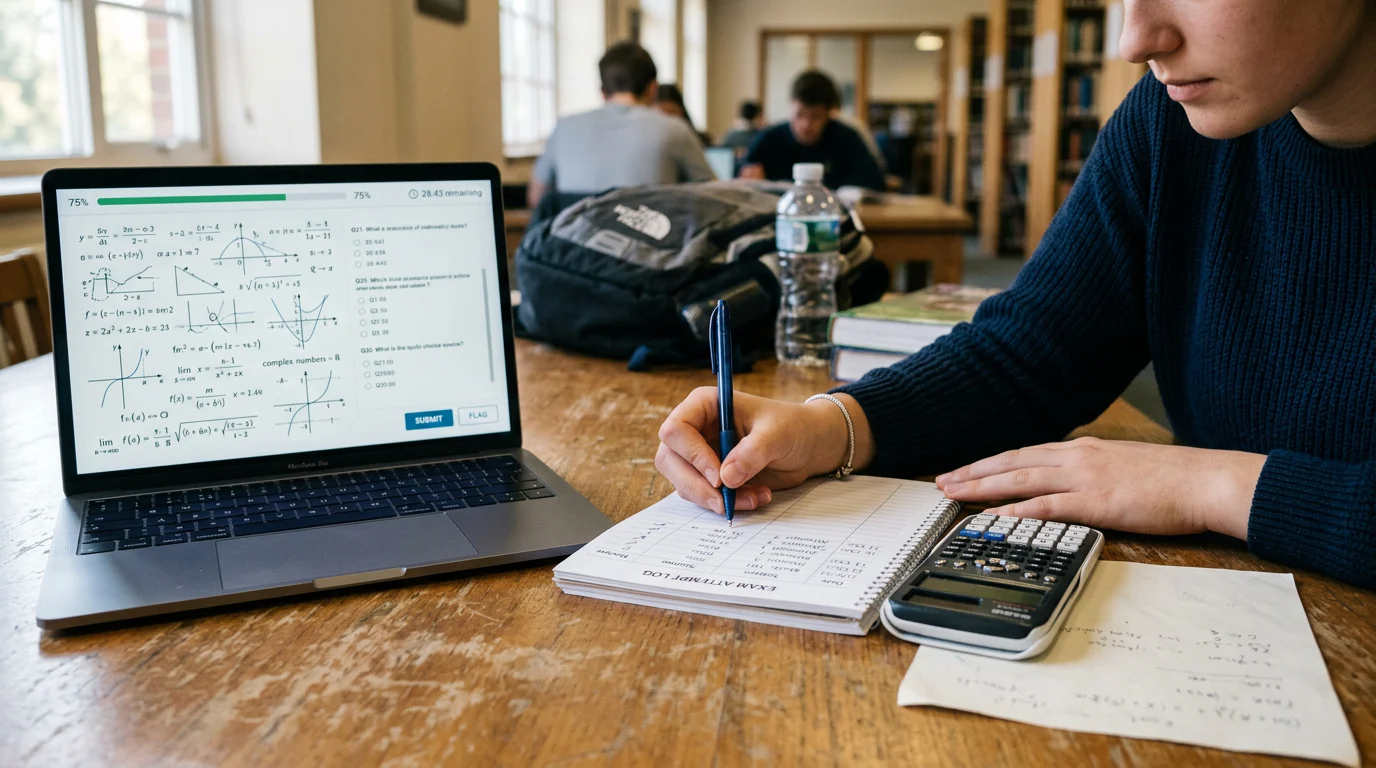
Follow the Six-Step Protocol
- Reserve one unfamiliar paper and hide its solutions.
- Set one uninterrupted 180-minute timer.
- Mark each question as attempt, defer, or skip as you work.
- Move on when you cannot identify a credible route within your own pre-declared recognition window.
- Return only to questions with a clear route and enough remaining time.
- Review every wrong, deferred, slow, and skipped question, then retest the weakest pattern on another paper.
Do not set arbitrary section quotas before you have evidence from your own attempts. Instead, use a first pass to collect reachable marks, then use later time for questions where you can name the next mathematical step.
Use an Attempt Log
| Paper And Date | Question Type | Start Time | Completion Time | Result | Confidence | Decision | Skip Or Error Reason | Next Drill |
|---|---|---|---|---|---|---|---|---|
| 2025 MA | NAT | 42:10 | 47:35 | Wrong | 3/5 | Attempt | Slow calculation | Timed algebra variations |
| 2024 MA | MCQ | 61:20 | 61:45 | Unattempted | 1/5 | Skip | No method recognised | Method-identification sprint |
The log should record the result, but never stop at the result. A correct answer that used too much time can be as revealing as a wrong answer. Before choosing any practice product, compare its question-level review with test series realism.
Why Are You Slow in IIT-JAM Mock Tests?
A slow mock is not one problem. Students often try to solve it with more papers, when the real cause is slow calculation, delayed method recognition, conceptual hesitation, or repeated checking.
| Log Pattern | Likely Cause | Drill | Improvement Signal |
|---|---|---|---|
| Correct answers with long completion times | Slow calculation | Timed single-skill calculations, then mixed variants | Less time with stable accuracy |
| Long delay before the first step | Slow recognition | Identify the method before solving | Faster starts and fewer empty skips |
| Solvable only with unlimited time | Conceptual hesitation | Retrieve the theorem, then solve a parallel problem | More confident first-pass attempts |
| Correct answer followed by long rechecking | Repeated checking | One-check stop rule | Less checking time without more errors |
A strong review process asks what happened between opening the question and submitting the answer. That is why feedback matters. A feedback meta-analysis covering 435 studies found an overall positive effect on learning, while also showing that feedback quality and content matter greatly.
- Slow Calculation: Build speed with short, repeatable calculations that match the operation causing the delay, then return to mixed questions.
- Slow Recognition: Practise naming the likely method before doing the algebra. Recognition should become quicker without becoming careless.
- Conceptual Hesitation: Separate “I forgot the idea” from “I know the idea but cannot apply it.” These need different revision.
- Repeated Checking: Set one deliberate verification step, then move on unless new evidence changes the answer.
If the same code appears across several papers, it is a pattern rather than bad luck. Use mock-score plateau to investigate the pattern before changing your entire study plan.
Does Coaching Improve IIT-JAM Exam Pacing More Than Self-Analysis?
Coaching does not automatically create better pacing. The important comparison is the feedback delivered after a timed attempt: does someone review your decisions, prescribe a drill, and verify that it worked on a later paper?
Compare the Feedback Function
| Support Option | Analysis Depth | Personalisation | Accountability | Direct Cost |
|---|---|---|---|---|
| Self-Analysis | High with a complete log | High | Self-managed | No direct fee |
| Peer Review | Variable | Moderate | Moderate | Usually free or shared-cost |
| Mentoring | Can audit decisions | High | High | Varies by provider |
| Test Series | Often score-led | Low to moderate | Moderate | Varies by provider |
| Full Coaching | Varies widely | Moderate to high | High | Varies by provider |
What Paid Feedback Must Add
- Decision Review: It should identify where your time went and whether the skip decision was right.
- Drill Prescription: It should connect one recurring error to one specific practice task.
- Retest Accountability: It should check whether a later unfamiliar paper improved the same metric.
A practice review found positive associations between purposeful practice and performance both with and without a coach or teacher. That is not IIT-JAM-specific proof, but it supports our standard: judge support by the feedback it produces, not its label.
Use an Evidence-Based Checkpoint
After a baseline and three unfamiliar full-paper simulations, continue self-analysis if you can identify the bottleneck, choose a drill, and improve at least two logged measures. Those measures may include lower unproductive time, more accurate first-pass attempts, or fewer repeated skip reasons.
Seek outside structure when the same error code persists, you cannot turn the log into a drill, or feedback never gets beyond “practise more.” For that broader choice, compare coaching versus self-study.
Build a Pacing System with SBTech Math
At SBTech Math, we help students turn practice into evidence instead of a vague promise to be faster. We start with the exam your plan actually targets, then ask you to record the decisions that cost marks or minutes. Our role is useful when it makes the next action clearer: a focused speed drill, a better skip rule, a review of a mock, or a return to a concept that is not yet automatic. If you are self-directed, use our framework until you can identify the cause of every repeated pacing problem. If you need a clearer review routine, bring us the log, not just the score. We will help you decide whether more practice, feedback, or structure is the missing layer, then test that decision against another unfamiliar paper. That keeps support accountable to visible improvement rather than reassurance. Start with SBTech Math.
FAQs on IIT-JAM Time Management
Can Past Papers Improve IIT-JAM Time Management?
Yes. Use unfamiliar papers in a full 180-minute simulation, then record timing, accuracy, confidence, and skipped questions. Untimed or remembered papers show knowledge, not reliable pacing.
How Should I Practise IIT-JAM Papers Under Time Pressure?
Set a single 180-minute timer, remove study aids, use appropriate digital tools, tag decisions as you go, then review every slow, wrong, deferred, or skipped question.
Why Am I Slow in IIT-JAM Mock Tests?
Slow mock performance usually comes from calculation, recognition, concepts, or repeated checking. An attempt log separates these causes, so practice can target the real bottleneck.
Should I Guess IIT-JAM MCQs When Time Is Running Out?
Avoid blind guesses. Four-option MCQ negative marking means a 25% guess only breaks even in expected marks. Attempt when you have a reasoned probability above chance.
Does IIT-JAM Coaching Help with Exam Pacing?
Coaching helps when it reviews timing and skip decisions, assigns targeted drills, and retests them. Disciplined self-analysis can provide the same pacing function when completed consistently.