


TL;DR
We find that PYQs teach IIT-JAM question styles and concepts, while structured IIT-JAM practice trains the decisions that determine pace during a live paper. We show how to time and preserve papers, choose attempts by format, log errors, retest weaknesses, and decide whether independent study or outside support fits.
The latest published JAM brochure makes Mathematics a 60-question paper. That format rewards more than knowing how to finish a familiar problem after unlimited thought.
Structured IIT-JAM practice adds the exam-execution layer that ordinary PYQs miss: a time limit, a fast triage rule, mixed-topic conditions, an error log, and a retest. Self-studiers can build this system themselves; outside support is valuable only when feedback, planning, or accountability repeatedly breaks down.
We will separate what previous papers genuinely teach from what they cannot diagnose alone. Then we will build a timed-PYQ method, attempt rules for each format, and a review system that turns one mock into a better next attempt. Start with free study content if you need targeted material for a specific weakness.
| Practice Setup | What PYQs Contribute | What It Measures About Execution | What Is Still Needed |
|---|---|---|---|
| Ordinary PYQ Practice | Concepts, wording, and familiar formats | Usually eventual correctness | Timing, triage, error classification, retest |
| Structured Self-Study | The same paper value plus a repeatable system | Pace, selection, confidence, and recurring errors | Consistency and honest review |
| Test-Series Support | New mixed-topic simulations and solutions | Performance on unfamiliar sets | A plan for acting on feedback |
| Full Coaching | Scheduled teaching, practice, and accountability | Can reduce planning friction | Independent timed attempts |
What Do IIT-JAM PYQs Teach, and Why Are They Necessary?
Previous papers are indispensable because they show how syllabus knowledge becomes an actual exam prompt. They reveal the level of precision expected, the difference between solving a mathematical idea and recognising it quickly, and the response formats you will face. They should guide practice, not become a prediction game about repeated questions.
Use PYQs to identify the concepts you can retrieve without notes, the constructions that slow you down, and the topics where your method is shaky. A solid foundation plan helps make that review useful, because a paper cannot repair a missing prerequisite by itself.
A previous paper also gives you a fair baseline. If you solve it carefully after studying a topic, you have evidence that you understand that topic in a low-pressure setting. The next question is whether that understanding survives a mixed paper, limited time, and a difficult question appearing before an easier one.
What Does Untimed PYQ Work Miss About Exam Execution?
Untimed practice is still practice, but it leaves several important questions unanswered. It cannot show whether you spot an accessible question fast enough, whether you spend too long proving a point you should leave, or whether your accuracy drops after a demanding hour of work.
It also hides transitions. A chapter-wise exercise lets you settle into one mode of thought, while the real paper makes you switch between analysis, algebra, differential equations, and numerical work. That is why a good previous-paper guide should lead into timed mixed practice rather than end with solution reading.
The missing measurement is not intelligence or effort. It is decision quality under constraints. When a student says, “I knew that question after the exam,” the useful follow-up is not simply “study more.” It is: Did you fail to recognise it, fail to reach it, misjudge its time cost, or lose accuracy while returning to it?
How Does Structured IIT-JAM Practice Turn PYQs into Time Training?
We build structured IIT-JAM practice around repeatable conditions, not around doing more papers as fast as possible. Keep older papers for drills and preserve recent untouched papers for realistic simulations. Before a full paper, use the official mock test so the computer-based interface is not another surprise on exam day.
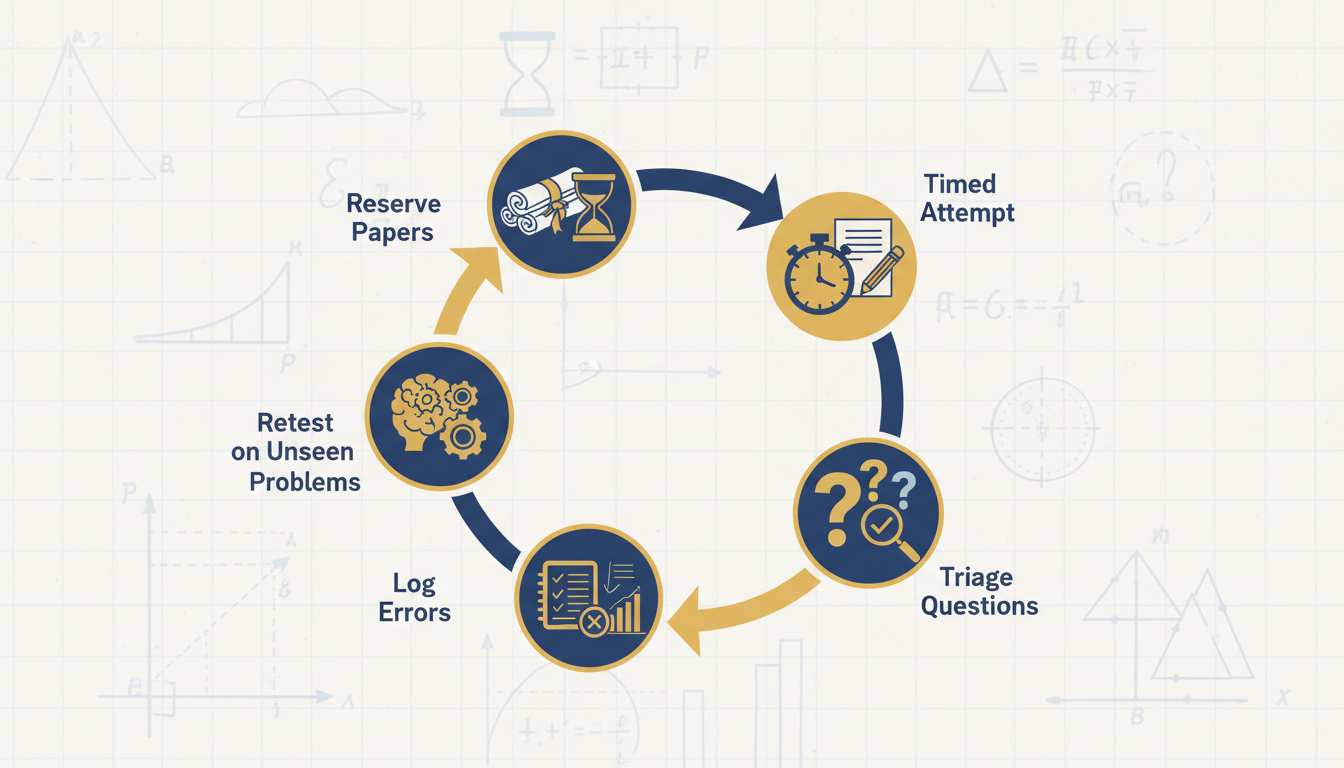
Reserve Papers Before You Start
Use older papers for topic drills, mixed sets, and learning the pattern. Keep at least two recent papers unseen until late preparation, when you can take them in uninterrupted conditions. This protects your best simulation material from becoming a remembered solution set.
Use a Five-Step Timed-PYQ Protocol
- Select: Choose an older paper or a mixed set that contains MCQ, MSQ, and NAT questions.
- Set Conditions: Start one timer, remove solutions, and use only the tools allowed for that session.
- Triage: Mark questions as start now, return later, or leave before committing to lengthy work.
- Log First: Record time, confidence, and answer status before checking the key.
- Retest: Repair the specific weakness, then try an unseen question testing the same skill.
Build from Drills to Simulations
Begin with short mixed sets, then move to sectional sessions, then full papers. The target is not a universal minutes-per-question rule. It is learning which questions are accessible for you, which ones are expensive, and when your return decisions improve.
For full simulations, match the official three-hour setting and include all formats. If you use outside mock material, compare it against a mock realism guide rather than assuming a harder paper is automatically better practice.
Which Attempt Order and Skip Rules Fit Each Question Format?
A strong attempt order begins with recognition, not with whichever topic you enjoy most. The latest published marking rules set different risk conditions for MCQ, MSQ, and NAT, so your decision rule should change with the format.
Use this flow during a timed session:
Can I identify a valid starting method quickly?
├─ No: Tag it and move on.
└─ Yes: Is the path reasonable for the remaining time?
   ├─ No: Tag it and return later.
   └─ Yes: Solve, then apply the format check.
      ├─ MCQ: Submit only after a solution or check supports the option.
      ├─ MSQ: Submit only after every selected option is checked.
      └─ NAT: Recheck sign, range, rounding, and numeric entry.
- MCQ: Wrong answers carry negative marking, so do not turn an unsupported hunch into an attempt.
- MSQ: There is no negative or partial marking, but incomplete option checking can still waste valuable time.
- NAT: There is no negative marking, yet a careless sign, range, or keypad-entry error still loses the mark.
A skip is not a surrender. It is a way to protect accessible marks while keeping a difficult question available for a later decision. Use a test-series comparison only after you have a clear rule for what its scores are supposed to diagnose.
How Should You Analyse a Timed PYQ After the Timer Stops?
Checking the answer key is only the first part of review. We want the reason behind a result, because a wrong answer caused by a missing theorem needs a different repair from a wrong answer caused by slow selection or a rushed calculation.
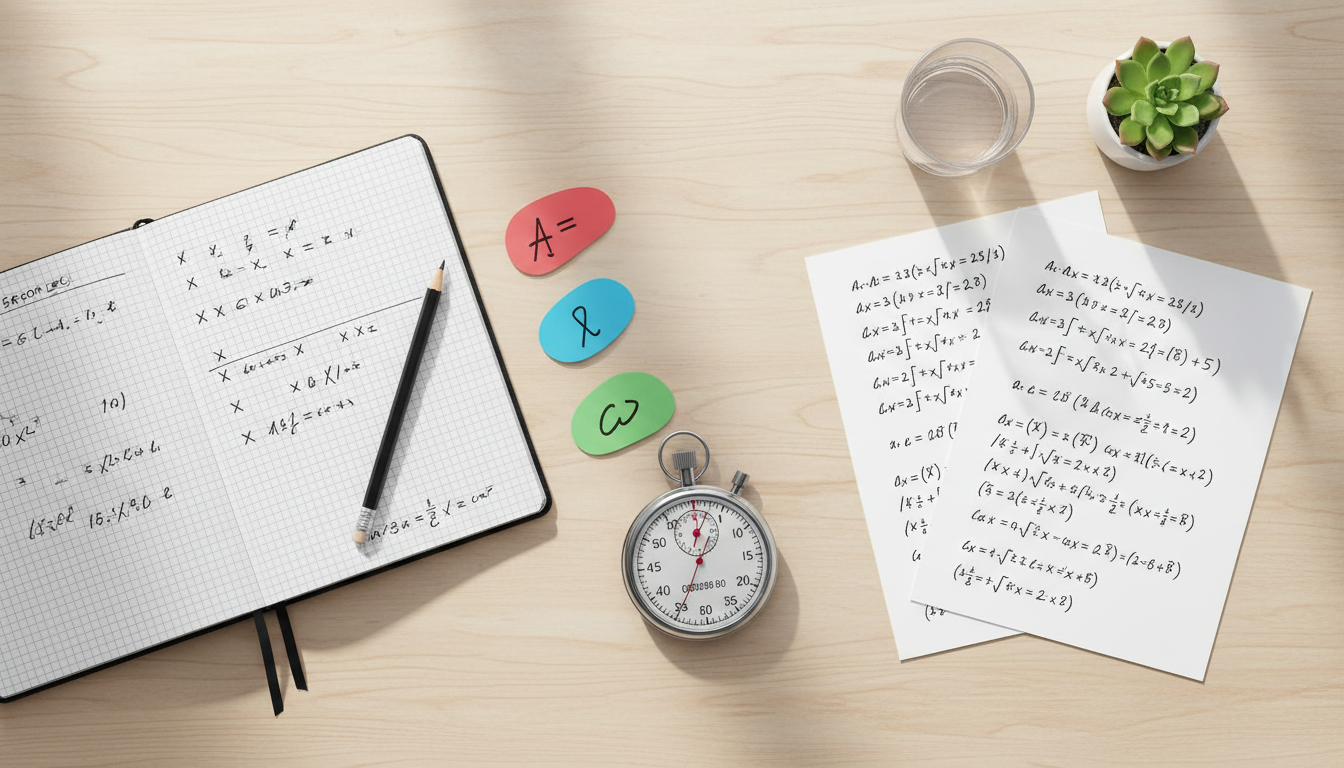
Record More Than Correct and Wrong
Use an error log that tracks the decision as well as the answer.
| Field | What To Record |
|---|---|
| Question And Format | Question number, topic, and MCQ, MSQ, or NAT |
| Time Spent | Time before answering, skipping, or returning |
| Result | Correct, wrong, or blank |
| Confidence | High, medium, or low before checking |
| Error Type | Concept, method, calculation, reading, entry, or time allocation |
| Missed Accessible Question | Whether you could solve it in review but did not reach it in time |
| Repair And Retest | Specific drill, date, unseen item, and outcome |
Classify the Pattern
High-confidence errors often signal a misconception, a reading habit, or an unchecked calculation. Low-confidence correct answers can show a method that works but is not stable yet. Blank questions matter too, especially when they were accessible in review but lost to poor triage.
If the same category appears across sessions, use a plateau diagnostic before adding another random paper. The point is to change the cause, not merely create another score.
Retest the Skill, Not the Memory
Do not prove improvement by repeating the identical question until it feels familiar. Retest the same underlying skill using an unseen item after a planned gap. Improvement means better correctness, less wasted time, and a better choice about whether to attempt the question.
Specific feedback is worth building into this loop. A large study on feedback found a medium overall learning effect, while also showing that the content of feedback matters. Use targeted revision, then return to an unseen timed set.
How Can SBTech Math Support Structured IIT-JAM Practice?
At SBTech Math, we work with Mathematics candidates who want a working practice system, not a vague promise that more classes will solve every problem. We help you turn preparation into scheduled drills, mixed mocks, clear solution review, and regular progress checks, while keeping responsibility for actual attempts with you. If your logs show a knowledge gap, we can help you organise the right study sequence. If they show a pacing or confidence problem, we can help you interpret it and build a retest plan. If you already run this system well alone, keep doing that. Use our support when it removes a real bottleneck, whether that is feedback, accountability, or exam-specific practice. Our materials are meant to make your decisions visible, so you can improve the system rather than merely consume more lessons. Start with the approach that fits your evidence, then explore SBTech Math
FAQs on Structured IIT-JAM Practice
Use these answers with your timed evidence. Check your own logs too.
Can I Prepare with Self-Study and PYQs Alone?
Yes. With timed mixed sets, a useful error log, planned retests, and untouched papers saved for full simulations, disciplined self-study can build exam-execution skill independently.
How Many PYQs Should I Keep Untouched for Mocks?
Reserve at least two recent papers until late preparation. Use older papers for drills, then take each saved paper once under full, uninterrupted official conditions.
Should I Attempt Every MSQ and NAT Question?
No. No negative marking removes the score penalty, but every uncertain question still consumes time. Attempt it only after accessible questions and high-value returns are handled.
What Belongs in an IIT-JAM PYQ Error Log?
Record topic, format, time, confidence, result, error type, missed accessibility, repair action, and retest evidence. This turns a disappointing score into a specific next practice task.