
How to Build an IIT-JAM Mathematics Plan with CUET-PG as a Real Backup


TL;DR
We build an IIT-JAM Mathematics plan with CUET-PG as a real backup by sharing core learning while separating syllabi, practice, mocks and deadlines. This guide crosswalks both papers, sets a primary-to-backup allocation and switch rule, and shows how to audit any preparation platform and admissions target before relying on it.
For the 2026 cycle, IIT JAM offered direct admission to about 3,000 seats across postgraduate programmes at 22 IITs. That opportunity deserves a focused primary plan, while CUET-PG gives Mathematics students a broader admissions route worth preparing for deliberately.
We build an IIT-JAM Mathematics plan with CUET-PG as a real backup by sharing foundations but splitting execution. Use one lesson sequence where syllabi overlap, then maintain separate checklists, question banks, mocks, error logs and revision deadlines. A course that merely lists both exams is not, by itself, an integrated preparation system.
This guide explains the syllabus overlap, paper-format differences, weekly allocation, switch point, admissions worksheet and platform audit needed to make CUET-PG a genuine backup.
Which Online Platform Can Prepare You for IIT-JAM and CUET-PG Mathematics?
We would evaluate any platform by its operating plan, not by a broad claim that it prepares students for several examinations. IIT-JAM Mathematics and CUET-PG Mathematics reward much of the same undergraduate foundation, but they test it through different syllabi, formats and time pressure.
A useful integrated system should make the shared work clear, then prove that each exam has its own completion and practice path. The first audit is simple: can you see where every official topic is taught, when it is practised in the correct format and how a missed topic returns in revision?
| Workstream | Can Be Shared? | Must Stay Separate? |
|---|---|---|
| Core algebra, linear algebra, calculus and ODE concepts | Yes | Exam-specific question selection |
| Syllabus tracking | No | Separate official checklists |
| Practice | Partly | JAM MCQ, MSQ and NAT versus CUET-PG MCQ banks |
| Mock tests | No | Separate timing, marking and interface simulations |
| Revision | Partly | Separate final-week calendars and error logs |
JAM is a three-hour CBT with 60 questions and 100 marks, while CUET-PG Mathematics is a 90-minute, 75-question paper. Those facts alone mean a shared lecture library can help, but a shared mock strategy cannot. Before paying, use our platform audit to inspect the lesson map, practice banks and review tools rather than trusting a course label.
What Overlaps and What Requires Separate Preparation?
Start with the current official syllabi, not a familiar chapter list from college. The overlap is substantial enough to reduce duplicated learning, especially in algebra, linear algebra, real analysis, multivariable calculus and differential equations. It is not complete enough to let you skip either checklist.
| Topic Cluster | IIT-JAM Mathematics | CUET-PG Mathematics, SCQP19 | Planning Label |
|---|---|---|---|
| Groups, matrices and vector spaces | Included | Included, with broader algebra detail | Shared foundation |
| Sequences, limits, continuity and derivatives | Included | Included | Shared foundation |
| Multivariable and integral calculus | Included | Included | Shared foundation |
| Ordinary differential equations | Included | Included | Shared foundation |
| Rings, ideals, fields, Cayley-Hamilton and special matrices | Not explicit in the JAM MA syllabus | Included | CUET-PG extension |
| Complex analysis, vector calculus and linear programming | Not in the JAM MA syllabus | Included | CUET-PG separate track |
| Power series, Bolzano-Weierstrass, permutations and binomial theorem | Explicitly listed | Not equivalently listed | JAM emphasis |
Build the Shared Foundation First
We recommend learning shared concepts once, in a sequence that respects prerequisites. Matrices before eigenvalues, limits before continuity, and first-order equations before higher-order methods give both exams a useful base. Students beginning from an uneven undergraduate foundation can use our foundation guide to create that first layer before intensifying exam practice.
Mark Partial Overlap Carefully
A shared chapter title is not proof of shared coverage. For example, both exams include algebra and analysis, yet the named subtopics and expected question types differ. We would maintain a two-column checklist and mark a topic complete only after it has been checked against both official documents.
Protect Separate CUET-PG Blocks
CUET-PG Mathematics adds areas such as complex analysis, vector calculus and linear programming that need protected study blocks. Its current SCQP19 syllabus should be the controlling document for those additions, while the official JAM syllabus controls JAM-specific emphasis such as power series and its listed algebra topics.
Conceptual study still needs evidence from questions. Our coaching versus self-study guide can help students decide where outside structure adds value, without replacing the official checklist.

How Do the Two Exam Formats Change Practice?
Format changes what good preparation looks like. IIT-JAM asks students to navigate MCQ, MSQ and numerical-answer questions across three hours. CUET-PG asks for fast decisions across 75 MCQs in 90 minutes, with a different negative-marking tradeoff.
| Feature | IIT-JAM Mathematics | CUET-PG Mathematics |
|---|---|---|
| Mode | Computer-based test | Computer-based test |
| Duration | 180 minutes | 90 minutes |
| Questions | 60 | 75 |
| Total Marks | 100 | 300 |
| Question Types | 30 MCQ, 10 MSQ, 20 NAT | 75 MCQs |
| Negative Marking | MCQs only, minus one-third or two-thirds by mark value | Minus 1 for an incorrect answer |
| Nominal Time Per Question | 3 minutes | 1.2 minutes |
The JAM format makes selection discipline important in MSQs and answer entry important in NATs. Its official pattern confirms that only MCQs carry negative marking, while MSQ and NAT questions do not. CUET-PG requires a different habit: quick elimination, controlled guessing and enough timed repetition to prevent speed from becoming careless inaccuracy. JAM’s test pattern is the right reference for the first set of rules.
We would keep separate error tags in the review log: JAM MCQ penalty, JAM MSQ selection, JAM NAT entry, CUET-PG speed and CUET-PG avoidable negative. That tells you whether a weak score came from concepts or from the wrong exam behaviour. Build exam realism before judging results, and use previous-paper practice alongside timed work rather than treating one score as a verdict.
How Should CUET-PG Work as a Backup for IIT-JAM?
A real backup begins with admissions targets, not simply an additional test form. CUET-PG institutions and programmes can differ in eligibility, qualifying-subject requirements, application steps and deadlines. A score is useful only if it matches a programme you can and would attend.
Build an Admission-Target Worksheet
Create one row for every intended programme, with the university, exact programme title, paper code, eligibility rule, required undergraduate subjects, application route and personal target category. Classify each as dream, realistic or safety based on your own record and preferences, not on the label “CUET-PG university.”
The NTA’s programme mapping shows why this check matters: SCQP19 is tied to named programmes with their own published eligibility wording. Verify every row against the current university prospectus, then use our platform comparison only to evaluate learning coverage, never to choose a university for you.
Set the Starting Allocation from Your Baseline
Take one timed diagnostic in each format after completing an initial shared foundation. A strong JAM baseline with limited CUET-specific gaps can begin around 75 percent JAM and 25 percent CUET-PG. A mixed baseline can begin around 65 percent and 35 percent. If JAM indicators are weak or CUET-specific gaps are broad, 55 percent and 45 percent protects the backup earlier.
These are planning ratios, not official score targets. We adjust them based on completed syllabus items, accuracy, pace and the number of repeated errors, not on a single raw score.
Keep Free Official Material in the Plan
Paid instruction should never replace official material. We would retain the official JAM Mathematics mock, official previous-year papers and the current NTA syllabus and notices throughout preparation. Use our free study content to supplement that system, then keep source documents saved beside your own checklist.
Separate the Revision Calendars
Schedule shared-topic revision together, but set separate final deadlines. The JAM calendar should include MSQ and NAT practice. The CUET-PG calendar should include its separate topics, fast MCQ sets and admissions worksheet review. That is the difference between a backup plan and a backup intention.
When Should You Increase CUET-PG Preparation?
Use dates as planning anchors, not assumptions. JAM 2026 was held on 15 February, and CUET-PG 2026 examinations ran from 6 to 27 March. The short gap makes it sensible to complete CUET-specific learning before JAM, then reserve the post-JAM window for CUET-PG mocks, repair and revision. Always replace those dates with the next cycle’s official notices. NTA’s CUET-PG portal remains the source to check.
| Timeline Template | Before JAM | After JAM | Best Fit |
|---|---|---|---|
| JAM-led | 75/25 after shared foundation | CUET-PG-only sprint to the confirmed exam date | Strong JAM diagnostic |
| Balanced | 65/35 with one weekly CUET-PG timed set | Separate-topic repair plus full mocks | Mixed diagnostic |
| Backup-protection | 55/45 with early CUET-PG extensions | CUET-PG mocks, revision and admissions checks | Weak JAM indicators or broader target list |
Increase CUET-PG to at least 45 percent of weekly study time when three conditions hold: at least three-quarters of your JAM checklist is complete, three consecutive timed JAM reviews remain below your own programme-linked target, and the error log shows repeated losses that cannot reasonably be repaired before JAM without sacrificing CUET-PG coverage.
This rule prevents panic switching. It also prevents the opposite mistake, spending every remaining hour on the primary exam while leaving the backup syllabus unfinished. Our Mathematics PDF resources can support quick revision, but only when each resource is attached to a dated task in the right exam calendar.
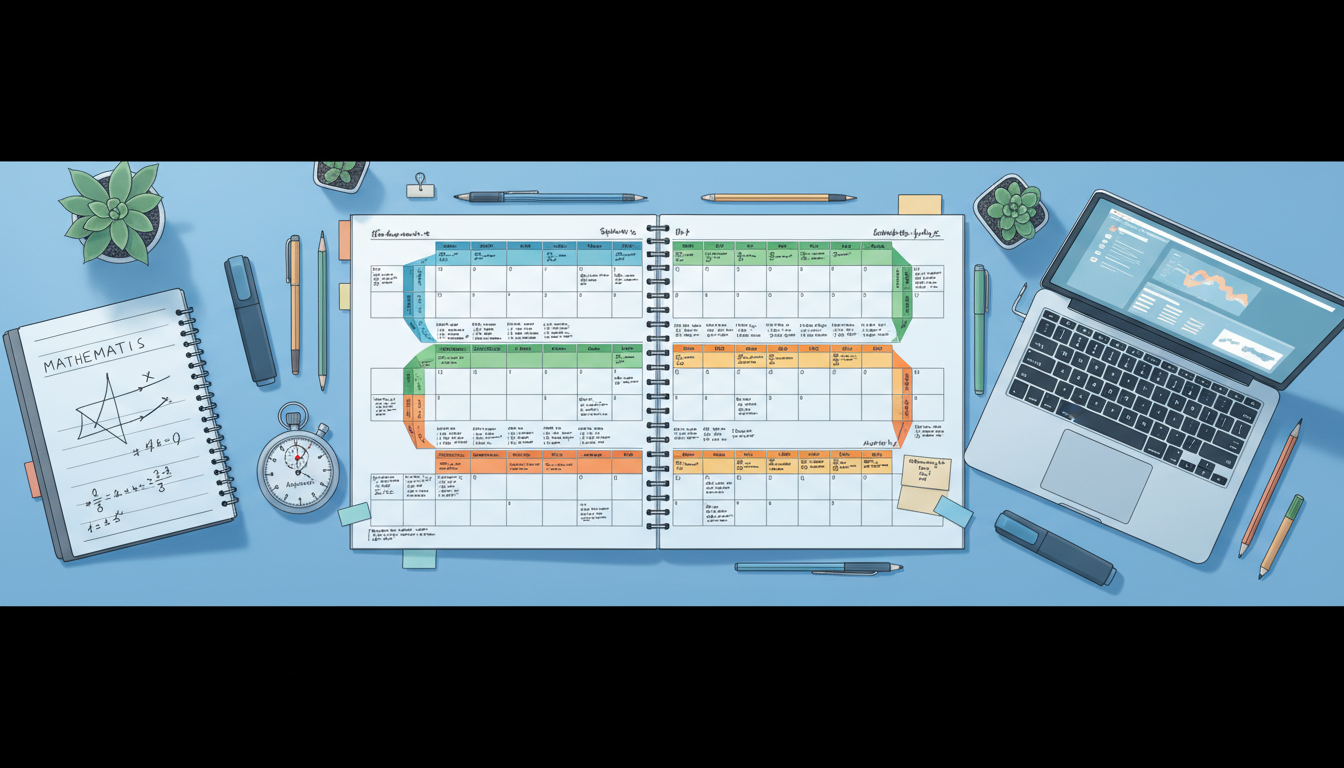
How SBTech Math Fits a Two-Exam Plan
At SBTech Math, we believe a good course decision begins with evidence, not a promise that every exam can be handled the same way. Use the audit above to inspect the lesson sequence, the two exam-specific practice systems, worked solutions, analytics and calendar before you commit.
Then compare that evidence with your diagnostic result, university worksheet and available weekly hours. If you need a structured home for your IIT-JAM Mathematics plan with CUET-PG as a real backup, start by exploring how our mathematics preparation resources fit the plan you have already built.
We encourage students to keep official syllabi, previous papers and exam notices in their workflow, because a platform should make independent verification easier. When you are ready to examine our learning options and free study material, decide whether our approach matches your next preparation cycle at SBTech Math.
Explore our courses today!
FAQs on IIT-JAM Mathematics Plan with CUET-PG as a Real Backup
Can I Prepare for IIT-JAM Mathematics and CUET-PG Together?
Yes. We recommend shared concept study, then separate timed practice because the exams use different question formats, scoring, pace and syllabus details. Treat both calendars independently.
When Should CUET-PG Receive More Study Time?
Increase CUET-PG time when repeated JAM reviews stay below your programme-linked target, the JAM checklist is substantially complete, and CUET-PG-specific topics still need timed practice.
Are IIT-JAM Mocks Enough for CUET-PG Preparation?
No. JAM mocks build useful concepts and computer-test comfort, but CUET-PG needs its own 90-minute, 75-question MCQ simulations, speed review, and negative-marking decisions under pressure.