
IIT JAM Test Series Difficulty Calibration: How to Compare Mock Exam Realism
IIT JAM Test Series Difficulty Calibration helps you compare mock exam realism through paper alignment, score calibration, and progression.

For IIT JAM 2027, current published guidance describes a three-hour, 100-mark CBT with 60 questions: 30 MCQs in Section A, 10 MSQs in Section B, and 20 NAT questions in Section C. The current pattern guide reports negative marking in Section A, but not in Sections B and C. Confirm the final organiser brochure before treating any mock as a benchmark. A realistic mock needs to reproduce more than difficult-looking problems.
For IIT JAM Test Series Difficulty Calibration, choose a series only when it mirrors the official question formats, samples the syllabus and past-paper patterns, shows how learner mock scores relate to exam scores, and increases challenge deliberately. A hard paper alone can create anxiety, while an easy one can create false confidence.
IIT JAM Test Series Difficulty Calibration: What Realism Requires
A useful mock should feel recognisable in the ways that matter on test day. That means matching the official mix of multiple-choice, multiple-select, and numerical-answer questions, while also requiring the same kind of pacing and answer discipline. A series full of advanced problems can still be poorly calibrated if it neglects the formats that shape real decision-making.
We recommend using past papers as the reference point, but not as the entire practice plan. Our guide on past-paper limits explains why repeating familiar questions can lift comfort without proving readiness for unfamiliar versions of the same concepts.
| Realism Signal | Official Benchmark | What A Mock Should Show |
|---|---|---|
| Question formats | MCQ, MSQ, and NAT | Meaningful practice across all three |
| Time pressure | A fixed exam session | Full-length timed attempts |
| Marking behaviour | Different response risks by format | Separate accuracy review by format |
| Topic coverage | Mathematics syllabus breadth | A visible coverage map, not random variety |
Previous-cycle cut-offs can help frame score interpretation but cannot predict 2027 because paper difficulty and cohort performance change. Compare your score across full-length tests using the same section mix and marking rules, then wait for the organising institute’s final result and cut-off notice. The current IIT JAM 2027 overview is a planning reference, not a substitute for official results.
How We Measure Mock-Test Realism
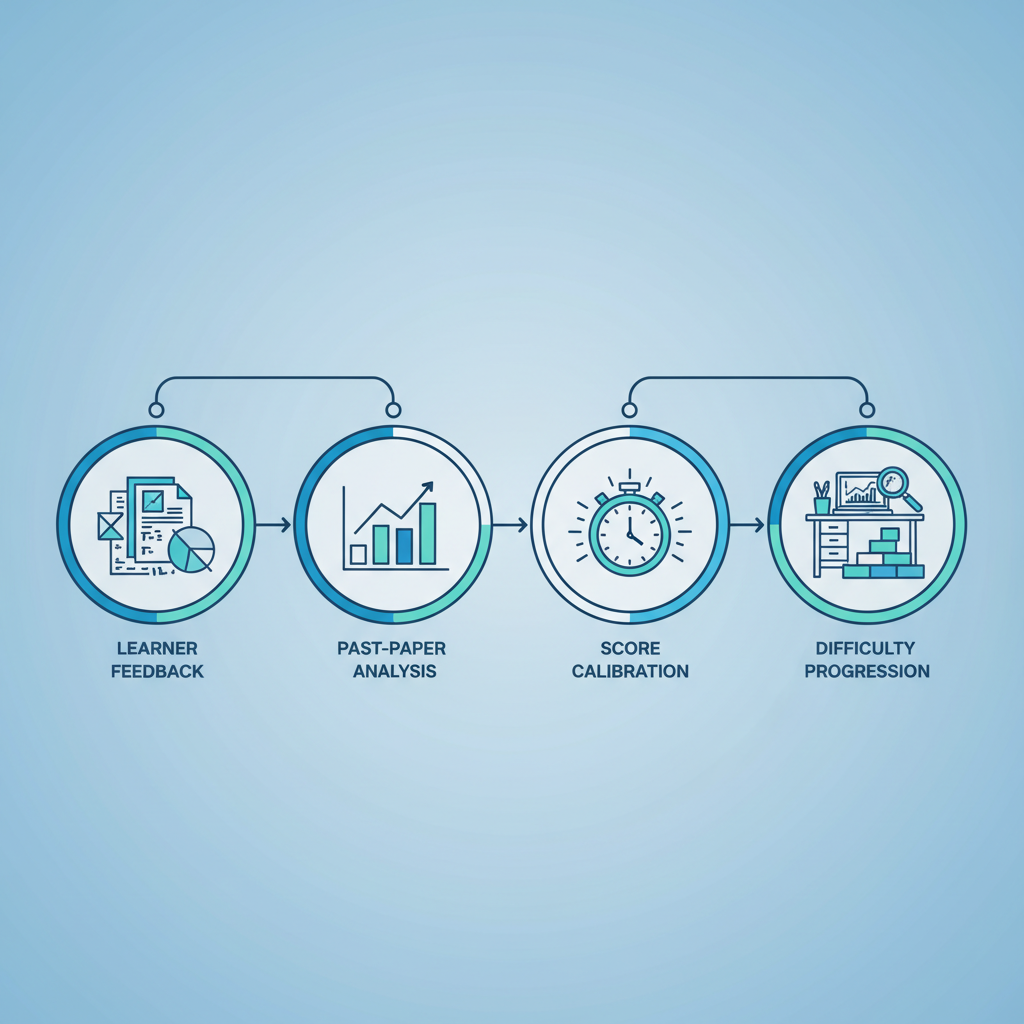
We do not think a provider should be called realistic merely because learners describe its papers as tough. Toughness is only one component. A credible comparison needs disclosed methods, a clear sample, and results that readers can inspect rather than marketing language they must trust.
Learner-Reported Difficulty Match
Ask the same learners to rate their final practice tests and the official paper using the same scale. Report the respondent count, survey dates, median rating, and the share whose ratings were close. Anonymous comments can add colour, but they cannot replace a defined survey.
Past-Paper Alignment
Code questions by topic, format, marks, multi-step reasoning, and likely time demand. The resulting percentage should be weighted and reproducible, with an explanation of who coded the papers. Our foundation guide can help students identify whether an apparent difficulty problem is actually a topic-foundation gap.
Score Calibration
Compare each learner’s timed full-length mock scores with their official score, then publish the correlation, median error, absolute error, sample size, and exclusions. A relationship is useful evidence, but it is not a personal score guarantee.
Difficulty Progression
A series should explain how its tests develop from diagnostic practice to full exam simulation. We look for a visible sequence, with intended skill focus and increasing time pressure, rather than an unexplained mixture of easy and hard papers.
This approach follows established assessment practice. The testing standards distinguish content-alignment evidence from correlation evidence, which is exactly why a single “exam-level” claim is insufficient.
How to Read a Realism Comparison Table
A ranking only helps when the underlying evidence is available. If a series does not publish a survey method, question-coding method, or learner score dataset, the honest result is “not publicly verified,” not a guessed score. We would rather give readers a usable framework than dress assumptions up as precision.
| Evidence Profile | Difficulty Match | Paper Alignment | Score Calibration | Difficulty Progression | Appropriate Conclusion |
|---|---|---|---|---|---|
| Published and reproducible | Survey method and sample disclosed | Percentage and rubric disclosed | Correlation and error disclosed | Sequence explained | Suitable for a measured realism assessment |
| Partially disclosed | Testimonials only | Topic list only | No dataset | General claims only | Useful for exploration, not ranking |
| Not disclosed | No auditable evidence | No auditable evidence | No auditable evidence | No auditable evidence | Do not infer exam realism |
The proposed realism index should combine four disclosed inputs: past-paper alignment, score calibration, learner-reported difficulty match, and progression quality. Without all four, an overall score falsely suggests completeness. We also avoid declaring a “best for budget” choice unless the current price, access duration, number of tests, and sale conditions have been checked on the same date.
Before paying for any series, compare its full-length papers with official materials and decide whether structured help fits your needs. Our discussion of coaching and self-study can make that choice more practical, especially if feedback and accountability matter as much as question volume.
Use Your Results Without Creating False Confidence
The most useful response to an easy mock is not panic or dismissal. Treat it as a diagnostic. Check whether your speed, MSQ decisions, NAT entries, and weak-topic accuracy would survive a paper with a different question mix. A harder mock deserves the same scrutiny: if it is difficult because it is off-syllabus or badly written, it teaches the wrong lesson.
We suggest a simple review routine after every full-length attempt:
- Format analysis: Separate MCQ, MSQ, and NAT errors before calculating an overall conclusion.
- Topic analysis: Identify whether missed marks came from missing knowledge, weak recall, or an inefficient method.
- Timing analysis: Record questions left unattempted because of pace, not just questions answered incorrectly.
- Adjustment decision: Choose one focused revision action before starting the next test.
Use free study content to repair a weak concept before retaking a similar topic under time pressure. A detailed error log is more valuable than a vague impression that a test felt easy or hard. Record the topic, format, time spent, first method tried, and reason the answer failed. Over several papers, those notes reveal whether performance is improving because your understanding is deeper or simply because the questions are becoming familiar.
A good review also separates a low score caused by missing knowledge from one caused by poor selection. If you understood most attempted questions but ran out of time, focus on triage and pacing. If you skipped familiar topics or repeatedly made calculation errors, rebuild those habits before adding more full-length papers. Once your review routine is working, use the course store to find structured support that matches the gaps your results reveal.

Choose the Right Practice Stage
The right test is the one that tells you something actionable about your next week of preparation. Early practice can be intentionally confidence-building when it is labelled diagnostic. Later practice should demand full-paper stamina and reveal whether your performance holds when topics and formats are mixed.
A realistic-practice series is best judged by transparent evidence, not by a claim that every paper is brutal. A confidence-building series is useful when it helps you establish routines and isolate gaps. A budget option is only comparable when its current terms are visible and you can calculate what you receive per full-length test.
If you need continued practice while balancing revision, compare our membership options against your study calendar. The goal is not to chase the lowest score. It is to make every score explain what to revise, what to practise, and what to attempt differently next time.
Prepare with SBTech Math
At SBTech Math, we want mock practice to produce clear decisions, not borrowed confidence. Our preparation approach keeps the official paper structure, topic coverage, timed problem solving, and post-test review in view, so you can see what a score does and does not tell you. We focus on purposeful practice, where every attempt leads to a revision decision instead of an unexplained number. If your score exposes a gap in knowledge, pacing, or answer selection, we help you choose the next practice level with intention. That makes preparation calmer, more measurable, and easier to adapt as the examination approaches. With a structured routine, you can review mistakes, strengthen weak topics, and return to the next full-length paper ready to learn more. Use our guidance to turn timed attempts into a plan you can follow consistently, then build your IIT JAM Mathematics preparation with SBTech Math.
FAQs on IIT JAM Test Series Difficulty Calibration
Should Every Mock Be Harder Than IIT JAM?
Not automatically. A harder paper helps only when its topic mix, question formats, time pressure, and scoring behavior still resemble the official MA examination closely.
Can a Mock Score Predict My IIT JAM Score?
Only cautiously. Check for a disclosed learner dataset, comparable timed conditions, correlation results, and an error range before using any mock score as predictive evidence.
Why Should I Track MSQ and NAT Accuracy Separately?
These formats demand different decisions and response methods. Tracking them separately reveals whether marks were lost through concepts, answer selection, calculations, or numerical-entry discipline under timed pressure.