How Does the GATE Mathematics vs IIT JAM Mathematics Syllabus Differ?


TL;DR
At SBTech Math, we show that GATE Mathematics and IIT JAM Mathematics share a usable foundation, but not a complete syllabus or identical level of detail. Our crosswalk separates common subtopics, exam-specific branches, paper formats, and the point at which students need different practice plans.
The current GATE Mathematics paper has 100 marks, including 15 marks of General Aptitude and 85 subject marks, according to the official pattern. That structure alone makes it a different preparation target from IIT JAM Mathematics, even before students compare the topics.
We find that GATE Mathematics and IIT JAM Mathematics share foundational areas, but identical topic labels do not mean identical preparation. Students can study verified common subtopics together, then branch for exam-specific units, depth, and formats. Proof knowledge should support reasoning and concept selection, not be mistaken for a formal proof-writing paper.
Below, we map the real overlap, identify the branches, compare paper formats, and show how to build a preparation plan without assuming one broad mathematics course covers both exams.
What Does the GATE Mathematics vs IIT JAM Mathematics Syllabus Share?
The shared core is substantial enough to save time, but only if students define “shared” at the subtopic level. We last checked the current 2027-cycle official documents on 16 September 2026. GATE MA lists 11 subject sections in its current syllabus, while JAM MA groups its material into real analysis, multivariable calculus with differential equations, and linear algebra with algebra.
Calculus and Analysis Foundations
Both exams require continuity, derivatives, maxima and minima, power series, multiple integrals, and core convergence ideas. That makes them sensible shared-trunk material. The branch begins when GATE moves into metric spaces, Lebesgue integration, uniform convergence, and multivariable theorems beyond the narrower JAM list.
Linear Algebra and Group Theory Foundations
Systems of linear equations, rank, nullity, eigenvalues, eigenvectors, vector spaces, linear transformations, and introductory group theory belong in a common foundation. GATE then extends farther into inner-product spaces, canonical forms, rings, fields, and advanced group results.
Differential Equations Foundations
Separation of variables, constant-coefficient second-order equations, and Cauchy-Euler equations are shared. JAM separately names Bernoulli equations, exact equations, integrating factors, orthogonal trajectories, and variation of parameters. GATE continues into existence theorems, Laplace transforms, Frobenius methods, special functions, systems, and stability.
A useful first move is to complete a common foundation, then check each lesson against our foundation-course comparison before calling it dual-exam preparation.
Where Do Identical Topic Names Conceal Different Scope?
Broad headings such as “analysis” and “algebra” hide the gaps that create false confidence. We built this crosswalk from the official 2027 PDFs so students can distinguish a genuinely shared subtopic from a similar label with a different scope.
| Concept | JAM Wording | GATE Wording | Overlap Status | Depth Note | Official Basis |
|---|---|---|---|---|---|
| Power Series | One real variable, radius and interval of convergence, term-wise differentiation and integration | Power series in real and complex analysis | Shared, differently scoped | Start together, then extend to GATE analysis and complex-variable use | Both 2027 syllabi |
| One-Variable Calculus | Limits, continuity, Rolle’s theorem, MVT, L’Hospital rule, Taylor’s theorem, Riemann integration | Not listed as a separate one-variable theorem set | JAM-led | JAM’s named theorem list needs direct practice | Both 2027 syllabi |
| Multivariable Derivatives | Limits, continuity, partial and total derivatives, maxima and minima | Adds directional derivatives, saddle points, Taylor’s theorem, Lagrange multipliers | Shared, GATE-extended | Branch at constrained optimization and saddle-point work | Both 2027 syllabi |
| Multiple Integrals | Double and triple integrals, change of order, areas and volumes | Double and triple integrals, Jacobians, change of variables, surface area | Shared, GATE-extended | Change of order does not replace Jacobian practice | Both 2027 syllabi |
| Core Linear Algebra | Systems, rank, nullity, inverse, determinant, eigenvalues and eigenvectors | Adds characteristic and minimal polynomials, diagonalization, inner-product spaces, Jordan form | Shared, GATE-extended | Core matrix work is shared, advanced structure is not | Both 2027 syllabi |
| Vector Spaces | Basis, dimension, transformations, matrix representation, range and null spaces | Real and complex spaces, Gram-Schmidt, unitary diagonalization, bilinear and quadratic forms | Shared, GATE-extended | Complex-field and canonical-form work requires a GATE branch | Both 2027 syllabi |
| Group Theory | Cyclic, abelian, non-abelian, permutation, normal and quotient groups, Lagrange theorem | Adds automorphisms, group actions, finite abelian groups, Sylow theorems | Shared, GATE-extended | Build group foundations together, then separate | Both 2027 syllabi |
| First-Order ODEs | Bernoulli, exact equations, integrating factors, orthogonal trajectories | First-order ODEs and existence and uniqueness theorems | Differently scoped | Neither list substitutes exactly for the other | Both 2027 syllabi |
| Combinatorics | Permutations and combinations, binomial theorem | Not listed | JAM-only | A dedicated JAM module is needed | Both 2027 syllabi |
| Complex Analysis | Not listed | Full section, including residues and conformal mappings | GATE-only | Separate GATE branch | Both 2027 syllabi |
| Functional Analysis | Not listed | Full section, including Banach and Hilbert spaces | GATE-only | Separate GATE branch | Both 2027 syllabi |
| PDE, Topology, Numerical Analysis, Linear Programming | Not listed | Separate GATE sections | GATE-only | These are not optional extras in a complete GATE plan | Both 2027 syllabi |
What IIT JAM Adds or Narrows
JAM gives more explicit attention to one-variable real analysis results, named first-order differential-equation methods, and basic algebra through permutations, combinations, and the binomial theorem. Students should not assume that a more advanced-looking GATE module automatically rehearses these named JAM tasks in exam-ready form.
For students rebuilding these basics, our foundation bridge is a better starting point than rushing into advanced-only chapters.
What GATE Adds or Extends
GATE requires a much broader upper layer: vector calculus, complex analysis, functional analysis, numerical analysis, partial differential equations, topology, and linear programming. It also deepens overlapping areas through Lebesgue theory, advanced algebra, special functions, stability, and canonical forms.
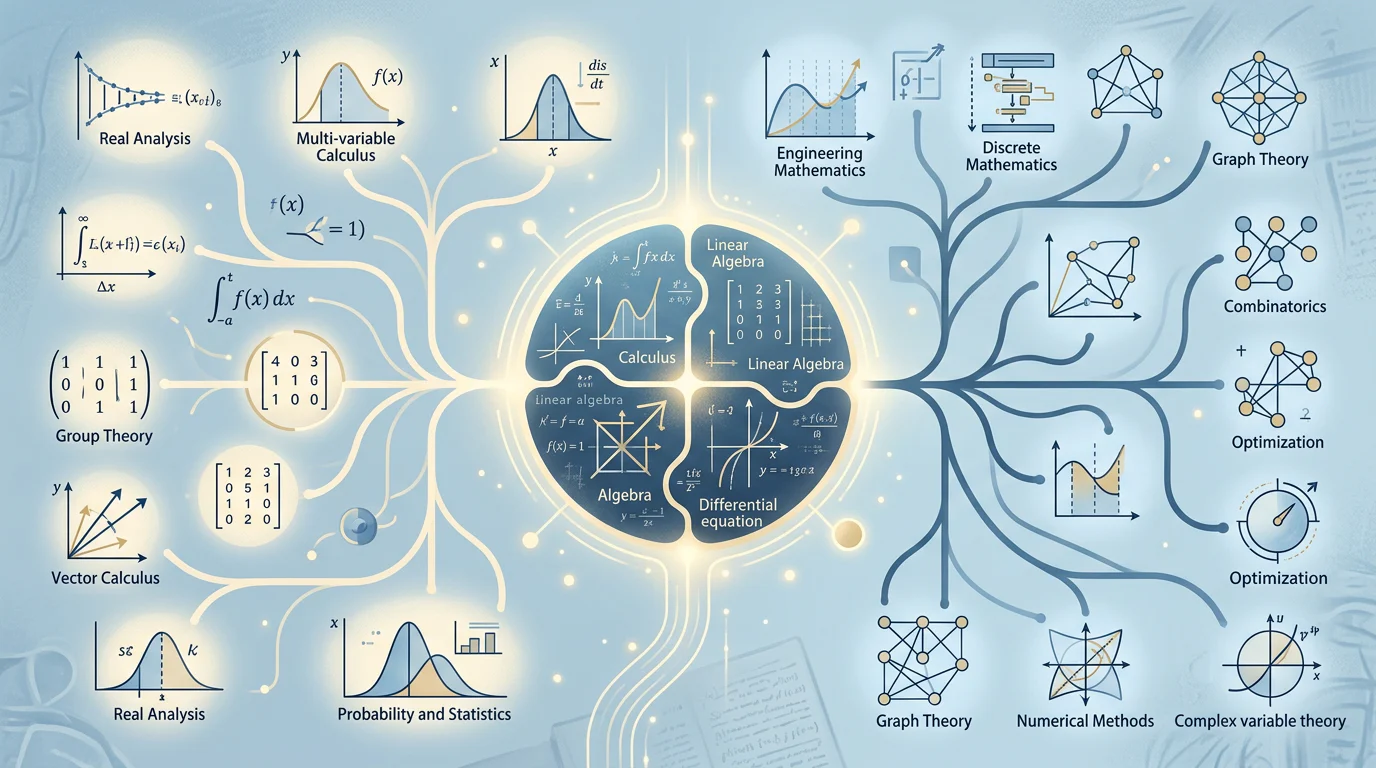
The practical lesson is simple: shared foundations can be taught once, but advanced GATE coverage and JAM-specific named methods must be planned separately.
How Do GATE and IIT JAM Paper Formats Change Preparation?
Syllabus coverage is only half the comparison. GATE MA includes General Aptitude, while IIT JAM Mathematics is entirely within its test-paper structure. Both use computer-based objective and numerical formats, so students need concept selection, option checking, and numerical-entry discipline rather than essay-style proof practice. Before timed work begins, our previous-year-papers guide can help students turn solved papers into a structured review process.
| Paper Feature | IIT JAM Mathematics 2027 | GATE Mathematics 2027 | Preparation Consequence |
|---|---|---|---|
| Mode | Computer-Based Test | Computer-Based Test | Practise on screen under timed conditions |
| Duration | Current public pattern page does not state a detailed duration split | 3 hours, 180 minutes | GATE pacing must include aptitude time |
| General Aptitude | No separate allocation stated on the current public pattern page | 10 questions, 15 marks | Reserve a recurring GATE GA practice block |
| Subject Allocation | Current public page confirms sections and formats | 55 subject questions, 85 marks | Treat most GATE time as mathematics, not aptitude |
| MCQ | Negative marking applies | Negative marking applies, with deductions for wrong 1-mark and 2-mark MCQs | Attempt selection matters |
| MSQ | No negative marking | No negative or partial marking | Train complete option-set judgement |
| NAT | Numerical answers entered on a virtual keyboard | Numerical Answer Type questions | Check signs, range, and entry accuracy |
| Calculator | Online virtual calculator available | Virtual scientific calculator available | Practise with the permitted interface |
JAM’s current pattern page confirms MCQ, MSQ, NAT, negative marking for MCQs, and an online virtual calculator. Until a detailed 2027 brochure specifies its complete numerical split, students should not copy older-cycle question counts or marking details into a current plan.
For GATE, wrong MCQs lose one-third of a mark for a 1-mark question and two-thirds for a 2-mark question. MSQ and NAT questions do not carry negative marking, and physical calculators are not allowed under the GATE instructions.
That difference is why a student can know the same mathematics yet need separate mock analysis. Use JAM mock calibration for JAM timing and error patterns, then assess GATE practice with its aptitude block and MCQ-risk decisions in view.
Can One Shared Foundation Course Prepare You for Both Exams?
Yes, a course can prepare students for both exams at the foundation stage. No, it cannot honestly claim complete dual-exam preparation unless it visibly covers each branch in the crosswalk, offers exam-specific timed practice, and updates its mapping when the official documents change.
Use a Five-Level Depth Rubric
| Level | What Students Should Be Able To Do | Why It Matters Here |
|---|---|---|
| Definition Recall | Recognise notation, hypotheses, and standard definitions | Necessary for fast option elimination |
| Theorem Use | Select a theorem and verify its conditions | Important for named real-analysis results |
| Multistep Reasoning | Connect results across several steps | Separates familiarity from usable understanding |
| Computation | Execute symbolic, numerical, and numerical-entry work accurately | Essential for MCQ, MSQ, and NAT |
| Proof-Informed Understanding | Explain why a method applies and reject invalid reasoning | Supports objective decisions without requiring formal proof writing |
Build the Shared Trunk First
Start with linear algebra, core calculus, real-variable foundations, basic group theory, and the common ODE ground. We recommend testing each completed unit against a short syllabus audit: Is it explicitly listed in both exams, and can the student answer both conceptual and numerical questions from it?
A combined plan becomes more realistic when students set the target examination first. Our platform-selection guide helps frame that choice before a schedule becomes crowded with unrelated material.
Branch Before Revision Begins
For JAM, add the named one-variable theorem set, first-order ODE methods, and basic algebra. For GATE, add vector calculus, advanced analysis, complex analysis, functional analysis, numerical analysis, PDE, topology, and linear programming before entering full revision mode.
The current JAM Mathematics test is scheduled for 14 February 2027 in the official schedule. That creates a useful planning window: build the shared trunk first, branch early enough to complete exam-specific modules, then finish with separate timed papers.
Decide Whether Structured Help Is Worth Paying For
Structured support is most useful when students cannot audit scope on their own, keep duplicating the same shared topic, or need feedback to turn theory into timed decisions. It adds less value when a student can already map the syllabus, schedule separate branches, and diagnose mistakes from practice accurately.
For a JAM-first plan with another examination as a backup, this combined study plan can keep the primary goal clear. Students should also match practice volume to the branch they still need to cover, rather than distributing time equally across every heading.
Prepare with SBTech Math
At SBTech Math, we build preparation around the decision students actually face: which mathematics exam they intend to take, what they already know, and where their syllabus stops overlapping. Our lessons should not make a student guess whether a module is a shared foundation, an IIT JAM extension, or a GATE branch. We help students audit that distinction before they commit time to a schedule, test series, or paid support. If you are comparing structured help, use this crosswalk first, then ask whether the course includes exam-specific practice, feedback, and a clear update process when official syllabi change. That is the standard we believe preparation support should meet. Explore our current options and choose only the support that matches your examination path with transparent coverage, realistic pacing, and measurable practice aligned to your chosen paper before you decide to enroll through SBTech Math memberships.
FAQs on GATE Mathematics vs IIT JAM Mathematics Syllabus
Do GATE Mathematics and IIT JAM Mathematics Have the Same Syllabus?
No. Both test selected calculus, linear algebra, group theory, and differential-equation foundations, but GATE includes extra sections while JAM specifies one-variable analysis and basic algebra.
Which GATE Mathematics Topics Are Not in IIT JAM Mathematics?
GATE includes complex, functional, and numerical analysis, partial differential equations, topology, linear programming, plus wider real analysis, algebra, calculus, and ordinary differential equations not named by JAM.
Can One Course Prepare Me for Both IIT JAM and GATE?
A single course can cover the common foundation when its scope is explicit. Complete dual-exam preparation still needs separate branches, timed practice, and regular syllabus audits.
Does Proof Rigor Matter for GATE and IIT JAM Questions?
Proof-informed understanding helps students test hypotheses, choose appropriate theorems, and eliminate wrong options. Both current papers use objective and numerical responses rather than formal proof-writing.