
The IIT-JAM Mathematics Foundation Bridge You Need Before Starting IIT-JAM Preparation

TL;DR
We show students with uneven undergraduate teaching how to use an IIT-JAM Mathematics foundation bridge instead of restarting school Mathematics. Diagnose prerequisites, repair only the gaps, meet module exit criteria, and mix in exam problems early. We also explain free first steps and how to judge structured support.
The latest official IIT-JAM Mathematics pattern contains 60 questions worth 100 marks, so weak prerequisite knowledge can surface repeatedly across the same paper, not just in one difficult chapter.
An IIT-JAM Mathematics foundation bridge is the fastest sensible start for students whose degree classes left gaps. It checks notation, functions, proof logic, algebra, calculus, sequences and linear-algebra language, repairs only the missing prerequisite, then pairs each repair with exam-level problems until problem performance, rather than lecture completion, proves readiness.
We will map the prerequisites to the syllabus, show an 18-task diagnostic, set usable exit rules, and explain how to choose free or structured support without getting trapped in endless remediation.
What Does Your IIT-JAM Mathematics Foundation Bridge Need to Repair?
Most students do not need to restart school Mathematics from page one. We use the bridge to identify the precise idea that blocks a JAM topic, then repair that idea in the smallest useful unit.
| Foundation Prerequisite | JAM Area It Unlocks | Diagnostic Evidence |
|---|---|---|
| Sets, notation, quantifiers and counterexamples | Real analysis and groups | Read a statement and identify a valid counterexample |
| Functions, domains, composition and algebra | Limits, calculus and differential equations | State the domain before simplifying |
| Limits and calculus reasoning | One-variable and multivariable calculus | Name the condition before choosing a method |
| Sequences and convergence language | Real analysis and power series | Separate boundedness from convergence |
| Matrices, vectors and linear combinations | Rank, nullity and vector spaces | Interpret a row-reduced system |
| Definitions, mappings and structure | Groups and homomorphisms | Check every condition in a definition |
The official MA syllabus includes real analysis, multivariable calculus, differential equations, linear algebra, vector spaces and groups. That is why our bridge starts with university-level language and reasoning, not a generic formula revision.
Once the diagnostic shows where you stand, use our prepare from scratch guide to turn the bridge into a realistic weekly plan.
How Does the 18-Task Diagnostic Separate Gaps?
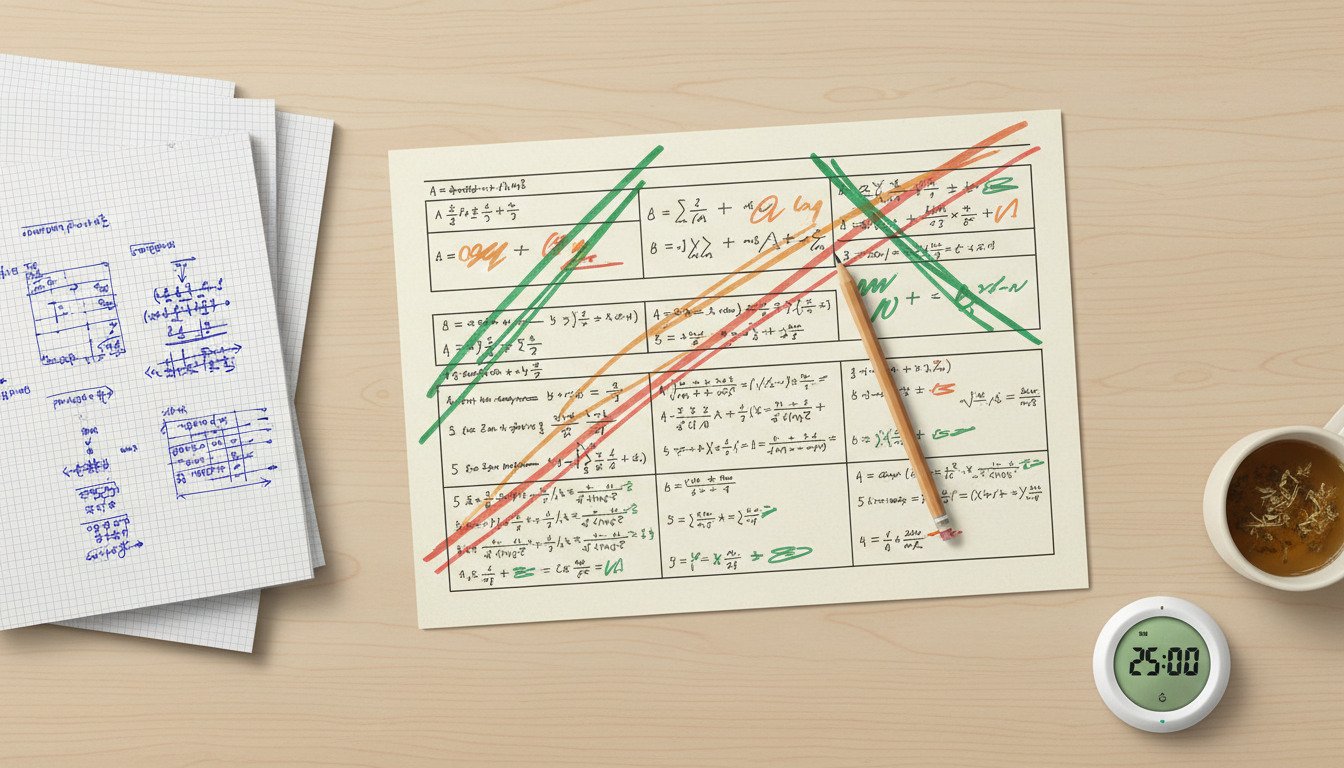
We use an 18-task diagnostic because six modules with three short tasks each can reveal a pattern without pretending that one score defines your ability. Complete it before choosing a course, a book sequence, or a full mock schedule.
| Result In A Three-Task Module Check | Readiness Status | Next Step |
|---|---|---|
| Zero or one correct, or no usable explanation | Red | Repair the prerequisite before full topic practice |
| Two correct with a cue, time issue, or notation error | Amber | Mix targeted repair with linked JAM problems |
| Three correct without cues | Green | Start the syllabus topic and retain weekly retrieval practice |
How We Identify Missing Knowledge
A missing-knowledge error remains after we give a definition, a glossary cue, or the first step of a solution. For example, a learner may know that a sequence is “increasing” but still be unable to state why monotonicity alone does not prove convergence.
How We Identify Slow Recall
Slow recall looks different. The learner knows what to do after a short pause or a prompt, but cannot yet retrieve it efficiently. That calls for short, repeated practice, not another long lecture cycle.
How We Identify Notation Gaps
Notation gaps appear when a student understands an idea in plain language but misreads a domain, index, quantifier, matrix dimension, or function symbol. We treat these as repairable reading problems, then use free Mathematics study content before recommending paid support.
What Six Modules Build a Usable Bridge?
We organise foundation work around six modules because the JAM syllabus demands connected reasoning. A strong answer often depends on several earlier skills working together, even when the question seems to belong to one chapter.
Proof Language and Functions
Begin with sets, logical implication, quantifiers, counterexamples, functions, domains, composition, and algebraic manipulation. These skills make definitions readable and prevent common errors such as simplifying an expression without checking where it is defined.
Calculus and Sequences
Next, repair limits, continuity, derivatives, integrals, boundedness, monotonicity, and convergence tests. We ask students to explain why a method applies before they calculate, because a correct-looking calculation can still rest on an invalid condition.
Matrices and Abstract Reasoning
Finish the bridge with systems of equations, rank, nullity, independence, basis, transformations, operations, groups, and mappings. Use structured practice to connect these definitions to increasingly unfamiliar problems.
A recent learning study involving 124 participants found that sequences including problem solving produced higher test performance than worked examples alone. We therefore pair every bridge module with small JAM-level tasks instead of waiting for “perfect” foundations.
When Are You Ready to Mix in Full JAM Problems?
Readiness is not finishing a playlist. We move students forward when they can solve fresh problems, explain the method, and recognise the prerequisite underneath the question.
| Module Result | Bridge-To-JAM Mix | What To Do Next |
|---|---|---|
| Red | Four bridge sessions, two linked JAM sessions weekly | Repair one module at a time |
| Amber | Two bridge sessions, three JAM-topic sessions weekly | Keep fixing only the flagged subskill |
| Green | One retrieval session, regular JAM practice | Move into full syllabus coverage |
For every module, we use two fresh five-question exit sets. A learner should score at least 8 out of 10 while explaining key method choices before treating that prerequisite as usable. This is a working standard for study decisions, not an official prediction of marks or rank.
The 2026 MA qualifying cut-offs were 12.65 for GEN, 11.38 for OBC-NCL or EWS, and 6.32 for SC, ST, or PwD. Treat these as historical context only, because qualifying is not the same as admission and future thresholds can change.
If recurring study support would help, review our membership options only after identifying the modules where feedback or accountability is genuinely needed.
What Should You Expect from a Platform or Free Path?
A platform should be judged by evidence, not by a vague promise to “teach from basics.” We recommend asking whether its foundations are measurable, whether explanations show reasoning, and whether students are told when to stop remedial work.
| Evidence To Request | What A Useful Answer Looks Like | Why It Matters |
|---|---|---|
| Entry diagnostic | Sample tasks, scoring logic and module routing | Shows whether support matches your starting point |
| Prerequisite lessons | Outcomes mapped to JAM topics | Prevents vague basics-first claims |
| Worked reasoning | Full steps, assumptions and error notes | Shows how methods are chosen |
| Feedback | Doubt support, marking, or error review | Turns mistakes into a study plan |
| Module exit tests | Fresh questions and a progress rule | Makes readiness measurable |
| JAM transition plan | Linked exam problems before foundations end | Prevents endless remediation |
Start free if your diagnostic shows only one or two amber modules. Use the syllabus, a notebook of recurring errors, selected lectures, and short linked problems. Choose structured support when several modules remain red or when you need feedback and accountability, then use our platform comparison to judge the fit.
Keep an error ledger while you test any free path. Write the topic, the exact mistaken step, the missing rule, and the repair task next to each error. Review that ledger before repeating similar questions, because a repeated wrong answer is more useful as diagnostic evidence than as a score. If a question becomes easy only after seeing the answer, retry a fresh variant later. If it remains confusing after a definition and worked example, return to the relevant bridge module instead of collecting more question sets.
Use a simple weekly cycle: diagnose one weakness, learn one repair method, complete two linked problems, and review the resulting errors. Do not make a new resource your response to every difficult question. Instead, keep the same resource long enough to determine whether the obstacle is conceptual, notational, computational, or caused by time pressure. This routine protects your study hours from random switching and makes it easier to see whether a module is genuinely improving. It also gives you a concrete record to discuss if you later ask for feedback from a teacher or mentor.
If your scores stall after moving into larger sets, use our guide to mock-score plateaus to distinguish a foundation issue from a timing or review issue.
Build Your Bridge with SBTech Math
At SBTech Math, we want students to choose preparation support from evidence, not anxiety. Start with the diagnostic in this article and the free pathway, then decide whether you need a teacher, scheduled practice, feedback, or simply a clearer sequence. Our role is to help you make that decision with the same discipline you would use in a proof: inspect the premise, test it, and act on the result. If you want structured preparation, compare the course outline with your red and amber modules before enrolling. If your gaps are small, keep your money focused on practice and error review. If several modules remain red, choose support that can show explanations, feedback, and module exit checks. We built our learning paths for serious Mathematics aspirants who want an honest starting point and a measurable next step. Explore our SBTech Math.
FAQs on IIT-JAM Mathematics Foundation Bridge
What Mathematics Foundations Do I Need Before IIT-JAM Preparation?
Prioritize notation, functions, algebraic manipulation, proof logic, limits, calculus reasoning, sequences, matrices, vector spaces, and elementary group definitions. Repair only modules your diagnostic identifies as weak.
How Long Should I Stay in Foundation Work?
Stay in bridge work until you meet the module exit score on fresh tasks, explain your method clearly, and solve linked JAM questions accurately without relying on prompts.
What Should I Ask an IIT-JAM Platform Before Paying?
Ask for an entry diagnostic, prerequisite lessons, fully worked reasoning, feedback, fresh exit tests, and a clear rule for moving into exam-level questions. Claims alone are not evidence.
Can I Start the Bridge with Free Resources?
Start with the official syllabus, free lessons, and a short diagnostic. Pay only when you identify a specific gap that needs feedback, structured practice, or regular accountability.