Why Are You Losing CSIR-NET Algebra Marks? A CSIR-NET Algebra Weakness Diagnostic


TL;DR
We show CSIR-NET Mathematics students how to separate an algebra knowledge gap from a Part C application, speed, or selection failure. Our diagnostic uses verified questions, a subtopic heatmap, six error codes, and parallel re-tests. It also explains when structured support is worth paying for and what evidence to demand.
The current Mathematical Sciences paper contains 120 questions but evaluates only 60 attempts, so an overall algebra score hides crucial choices about what you attempted and why. The 2026 bulletin also confirms that Part C alone carries 95 of 200 marks.
A CSIR-NET Algebra Weakness Diagnostic works when it tags every verified PYQ or mock error by subtopic, paper part, accuracy, time, confidence, and cause. Repeated Part B misses usually expose missing definitions or theorem conditions; Part C-only misses more often expose application, invalid inference, speed, or selection problems.
We will show you how to build that record, read a subtopic heatmap, repair the actual cause, and test whether the repair lasted. You can begin with our free study material before deciding whether you need structured support.
How Does a CSIR-NET Algebra Weakness Diagnostic Find the Actual Leak?
An overall mark cannot tell you whether you forgot Sylow conditions, lost time on a polynomial question, or selected an uncertain Part B item. The official scheme separates conventional Part B questions from analytical, exact-set Part C questions, so your review should separate them too.
Start by recording every algebra question, including skips. A skip can be sensible selection, or it can reveal that you cannot recognize a closable question quickly enough.
| Pattern In Your Record | Likely Cause | First Repair |
|---|---|---|
| The same topic fails in Parts B and C | Concept or theorem-condition gap | Rebuild the definition and standard result |
| Part B is sound but Part C fails | Application or inference failure | Practise multi-statement reasoning and counterexamples |
| Accuracy drops as time rises | Speed or process bottleneck | Use a shorter solution route and re-time it |
| Part B negatives or avoidable skips recur | Poor selection | Use a confidence threshold before committing |
Use attempted, correct, skipped, negative marks, time, confidence, and cause as non-negotiable fields. Our guide to mock analysis can help you keep the review focused on decisions, not just total marks.
Which Algebra Subtopics Should You Test Separately?
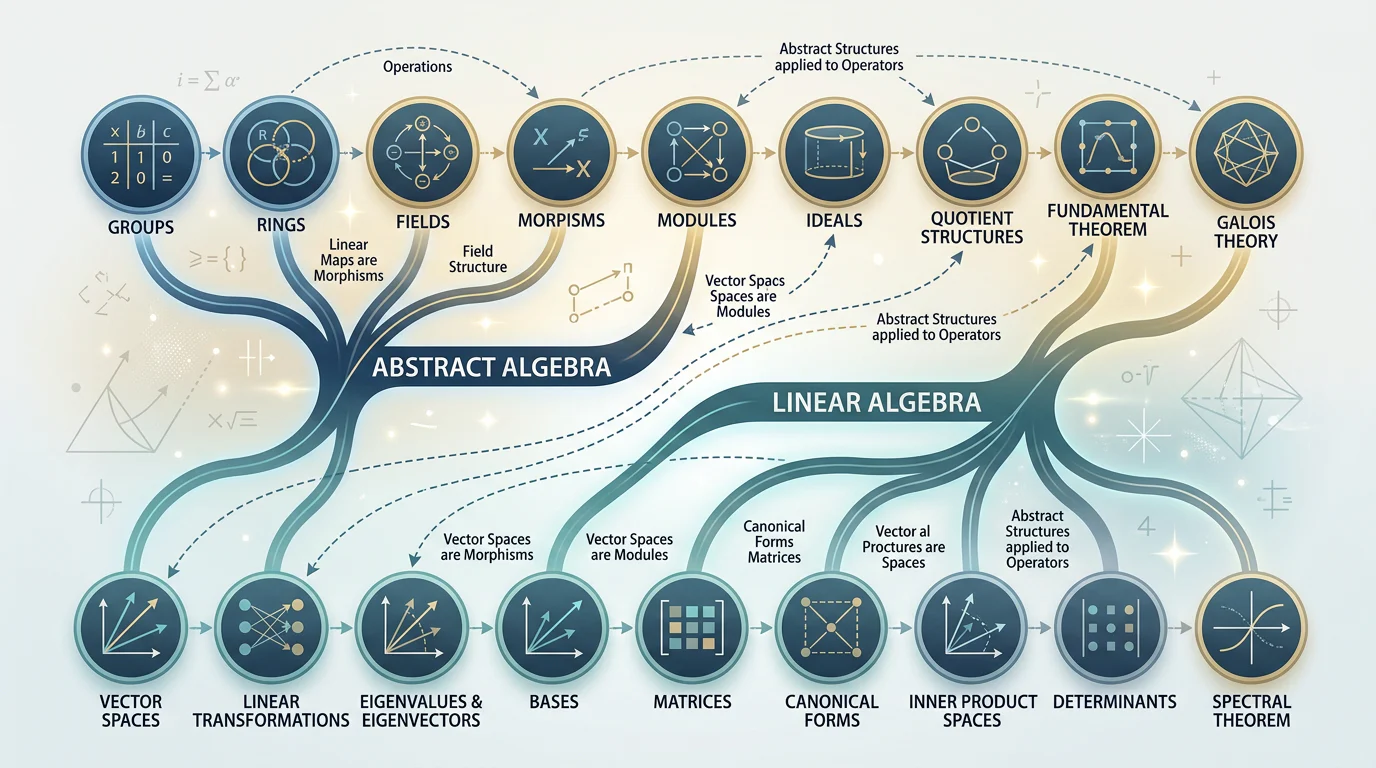
The syllabus does not treat “algebra” as one skill. It spans discrete methods, number theory, abstract algebra, and a substantial linear algebra lane, so a useful diagnostic needs separate rows rather than one algebra percentage.
Test Combinatorics and Number Theory Independently
Track permutations, combinations, pigeonhole principle, inclusion-exclusion, and derangements in their own row or rows. Keep divisibility in (\mathbb{Z}), congruences, the Chinese Remainder Theorem, Euler’s (\phi)-function, and primitive roots separate because they demand different recognition cues.
Split Abstract Algebra into Its Real Failure Points
Use distinct rows for groups, rings, polynomial rings, and fields. Within those, tag subgroups, quotient groups, homomorphisms, class equations, Sylow theorems, ideals, prime and maximal ideals, UFDs, PIDs, irreducibility, finite fields, extensions, and Galois theory.
Keep Linear Algebra in a Parallel Lane
Track vector spaces, bases and dimension, transformations, matrix representation, rank, determinants, eigenvalues, Cayley-Hamilton, canonical forms, inner-product spaces, and quadratic forms separately. The official syllabus supports this breadth, which is why a single “abstract algebra weakness” label is rarely enough.
Build a baseline from verified official papers and final keys, distributing questions across these rows and across both Part B and Part C. If a row lacks a matching verified question, mark it as unsampled instead of quietly replacing it with an unverified item. For wider planning, use our guide to syllabus breadth.
What Does Your Part B Versus Part C Heatmap Reveal?
A heatmap turns your notes into a decision tool. Use color only after calculating each row from your own attempts, with red reserved for a repeated failure pattern rather than one difficult question.
| Subtopic | Part B Accuracy | Part C Accuracy | Median Time | Skips | Negative Marks |
|---|---|---|---|---|---|
| Combinatorics | Correct ÷ Attempted | Correct ÷ Attempted | Minutes Per Attempt | Count Skipped | 0.75 × Wrong Part B Attempts |
| Number Theory | Correct ÷ Attempted | Correct ÷ Attempted | Minutes Per Attempt | Count Skipped | 0.75 × Wrong Part B Attempts |
| Groups | Correct ÷ Attempted | Correct ÷ Attempted | Minutes Per Attempt | Count Skipped | 0.75 × Wrong Part B Attempts |
| Rings And Ideals | Correct ÷ Attempted | Correct ÷ Attempted | Minutes Per Attempt | Count Skipped | 0.75 × Wrong Part B Attempts |
| Polynomial Rings | Correct ÷ Attempted | Correct ÷ Attempted | Minutes Per Attempt | Count Skipped | 0.75 × Wrong Part B Attempts |
| Fields And Galois Theory | Correct ÷ Attempted | Correct ÷ Attempted | Minutes Per Attempt | Count Skipped | 0.75 × Wrong Part B Attempts |
| Vector Spaces | Correct ÷ Attempted | Correct ÷ Attempted | Minutes Per Attempt | Count Skipped | 0.75 × Wrong Part B Attempts |
| Transformations And Matrices | Correct ÷ Attempted | Correct ÷ Attempted | Minutes Per Attempt | Count Skipped | 0.75 × Wrong Part B Attempts |
| Rank, Determinants, And Systems | Correct ÷ Attempted | Correct ÷ Attempted | Minutes Per Attempt | Count Skipped | 0.75 × Wrong Part B Attempts |
| Eigenvalues And Cayley-Hamilton | Correct ÷ Attempted | Correct ÷ Attempted | Minutes Per Attempt | Count Skipped | 0.75 × Wrong Part B Attempts |
| Canonical Forms | Correct ÷ Attempted | Correct ÷ Attempted | Minutes Per Attempt | Count Skipped | 0.75 × Wrong Part B Attempts |
| Inner Products And Quadratic Forms | Correct ÷ Attempted | Correct ÷ Attempted | Minutes Per Attempt | Count Skipped | 0.75 × Wrong Part B Attempts |
Use six short codes to preserve the cause of each error:
- CG, Concept Gap: You did not know the definition, object, or standard result.
- TC, Theorem Condition: You recalled a result but lost a hypothesis, direction, or field condition.
- II, Invalid Inference: You made an unsupported implication, converse, or proof step.
- CA, Calculation Error: A sign, operation, simplification, or option-marking mistake changed the result.
- TP, Time Pressure: You knew a valid route but could not close it in time.
- PS, Poor Selection: You spent an attempt on low-confidence work or skipped a closable item.
Low results across unrelated rows in both parts indicate a broad foundation issue. A red Part C cell beside a stable Part B cell is more likely an application issue, while high median time paired with falling accuracy is a speed issue. Our preparation strategy helps turn those patterns into weekly priorities.
How Do You Repair a Diagnosed Weakness and Prove It Improved?
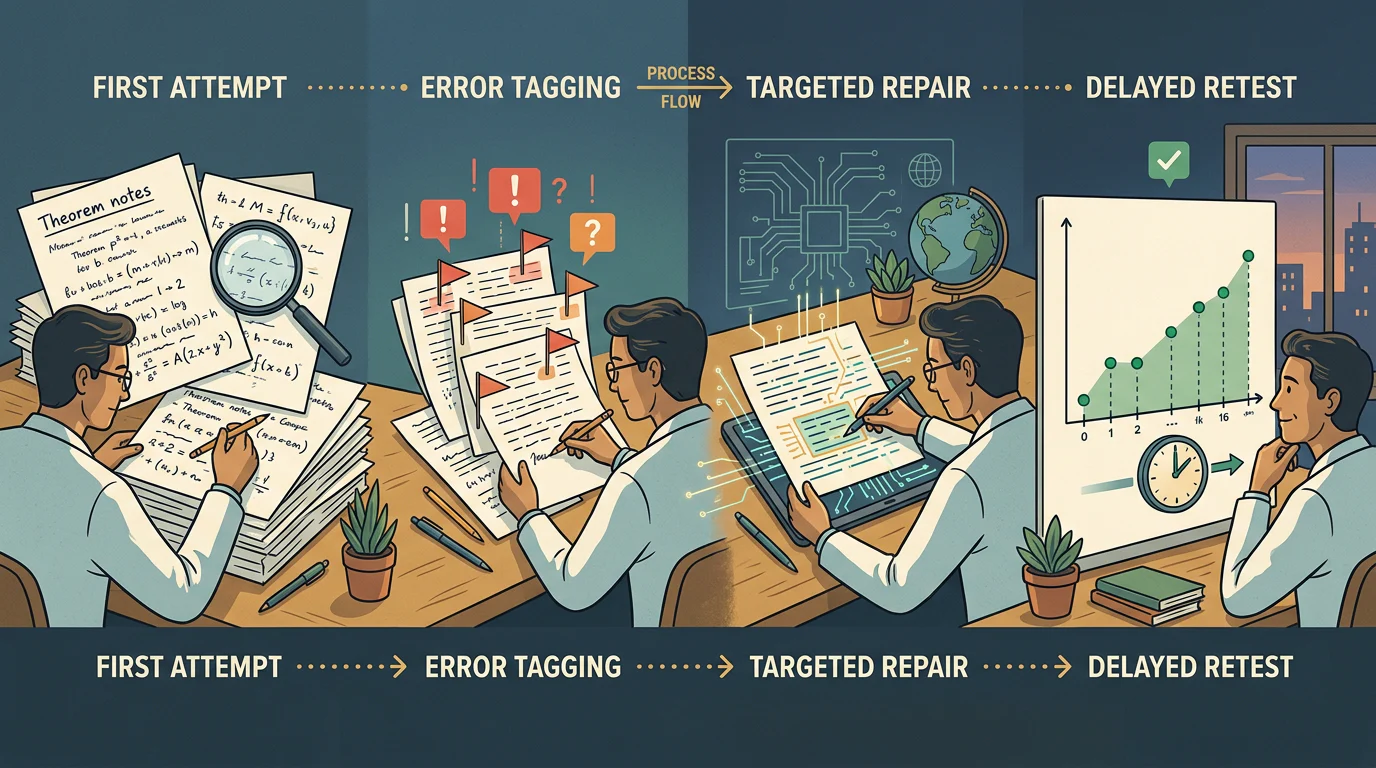
A repair counts only when it changes performance on a parallel question set. Repeating the same question until its answer feels familiar can disguise whether you learned the method.
Run the First Attempt Without Hints
Use official PYQs with their answers hidden, and record your decision before checking any solution. Keep Part B and Part C reports separate because an exact-set Part C miss has a different meaning from one incorrect Part B option.
Assign One Primary Error Code
Check against the official final key, then choose the main reason the answer failed. “Careless mistake” is not a diagnosis because it does not tell you what to practise next.
Match the Repair to the Cause
For CG, rebuild the definition and solve one canonical example. For TC, create a condition checklist. For II, write a counterexample or justify each implication. For CA, use short written calculation drills. For TP, use a timed two-pass method. For PS, record confidence before attempting.
Use Corrected and Delayed Re-Tests
Retest with new matched PYQs after the repair, then repeat the test after seven days. A retrieval study found repeated testing improved delayed recall, which is why our downloadable tracker compares first attempt, corrected attempt, and delayed re-test without predicting scores.
If a weakness remains after a fair parallel re-test, it is evidence, not a reason to panic. Use our score plateau diagnosis to decide whether the next issue is content, practice design, or feedback.
When Is Structured CSIR-NET Mathematics Support Worth Paying For?
Structured support is worth paying for when your tracker reveals a recurring problem that you cannot diagnose or repair alone. The useful question is not whether a program has more content, but whether it gives you a better feedback loop than your current one.
Before paying, check whether the support can show verified questions, explain how answers are checked, tag errors at subtopic level, and distinguish Part B knowledge from Part C execution. Ask whether it provides matching re-tests, not just more lectures.
Self-study may be enough when the heatmap identifies one narrow gap and you can repair it with official papers, disciplined review, and free material. Our support diagnostic helps you decide what level of help fits your record.
Build a More Reliable Algebra Practice System with SBTech Math
At SBTech Math, we built our preparation approach for students who need evidence about their algebra performance, not a vague label. Our useful support begins with a clean baseline, verified questions, and a tracker that distinguishes a missed theorem condition from an application failure. We help you turn the result into a focused repair plan, a matching re-test, and a record that shows whether the weakness actually changed after delay. Before paying for any structured help, ask to see how errors are classified, how answers are checked, and whether feedback separates Part B knowledge from Part C execution. If you prefer to start independently, use the same diagnostic with official papers and our free material first. We keep the next action visible, measurable, and tied to the actual question type. When you are ready for a more structured workflow, explore our approach at SBTech Math.
FAQs on CSIR-NET Algebra Weakness Diagnostic
These answers use the same evidence-first diagnostic. Keep your tracker beside you.
Why Can I Solve Real Analysis but Lose Algebra Marks?
Strong real analysis does not transfer automatically. Tag errors by subtopic and part. A narrow repeated pattern signals a repairable gap, not overall mathematical weakness.
How Many PYQs Should I Use for the Baseline?
Use enough verified questions to cover every tracked row in both Part B and Part C. If a row lacks official material, record it unsampled.
What Is the Most Important Part C Error?
Part C uses exact-set scoring, so one wrong or missing option earns no credit. Check whether theorem conditions, inference, timing, or selection caused the error.
When Should I Pay for Structured Help?
Pay when your tracker exposes recurring errors you cannot diagnose or repair alone. Choose support that shows verified questions, specific feedback, and matching re-tests clearly.