
Why an MSc Study Routine Fails for CSIR-NET Mathematical Sciences


TL;DR
We show why a linear MSc routine does not prepare candidates for CSIR-NET Mathematical Sciences: success depends on selective attempts, analytical problem solving, retrieval and timed decisions. Our guide turns that difference into a weekly Part A/B/C allocation, five-stage revision loop, note-conversion method, calendar and mock-error rubric.
CSIR-NET Mathematical Sciences is not simply an MSc paper with a broader syllabus. In the current official scheme, it is a 200-mark paper divided across three distinct sections.
CSIR-NET Mathematical Sciences needs a different study strategy from a typical MSc routine because candidates must choose limited attempts, apply concepts under time pressure and manage negative marking in Parts A and B. We recommend recurring cycles of theorem retrieval, mixed Part B and Part C practice, error correction and timed reattempts instead of a linear pass followed by end-term revision.
We will compare the two assessment systems, show how to allocate weekly hours, build a five-stage revision loop and turn mock results into a practical decision system.
How Does CSIR-NET Mathematical Sciences Change the Study Task?
An MSc assessment often rewards a coherent treatment of a defined module: learn a chapter, understand its proofs, prepare likely questions and explain the material in a university-specific format. That work matters, but it does not automatically train rapid question selection, option checking or recovery from an unfamiliar problem. Students can use our support diagnostic to identify which part of this transition needs attention.
For this exam, we ask students to make their study unit smaller and more useful. A topic is not complete when its notes are read. It is complete when the candidate can retrieve its conditions, spot its trigger in a mixed set, reject a tempting counterexample and decide whether the question deserves an attempt.
| Study-System Element | Typical MSc Routine | CSIR-NET Routine |
|---|---|---|
| Assessment Goal | Explain a course unit or derivation | Build marks across a three-part objective paper |
| Study Unit | Chapter, lecture block or proof | Definition, conditions, counterexample and problem trigger |
| Practice Type | Topic-set completion | Mixed Part B and Part C analytical practice |
| Feedback Signal | Chapter finished or coursework mark | Accuracy, selection quality, error type and timed reattempt |
| Revision Cadence | End-of-unit rereading | Recurring retrieval, correction and timed review |
The mechanics explain why selective attempts are part of preparation. Candidates see 20, 40 and 60 questions in Parts A, B and C, but can attempt only 15, 25 and 20 respectively. Part C carries no negative marking, yet it still has a capped attempt count and requires every correct option for credit, according to the current scheme.
We therefore teach students to label questions as “solve now,” “return if time remains” or “leave.” That is a trainable decision, not an instinct. For the wider foundation behind this approach, start with our preparation guide.
How Should Weekly Time Be Allocated Across Parts a, B and C?
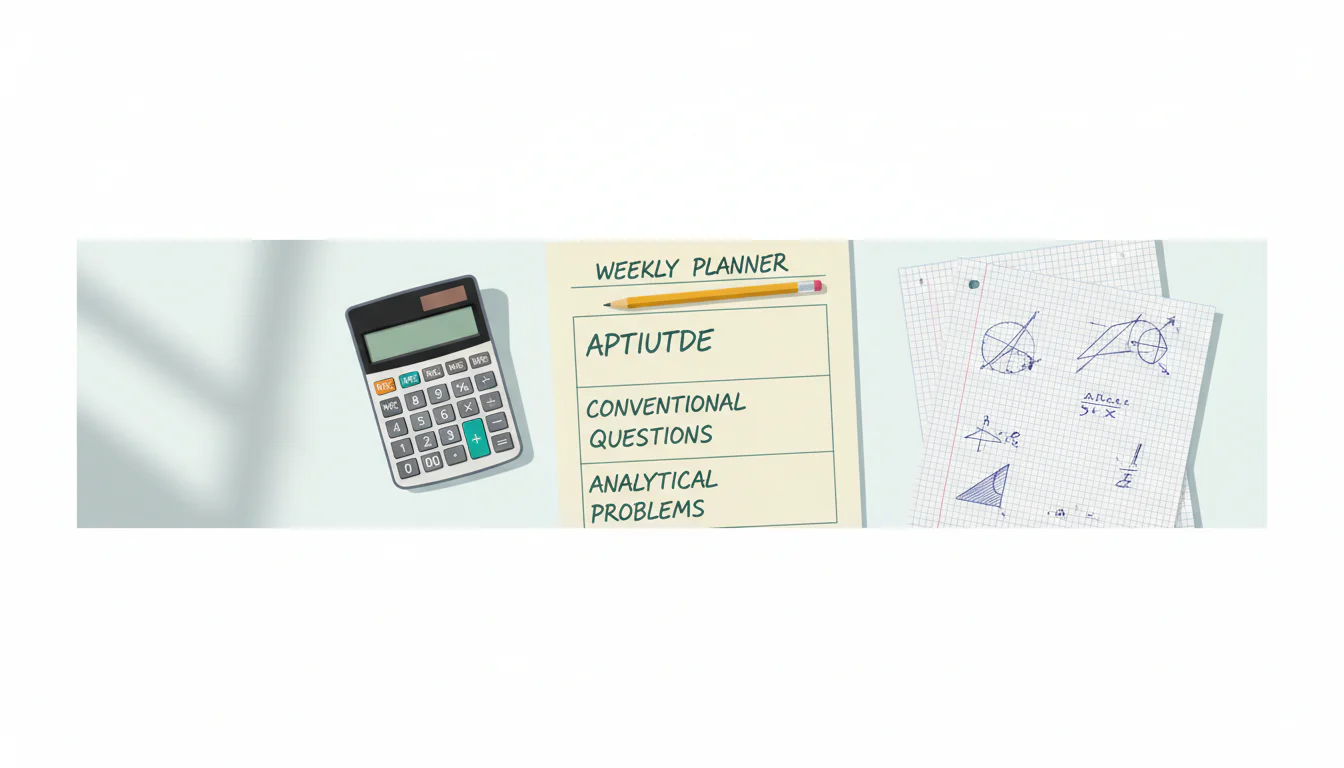
We begin with marks, not with a fashionable timetable. Part A offers 30 marks, Part B 75 and Part C 95, so a weekly plan should acknowledge that Part C has the largest scoring share while still protecting aptitude and conventional subject questions.
Use your available weekly hours as the input. This is a mark-proportional starting point, not a promise that every student should spend identical time on each section. Within every slot, include concept work, questions and retrieval from earlier weeks.
| Section | Maximum Marks | Share Of Paper | Weekly Hours Formula | Main Work |
|---|---|---|---|---|
| Part A | 30 | 15% | 0.15 × weekly hours | Aptitude sets and error review |
| Part B | 75 | 37.5% | 0.375 × weekly hours | Theorem conditions and conventional MCQs |
| Part C | 95 | 47.5% | 0.475 × weekly hours | Analytical problems, option verification and timed reattempts |
After two mixed tests, adjust the plan using evidence. A student who loses Part B marks through theorem-condition errors needs a different intervention from one who understands the mathematics but spends too long choosing Part C questions. Since CSIR uses cumulative performance rather than a separate sectional cut-off, the cut-off notice reinforces the value of a balanced system.
If work, classes or commuting restrict your study time, do not abandon the loop. Use a smaller but recurring schedule, and adapt the workload with our full-time plan.
Why Is Chapter Completion a Weak Progress Metric?
Chapter completion feels reassuring because it is visible. It also hides the difference between recognizing a theorem on a page and retrieving the exact condition that decides whether it applies. For analytical questions, the second ability is the one that survives a mixed paper.
We ask students to convert university notes into small working assets. That makes revision active and gives each revision gate a clear task rather than another vague instruction to “revise analysis” or “do linear algebra.”
- Definition card: Record the object, its exact conditions and one boundary case.
- Theorem card: Record the hypotheses, conclusion and the proof idea that signals use.
- Counterexample card: Record what fails when a condition is removed.
- Problem-trigger card: Record the wording, structure or transformation that should bring the result to mind.
This is not just a note-taking preference. A mathematics-focused review examined 34 studies and 85 effect sizes on spacing and retrieval practice, which supports giving retrieval a central role in our 2025 meta-analysis.
Track closed-note recall, first-pass mixed solves, poor attempt choices and timed reattempt results. Those signals reveal progress more honestly than pages read. Students who need a clean source bank can also use our PDF resources.
What Five-Stage Revision Loop Replaces End-Term Rereading?
A long MSc revision cycle often waits until a module or semester nears its end. For CSIR-NET, we build revision into the first encounter with a topic, then revisit it after enough time has passed to make recall effortful.
The exact calendar should suit your available hours, but the loop should stay intact. Research supports the principle: a meta-analysis found a strong spaced-retrieval advantage over massed retrieval, with an effect size of g = 0.74 in the relevant comparison set of its retrieval meta-analysis.

Build and Retrieve
- Day 0, Encode: Study the concept, create the four note assets and solve one representative Part B-type and Part C-type problem.
- Day 2, Retrieve: Recall the definition, conditions and trigger without notes, then repair only the missing pieces.
This first return separates familiarity from retrieval. It also prevents a beautifully written notebook from becoming a substitute for mathematical recall.
Interleave and Correct
- Day 7, Interleave: Mix the new topic with two older topics, so the task is choosing the method rather than repeating one method.
- Day 21, Correct: Revisit logged errors and solve a near-transfer problem without seeing the original solution.
We use mixed practice because the paper will not arrive in chapter order. For additional retrieval prompts and short practice material, browse our free study content.
Reattempt Under Time
- Day 42, Reattempt: Complete a timed mixed set, then record what changed in accuracy, selection and time use.
This stage is where a revision loop becomes exam preparation. If the same issue appears again, it returns to the error log and starts a fresh repair cycle.
How Should Mock Review Improve Selection and Analytical Performance?
A mock is useful only when it changes the next week’s work. We do not treat the score as a verdict on ability. We treat it as a record of where knowledge, interpretation, selection, algebra or time broke down.
Use a Five-Code Error Rubric
| Error Code | What Happened | Corrective Action | Reattempt Evidence |
|---|---|---|---|
| Concept | Definition, theorem or condition was missing | Rebuild the relevant card | Closed-note recall |
| Interpretation | A quantifier, condition or answer requirement was misread | Annotate the decisive condition | Fresh variant |
| Selection | Time or an attempt went to the wrong question | Record the missed trigger and stop rule | Timed mixed set |
| Algebra | Method was right but execution failed | Isolate the transformation pattern | Two short re-solves |
| Time | Solvable work was left too late | Change scan and return rules | Next timed reattempt |
Separate Knowledge from Decision Errors
A wrong answer can come from a missing theorem, but it can also come from choosing a question with too much setup or marking one option too quickly. These need different repairs. Concept errors go into retrieval; selection errors go into the next timed set.
Review for a Scheduled Action
Review the paper in three passes: score and classify, isolate the cause, then schedule the correction for Day 2, 7, 21 or 42. A classroom study of 155 students found stronger later performance for interleaved quiz content than blocked quiz content, as reported in this interleaving study.
If your scores stall despite regular work, use our plateau diagnosis before adding more lectures or more random question sets.
Build Your CSIR-NET Mathematical Sciences Study Strategy with SBTech Math
At SBTech Math, we believe strong preparation should make your next action obvious. Our learning approach is built around the same loop in this guide: study a definition or theorem, retrieve it without notes, solve mixed questions, classify the miss, then reattempt under time. That approach helps an MSc student turn limited weekly hours into evidence of readiness rather than a growing playlist of unfinished revisions. If you need help deciding how much structure fits your current stage, start by comparing your available hours, recent mock habits and MSc timetable. We encourage you to choose support that gives you useful feedback, realistic timed practice and a way to revisit recurring errors. Use the plan as a working system, changing the week only when results show a real need. When you are ready to build a more disciplined routine, begin with SBTech Math.
FAQs on CSIR-NET Mathematical Sciences
These concise answers restate the operating system for students who need to adapt an MSc routine without losing sight of the actual paper.
How Does CSIR-NET Study Strategy Differ from MSc Mathematics Preparation?
Treat it as a three-part decision paper, not a course-memory test. Each week should combine selective attempts, analytical problems, retrieval practice and timed review work.
How Should Revision Cycles Change for CSIR-NET Mathematical Sciences?
Use five stages: encode, retrieve, interleave, correct and reattempt under time. This recurring system replaces a single pre-exam reread with measurable recall and application evidence.
How Should I Allocate Time Across CSIR-NET Mathematical Sciences Preparation?
Begin with the paper’s mark shares, then adjust after mixed tests. Change the schedule only after identifying whether knowledge, selection or time caused lost marks.