
Why CSIR-NET Mathematics Scores Plateau After Self-Study: A CSIR-NET Mathematics Score Plateau Diagnosis


TL;DR
We help CSIR-NET Mathematical Sciences repeaters turn a stable run of timed mock scores into a diagnosis, not a reason to restart the syllabus. We show how to reconstruct lost marks, classify five error types, run a weekly repair loop, choose evidence-matched support, and decide whether recovery is real.
CSIR-NET Mathematical Sciences gives candidates just 180 minutes to make question-selection, retrieval, and accuracy decisions across a 200-mark paper. That makes a score near 40 to 45 less useful as a verdict than as evidence about where the paper is breaking down.
A CSIR-NET Mathematics score plateau diagnosis starts by treating stable mock results as evidence, not proof that you must restart the syllabus. When the same losses recur in selection, retrieval, speed, or accuracy, classify them, assign one corrective drill, and retest under realistic time limits before changing your whole preparation plan.
We will show how to establish whether the plateau is real, find the marks left on the paper, build a repair loop, and decide when structured support can genuinely help.
Start with a CSIR-NET Mathematics Score Plateau Diagnosis
A single low mock can follow an unfamiliar topic mix, poor sleep, or an overly difficult paper. A plateau needs a pattern. We recommend collecting three full, comparable papers before judging your preparation, with the same timing rules and without pausing to check notes.
| Plateau Evidence | Threshold To Inspect | What It Helps You Avoid |
|---|---|---|
| Full-length papers | 3 comparable mocks | Overreacting to one result |
| Testing conditions | 180 minutes, no notes or pauses | Comparing unlike scores |
| Timing window | Within 21 days | Using an outdated baseline |
| Score movement | Scores staying in a narrow 5-mark band | Calling ordinary variation a plateau |
| Error pattern | One category repeating in 2 or more papers | Restarting the whole syllabus blindly |
This is an editorial diagnostic threshold, not an official qualifying rule. Its value is that it gives you enough evidence to ask a better question: are you short of mathematical knowledge, or are you repeatedly losing marks you could have converted? Use our preparation guide to build the baseline, then let the response record decide what comes next.
Locate and Classify the Lost Marks
The official format rewards different decisions in each part. Part A and Part B penalise wrong answers, while Part C has no negative marking but awards credit only when every correct option is identified. A mock review therefore has to record more than correct and incorrect answers.
Rebuild the Recent Mock
Start with the response screen or your rough sheet. For each question, note the section, time spent, whether you attempted it, whether you later solved it unaided, and why it was lost. The aim is not to prove that every missed question was easy. It is to identify accessible marks that were lost through a repeatable behaviour.
Completed Hypothetical Mock Autopsy
This example shows a self-studier with a 43-mark result. The score is hypothetical, but the scoring follows the current Mathematics paper rules.
| Part | Response Evidence | Score | Time Used | Likely Issue |
|---|---|---|---|---|
| A | 8 correct, 3 wrong, 4 left | 14.5 | 29 minutes | Low-confidence attempts cost marks, but time was not the main problem |
| B | 6 correct, 5 wrong, 14 left | 14.25 | 94 minutes | Too much time went into 11 attempts while solvable questions were left unseen |
| C | 3 fully correct, 17 left | 14.25 | 57 minutes | Earlier time loss restricted access to higher-value analytical questions |
| Total | 17 scored-correct responses | 43.0 | 180 minutes | Selection and execution deserve testing before a full syllabus restart |
The immediate intervention here is not “study every topic again.” It is a three-pass selection drill for Part B, followed by a fresh timed set. If time routinely disappears before Part C, our repeater time-management guide can help you turn the response record into a practical paper order.
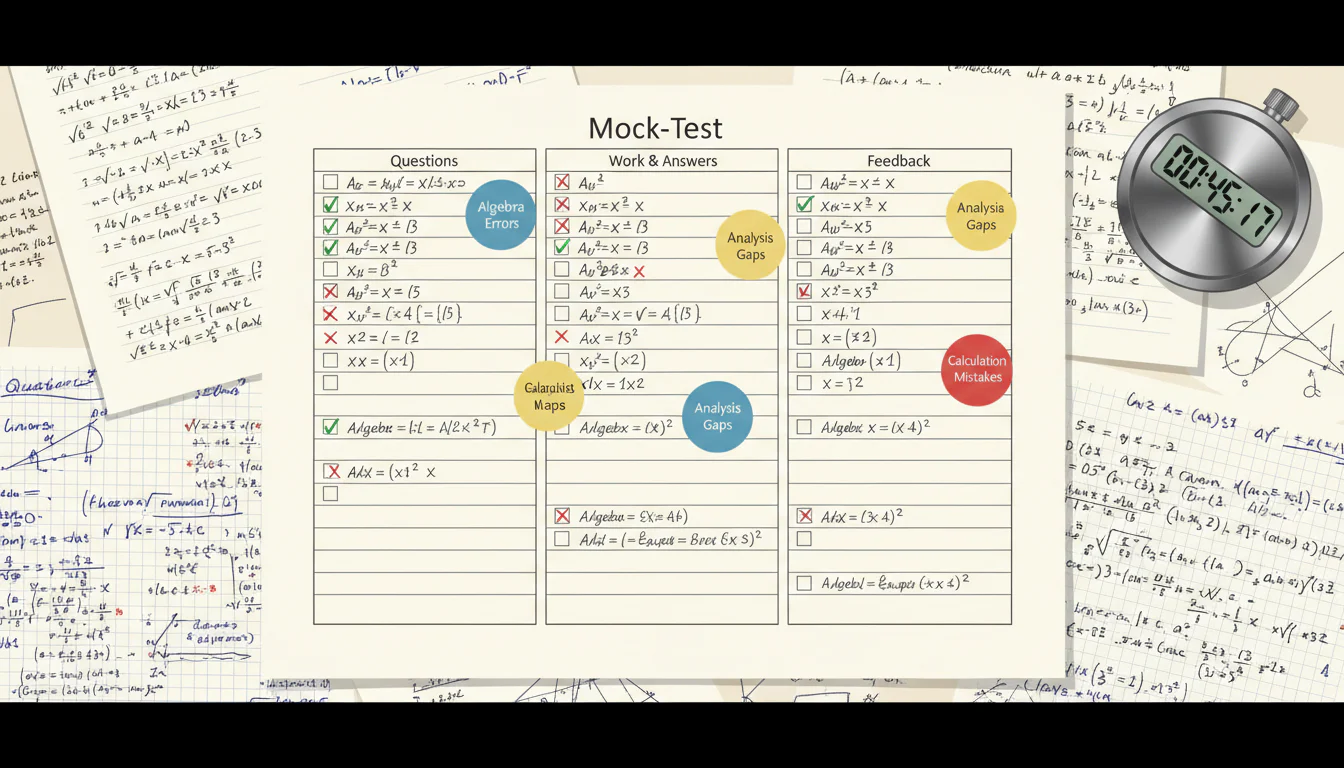
Use Five Error Categories
A label is useful only if it changes the next practice session. Research on effective learning methods identifies practice testing and distributed practice as high-utility approaches, while passive rereading is much less dependable for improvement. See the learning review before treating another round of videos as your default answer.
| Error Category | What The Mock Shows | One Corrective Exercise | Evidence Of Improvement |
|---|---|---|---|
| Incomplete knowledge | You cannot state the relevant theorem or first step | Build one concept sheet, then solve five graded questions | Solve a fresh similar problem unaided |
| Weak retrieval | The method looks obvious only after viewing a solution | Use a 48-hour blank-recall card and mixed retrieval set | Identify the method quickly on a new question |
| Poor question selection | You spend time on dead ends while shorter wins are skipped | Run a three-pass scan with a written skip rule | Fewer time sinks in the first pass |
| Slow execution | The method is right but takes too long | Complete a six-question time-boxed drill | Keep accuracy while reducing typical solve time |
| Avoidable error | You misread conditions, signs, or answer options | Use a final condition and option audit | The same slip stops recurring |
If you need a simple place to collect theorem sheets, worked practice, and review notes, use our mathematics study materials alongside the error log rather than starting a separate set of notes for every mock.
Run the Weekly Repair Loop
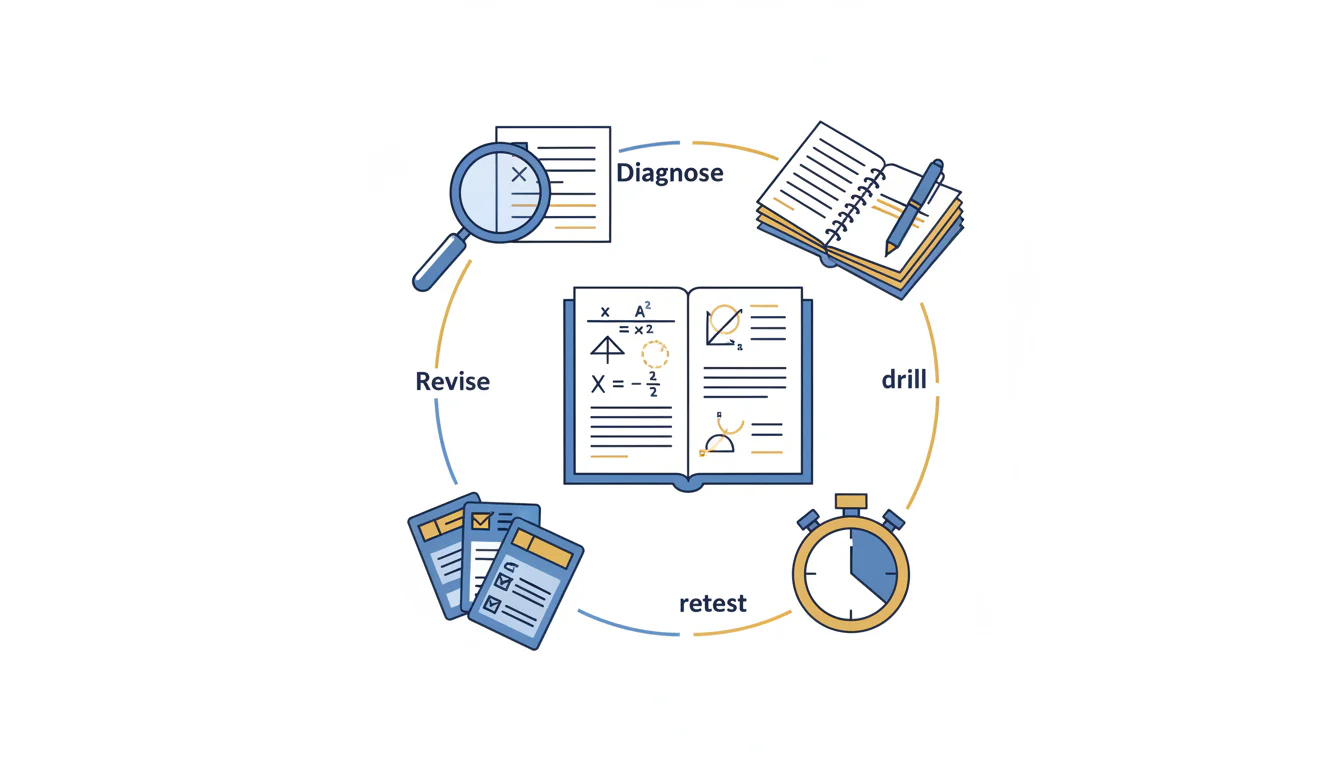
A useful repair loop is small enough to complete and specific enough to fail visibly. We use four steps because each one prevents a familiar self-study trap: diagnosing without practising, practising without retesting, or retesting without changing the plan.
Diagnose
Review the mock within a day, while your choices are still clear. Tag every lost mark with one category, then choose one high-impact error to address. Do not create a long weakness list that leaves you studying everything and learning nothing about the cause.
Drill
Give the selected problem one corrective exercise. Keep strong topics in rotation with a short maintenance set, because abandoning your reliable sections can reduce the score while you repair a weak one. If your record is clear but you struggle to follow through, one-to-one mentorship can be useful only when it reviews the actual log.
Retest
Use fresh questions after 48 to 72 hours. Repeating the same solved question measures recognition, not recovery. A large mathematics field experiment involving 19,355 students found that more matching mathematics problem practice improved later mathematics performance, which supports retesting the exact kind of work that failed. Read the maths field experiment.
Revise
Update your log after the retest. If the original category changes, change next week’s drill. If it does not, do not hide the result with more random practice. Keep the diagnosis visible until the recurring error has either declined or proved that the original intervention was wrong.
Choose Support That Changes the Evidence
Structured coaching helps repeaters when it supplies a function that self-study is missing. That may be current-pattern mock simulation, question-level review, a mentor who challenges a bad diagnosis, or a focused topic intervention. It is not automatically useful because it offers more lectures.
A practical decision starts with the error log. If incomplete knowledge dominates one or two topic clusters, choose a targeted module with graded questions. If the main losses come from selection, pacing, or recurring errors, choose support built around timed mocks and mock reviews. If the plan is sound but not being executed, accountability may matter more than coverage. Our support diagnostic is designed to help separate those cases.
Before paying, ask whether the support can show its work:
- Mock analysis: Can you see question-level timing, attempts, and a usable error record?
- Strategy feedback: Does the review explain why to attempt, defer, or skip a question?
- Fresh retesting: Are there new questions to test whether the repair worked?
- Targeted coverage: Can you address one gap without buying another full syllabus replay?
- Mentor review: Will someone inspect the evidence rather than merely ask whether you studied?
A 2022 study of practice tests included 201 students without feedback and 111 with individual corrective feedback, finding that more practice testing was associated with final-exam performance and more accurate self-monitoring. The useful lesson is not that any programme guarantees results. It is that feedback should make your judgment more accurate. Review our coaching value checklist before choosing a format.
Measure Recovery Before You Change the Plan
Recovery is not one encouraging score. It is a change in the pattern that caused the plateau. Track your rolling three-paper record: total score, section score, attempts, accuracy, time per attempted question, repeat-error count, and accessible marks left behind.
An intervention is working when the targeted error declines across two comparable retests and the intended behaviour improves without damaging another part of the paper. A selection drill, for example, should produce fewer early time sinks and better access to suitable questions, not simply faster guessing.
Change the plan when the same tagged error survives two fully completed repair cycles. If three comparable papers show no movement in your chosen leading indicators, revisit the diagnosis before adding more content. The goal is not to chase a perfect routine. It is to make each mock produce information that changes the next week’s preparation.
How SBTech Math Supports Evidence-Led Preparation
At SBTech Math, we build preparation around the evidence a stalled learner actually has, not around pressure to repeat every chapter. Our first useful question is simple: what changed in your last three papers, and which error has survived review? From there, we help you compare whether a focused test routine, strategy support, mentoring, or a targeted module matches the gap you have documented. Start by naming the job you need support to do: clearer diagnosis, fresh timed practice, a review of selection decisions, or accountability for the next repair cycle. If your record shows a clear, recurring pattern, our course paths let you inspect preparation options without pretending that one format suits every repeater. Bring the mock log, keep your strong topics active, and make the next decision from evidence when you are ready to compare details and choose a next step with us in confidence. Visit SBTech Math
FAQs on CSIR-NET Mathematics Score Plateau Diagnosis
Why Is My CSIR-NET Mathematics Score Not Improving?
Compare three timed papers. Tag repeated losses, use one corrective drill, and retest it before changing your syllabus or choosing broader support for next preparation decisions.
What Should I Do After a Year of Self-Study?
Reconstruct the latest mock before restarting lectures. Keep strong topics active, repair one recurring high-impact error, then retest it with fresh timed questions next week.
Can Structured Coaching Help Without Repeating the Syllabus?
Choose structured support only when it adds missing mock analysis, strategy feedback, fresh timed practice, or accountable reviews. Recorded error patterns should determine that choice.
How Do I Analyse a CSIR-NET Mathematics Mock Test?
Log timing, attempts, accuracy, skipped accessible questions, and each loss category. Assign one fresh timed drill, then review whether the same error returns within three days.