
Why Do CSIR-NET Math Repeaters Run Out of Time? A CSIR-NET Mathematics Strategy for Repeaters
CSIR-NET Mathematics strategy for repeaters: diagnose timing problems, improve question selection, and decide when structured support is worth it.

By Sunil Bansal, Founder · Updated 11 Oct 2026

In brief
At SBTech Math, we help CSIR-NET Mathematics repeaters diagnose whether lost time comes from recall, question selection, solution routes, or mock-review habits. We show how to prioritise topics, train under timed conditions, analyse errors, and decide whether a test series, mentor, or more syllabus coverage is actually needed.
In this article
- 1What Is Actually Causing You to Run Out of Time?
- 2Which Topics Matter Most in a CSIR-NET Mathematics Strategy for Repeaters?
- 3How Should You Choose Questions Instead of Trying to Solve Everything?
- 4How Do You Train CSIR-NET Math Speed Without Reinforcing Bad Habits?
- 5What Should Your CSIR-NET Mathematics Mock-Test Analysis Show?
- 6When Should You Choose SBTech Math for Structured Support?
- 7FAQs on CSIR-NET Mathematics Strategy for Repeaters
CSIR-NET Mathematical Sciences is a 200-mark paper completed in 3 hours, with candidates permitted a maximum of 60 attempts across its three parts under the current official scheme. That structure rewards fast judgment as much as mathematical knowledge.
A CSIR-NET Mathematics strategy for repeaters should treat time pressure as three separate skills: recognizing a solvable problem, choosing it at the right moment, and executing a short reliable method. More theory will not fix a repeated timing failure; timed triage, error review, and deliberate correction will.
We will help you diagnose the lost minutes, prioritise the right topics, improve paper choices, build timed practice, analyse mocks, and decide whether structured support is worth paying for.
What Is Actually Causing You to Run Out of Time?
Most repeaters do not lose time for one reason. They lose it in a chain: a familiar question takes too long to recognise, an uncertain question receives too much attention, a workable method becomes a long calculation, then late-paper pressure causes avoidable mistakes.
Our diagnostic starts by separating knowledge from performance. If you can solve a question calmly after the mock but could not start it during the mock, you need a recall, selection, or execution correction. If you still cannot explain the method, the issue is a concept gap.

Run a Timed Baseline Diagnostic
Use a 45-minute mixed set and record four things for every question: time spent, confidence before solving, whether you attempted or skipped it, and whether it was correct. Review the set after a break, when you can distinguish “I did not know this” from “I knew this but chose poorly.”
The goal is not a flattering score. It is a reliable pattern. Start with a free study set if you need questions for the first diagnosis, then repeat the same tracking method across comparable sets.
Match Symptoms to the Real Bottleneck
| Timed-Set Symptom | Likely Cause | What To Check | First Correction |
|---|---|---|---|
| You cannot begin familiar questions | Slow recall | Could you name the first step after the timer ended? | Practise first-step prompts |
| You find the method but finish late | Long solution route | Was there a shorter theorem or representation? | Write the method before calculations |
| You skip easy questions | Weak question selection | Did you solve skipped questions later? | Use a first-pass scan |
| You attempt too many uncertain questions | Risk control problem | Did negative marking erase gains? | Raise your certainty threshold |
| You lose marks after a strong start | Attention or anxiety pressure | Does it appear only in long mocks? | Increase full-paper exposure |
| The same topic fails repeatedly | Concept gap | Can you explain the missing condition? | Reteach, then retest |
Read Your Score Part by Part
Part A allows up to 15 attempts, Part B up to 25, and Part C up to 20. Part C carries the largest share of marks, but it also requires identification of every correct option for credit. A score total hides whether you are under-attempting, over-attempting, or misreading the paper’s risk.
Do not call yourself slow until you know where the time goes. A student who spends six minutes proving one uncertain Part C result has a selection problem. A student who reaches the right method but repeatedly makes algebraic slips has an execution problem.
Which Topics Matter Most in a CSIR-NET Mathematics Strategy for Repeaters?
Prioritisation should begin with the syllabus, not a recycled weightage chart. The official syllabus covers Analysis and Linear Algebra, Complex Analysis and Algebra, differential equations and applied areas, plus Probability, Statistics, and Operations Research in four broad units. Use the official syllabus as the non-negotiable coverage map.
Then layer your own evidence over it. A topic deserves priority when it is in the syllabus, appears in the official paper set you are reviewing, and either produces reliable marks or repeatedly costs you time. A topic is not automatically high priority because it appeared often in one session.
The syllabus is also not static background information. A 2026 April notice published revised-syllabus material for stakeholder consultation, so check the applicable syllabus before using older papers as a forecast.
Build a four-column topic list: secure and speed up, repair urgently, maintain, and defer deliberately. Our core preparation guide can support broad planning when you need to rebuild a study sequence around the evidence from your diagnostic.
How Should You Choose Questions Instead of Trying to Solve Everything?
The paper permits a maximum number of attempts. That means selection is not a passive consequence of knowledge, it is a skill you must train. Part A and Part B use negative marking, while Part C has no negative marking but gives no partial credit when an incorrect option is selected under the official rules.
On a first pass, label each question before you solve it. Attempt questions with an immediate route and high confidence. Hold questions where you can see a plausible method but need more thought. Skip questions where no useful first step appears quickly or the likely route is too long for the expected return.
| Decision | Use It When | Main Risk | What To Do Next |
|---|---|---|---|
| Attempt | The theorem, method, or key observation is visible | Rushing a verification step | Solve and check efficiently |
| Hold | A route is plausible but not yet certain | Spending too long too early | Return after easier marks |
| Skip | No first step appears or the path is unusually long | Ego-driven time loss | Move on without reopening immediately |
Your hold list should stay controlled. If it becomes a second full paper, you have not triaged. The practical aim is to protect early time for high-certainty marks, then spend the remaining time where the expected value is strongest.
For focused worked examples and concise revision material, use a math resource library to address the exact method or theorem that your log identifies.
How Do You Train CSIR-NET Math Speed Without Reinforcing Bad Habits?
Speed develops when the practice task changes gradually. Untimed learning is still useful, but it does not automatically transfer to a three-hour paper. Research guidance supports spaced study, worked examples mixed with problem solving, and quizzes that re-expose learners to important material, as summarised by the IES guide.
We recommend four stages. Do not rush from chapter revision to full mocks. Each stage should expose one bottleneck clearly enough to correct it.
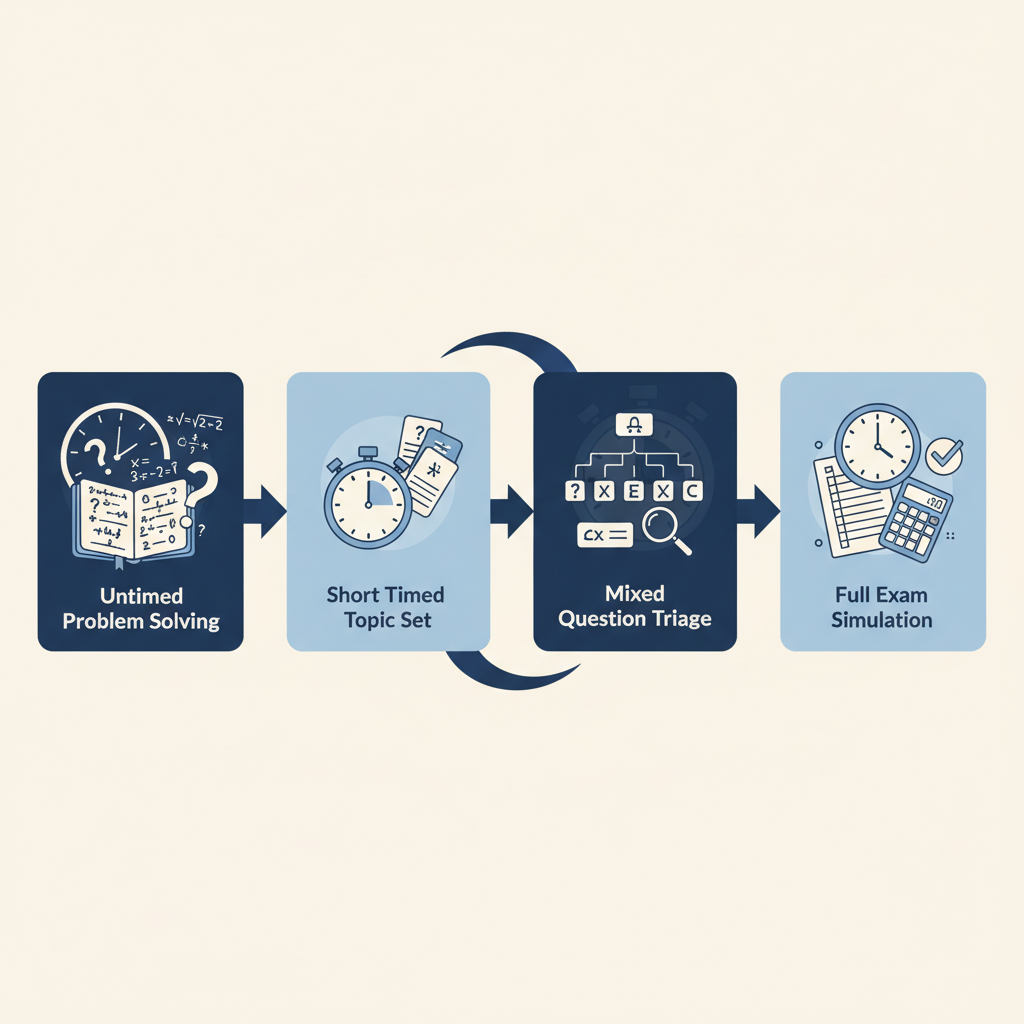
Stage One: Compress the Method
Work topic-focused questions without a tight timer. Before writing calculations, state the theorem, substitution, transformation, or proof idea that makes the question manageable. Compare your route with a clean solution and identify unnecessary steps.
This stage builds recognition. If the correct route only appears after several pages of exploration, a timer will merely make the same habit more stressful. If you want a schedule that matches your preparation cycle, compare the practical tradeoffs in our rolling-batch guide.
Stage Two: Cap Topic Sets
Use short timed sets from one topic after you can solve it reliably. Record whether the cap exposed missing recall, slow calculations, or uncertainty about which theorem applies. Correct only the revealed weakness before repeating the set.
A good correction is specific. “Revise linear algebra” is vague. “Practise identifying the right canonical form from the first two lines” is a drill.
Stage Three: Mix Topics and Train Triage
Now combine topics so recognition and selection become part of the task. Tag attempt, hold, or skip before you solve. Afterward, measure how many easy or medium questions you skipped and how many low-certainty questions consumed too much time.
This stage is where many repeaters first discover that their problem is not raw speed. It is the habit of treating every visible question as an immediate commitment.
Stage Four: Simulate the Full Paper
Use full-length papers only after the earlier stages produce stable patterns. Follow the official structure, respect attempt limits, and leave time to verify Part C options.
Review matters as much as the simulation. A large feedback review found that explanation-based feedback was more useful for learning than merely telling students whether they were right or wrong, according to this feedback study.
What Should Your CSIR-NET Mathematics Mock-Test Analysis Show?
A mock score is a result, not a diagnosis. Your analysis should show why marks were gained or lost, which mistakes recur, and whether your next week of work should focus on concepts, selection, execution, or attention control. When your log is clear but the same decision errors persist, one-to-one mentorship may help more than additional solo revision.
Use official papers and final keys where possible. The official archive lets you build a defensible previous-paper sample instead of relying on unverified recall-based topic claims.
| Question Or Topic | Part | Time Spent | Confidence | Result | Error Type | Corrective Drill |
|---|---|---|---|---|---|---|
| Topic or question ID | A, B, or C | Minutes | Low, medium, or high | Correct, wrong, or skipped | Concept, recall, route, selection, calculation, option control, or anxiety | One specific next exercise |
Your readiness dashboard should track accuracy by part, attempt rate by part, median time per attempted question, easy questions skipped, and repeated error categories. Compare three similar mocks, not one unusually easy or difficult paper. If one category remains dominant after targeted drills, that is evidence for a different form of help.
Avoid choosing a readiness target from a single historical cutoff. The UR JRF cutoff for Mathematical Sciences was 53.375% in June 2025 and 42.000% in December 2025 in the published cutoff notices. Your dashboard should measure improvement in controllable performance, not chase a fixed number detached from the session.
When Should You Choose SBTech Math for Structured Support?
At SBTech Math, use our coaching value checklist before buying more lectures. We help repeaters identify whether the bottleneck is coverage, recall, route selection, pace, or review, then match help to that evidence. If your log shows recurring concept gaps, a syllabus-led course may fit. If your knowledge is sound but timed decisions keep failing, feedback on paper choice and mock review is usually more useful than another complete course. Bring three comparable mock reports, your error log, and the topics that still consume too much time. We can then help you choose a proportionate next step, including self-directed practice when that is sufficient. Our aim is a clear correction loop, not pressure to enrol: test, classify, repair, retest, and only then add support that changes the repeated pattern. We focus on the smallest intervention that can improve performance. Start with SBTech Math.
FAQs on CSIR-NET Mathematics Strategy for Repeaters
Why Do I Know CSIR-NET Mathematics but Still Run Out of Time?
Timing problems usually reflect slow recognition, poor question selection, long solution routes, option-checking mistakes, or a late-mock attention collapse, rather than one missing chapter alone.
How Should I Analyse a CSIR-NET Mathematics Mock Test?
Use the same official-style conditions, then record attempts, accuracy, time per question, confidence, skipped solvable questions, and every error category. Compare three comparable mocks, not one.
Should I Attempt Part C Questions If I Am Unsure?
Attempt Part C only when you can verify every selected option, because credit requires all correct options and any incorrect selected option receives no credit.
When Should a CSIR-NET Repeater Join Coaching?
Structured help becomes worthwhile when three comparable mocks reveal the same bottleneck after targeted drills, especially when you need feedback on triage, methods, and review.