
Rolling Batch vs Fixed Cycle CSIR-NET Coaching Compared
Rolling batch vs fixed cycle CSIR NET coaching compared by scenario: late deciders, group-study learners, and retakers, with an honest trade-off table.
Miss a fixed enrollment window at some CSIR-NET coaching institutes and you could wait nearly six months for the next one, since several programs run just two admission cycles a year, roughly January to June and July to December, according to a coaching directory listing of typical batch structures. That gap matters, because a delayed attempt often means a delayed stipend, a delayed job offer, or another year spent waiting for a door to reopen.
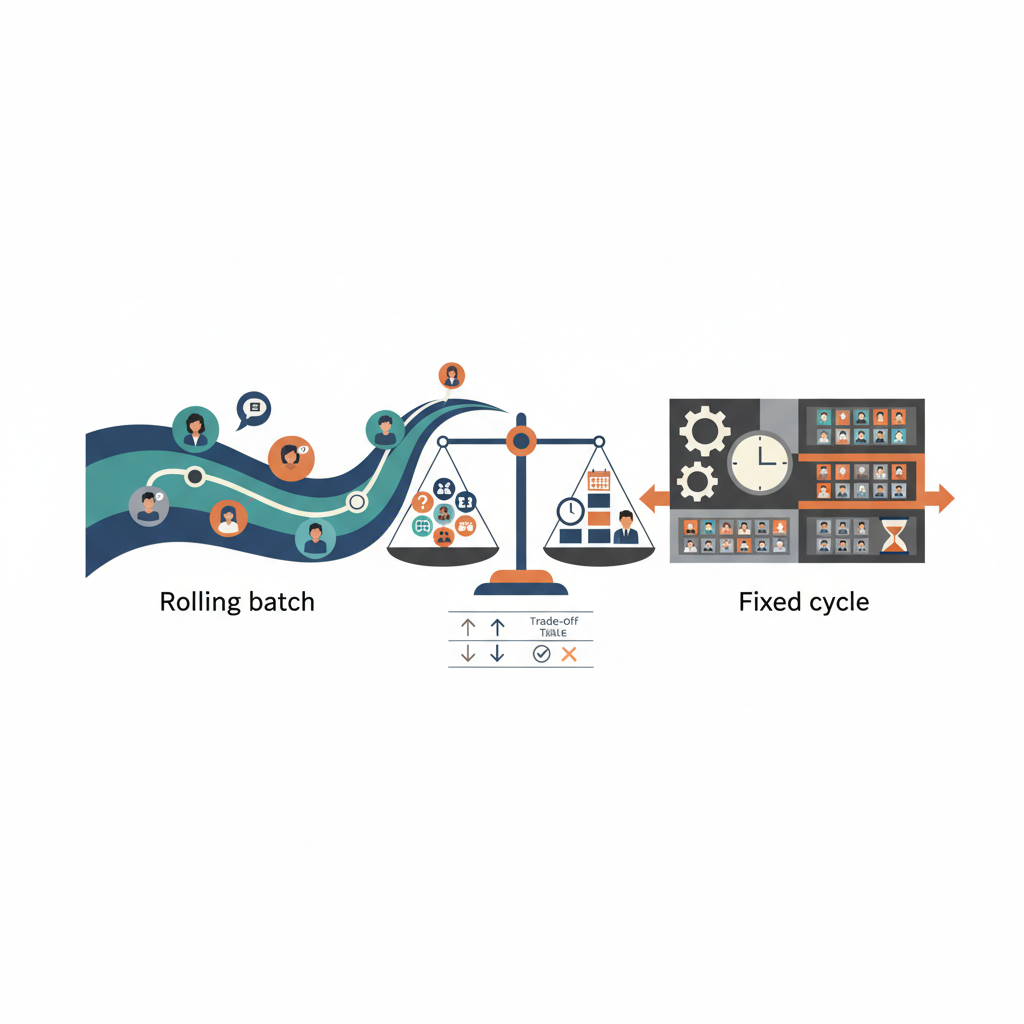
Rolling-batch CSIR-NET coaching launches a fresh cohort every few weeks, letting you start almost the moment you decide to prepare, while fixed-cycle coaching opens admissions only a couple of times a year but carries one cohort through the whole syllabus together. Weighing rolling batch vs fixed cycle CSIR NET coaching really means weighing your need to start now against your need for a stable peer group moving in lockstep. Neither model wins outright; the right pick depends on when you're deciding and why you're prepping.
This piece breaks down what each model actually does to syllabus continuity and peer stability, then segments the choice by three real situations: a late decider who quits a job mid-year, a learner who wants a stable group for daily discussion, and a retaker rebuilding after a June attempt that didn't go well.
What "Rolling-Batch" and "Fixed-Cycle" Actually Mean in CSIR-NET Coaching
Coaching pages throw the word "batch" around loosely without saying whether it resets every few weeks or only twice a year, and that vagueness is exactly why learners end up picking the wrong model. Here's what each term means in practice, and why the difference is bigger than a calendar detail.

A rolling-batch program opens a brand new section on a short cycle, often every four to eight weeks, so there's almost always a fresh start point close to whatever date you happen to decide on. A fixed-cycle program instead locks enrollment into one or two windows a year and moves that single group through Real Analysis, Linear Algebra, and the rest of the syllabus in one continuous arc, week after week, without new joiners disrupting the pace. If you're still deciding whether structured coaching is worth the money at all before you pick a model, that's a separate question worth settling first.
Rolling Batch vs Fixed Cycle CSIR NET Coaching: the Comparison Table
Reading marketing copy from either camp, both sound like the obviously correct choice. The honest picture only emerges once you line up the trade-offs side by side.
| Factor | Rolling-Batch Model | Fixed-Cycle Model |
|---|---|---|
| Enrollment window | New section every 4 to 8 weeks, near-continuous | Two or three windows a year, calendar-locked |
| Syllabus coverage continuity | Fragmented across parallel sections; easy to miss a linear thread | One continuous pass through the full syllabus, start to finish |
| Peer cohort stability | Low; cohorts reshuffle as new joiners enter each cycle | High; same group through classes, tests, and revision |
| Mid-cycle join feasibility | High; almost always a batch starting soon | Low; late joiners either wait months or enter mid-syllabus |
Read that table plainly and the trade-off is obvious: rolling-batch buys you speed to start at the cost of a settled peer group, fixed-cycle buys you a stable cohort and one clean syllabus pass at the cost of flexibility on when you begin.
The Real Trade-off: Momentum vs Cohort Continuity
every batch-schedule comparison page stops at "here's when each batch starts." What it skips
Momentum matters most when your own preparation is fragile: you've just decided to attempt CSIR-NET, your foundation in a subject is thin, and every week you wait to start is a week you're not building it. Cohort continuity matters most when your foundation is already reasonably solid and what you need is disciplined pacing alongside people at your level, not a fast entry point. If your gap is foundational, rebuilding topic-by-topic from scratch matters more than which cohort you land in, and a structured path like this IIT JAM Mathematics guide illustrates what starting from zero and building systematically actually looks like, regardless of which coaching calendar you follow.
Best for Late Deciders: Why Rolling-Batch Wins When Your Timeline Is Tight
Picture someone who resigns from a job in August, decides on CSIR-NET only after that, and finds the nearest fixed-cycle window doesn't open until January. That five-month dead zone is the exact scenario rolling-batch coaching was built to solve.
For this learner, a program that starts fresh every four to eight weeks removes the waiting entirely; they enroll within days of deciding instead of sitting idle until the next official intake. The honest cost is that they'll likely study alongside a rotating cast of people at different stages, so any sense of shared momentum has to come from self-discipline rather than group pressure. A flexible membership structure, like the tiered options in SBTech Math's memberships, suits this exact profile because it doesn't force a learner to wait for an artificial calendar slot before starting real preparation.
Best for Group Study: Why Fixed-Cycle Cohorts Hold Together
Now picture a small group of MSc classmates who want to prepare together, hold each other accountable on weekly targets, and discuss the same topic on the same day. That only works cleanly if everyone is on an identical syllabus schedule, which is precisely what fixed-cycle coaching guarantees and rolling-batch coaching cannot.

Coaching researchers note a related pattern in offline classroom settings: institutes that keep batches fixed regardless of performance give students "a sense of security" in a stable peer group, according to an analysis of batch segregation, even though that same stability can mask uneven ability levels within the group. The trade-off applies just as much online. If your study group wants that shared pacing, free resources like SBTech Math's study content can supplement group sessions without disrupting whichever cohort schedule the group has already committed to.
Best for Retakers: Matching the Model to a June Attempt
A retaker coming off a June attempt has a different problem than either of the above: they don't need a full syllabus restart, they need targeted repair on two or three weak topics before the December attempt, plus heavy previous-year-question practice.

For this learner, rolling-batch flexibility usually wins, because sitting through a fixed-cycle cohort's full syllabus again wastes months on topics they've already cleared. What actually moves the score is disciplined weak-area drilling, and generic PYQ repetition alone rarely closes that gap, a point covered in why previous year papers alone won't help. Pairing targeted revision with structured practice sets, such as the downloadable material in the mathematics PDF resource, tends to close retake gaps faster than re-enrolling in a full-length cycle.
Mid-Cycle Joining: What Actually Happens When You Enroll Late
Both models get asked the same question constantly: what if I join after the batch has already started? The honest answer differs sharply between the two, and it's worth knowing before you pay.
In a rolling-batch setup, joining late usually means joining a newer parallel section rather than actually entering mid-syllabus, since a fresh section is starting soon anyway. In a fixed-cycle setup, joining late genuinely means walking into a syllabus already in progress, and institutes vary widely on whether they'll let you switch batches or get a partial refund if the fit turns out wrong, a friction point covered in guidance on batch and refund rights. Before committing to either model, it's worth checking a program's own policy directly; SBTech Math's background and approach and its FAQ page both lay out access and scheduling terms upfront rather than leaving them to a phone call after payment.
Build Your CSIR-NET Timeline with SBTech Math
If your problem is a fixed calendar that never matches your actual decision date, the fix isn't finding a better fixed cycle, it's removing the calendar dependency altogether. SBTech Math structures its mathematics prep so you build from wherever you actually stand today, whether that's a mid-year job switch, a gap-year restart, or a retake after a rough June attempt. Instead of waiting on an institute's next intake window, browse the SBTech Math course store and start on a schedule that matches your timeline, not the other way around. If you're unsure which path fits your current preparation stage, reach out directly and get a straight answer before you commit any money.
FAQs on Rolling Batch vs Fixed Cycle CSIR NET Coaching
What Is the Difference Between Rolling Batch and Fixed Cycle CSIR NET Coaching?
Rolling-batch coaching opens new sections every few weeks so you can start almost anytime; fixed-cycle coaching enrolls only once or twice a year but keeps one cohort together through the entire syllabus.
Which Coaching Model Is Best for a Mid-year Job Switch?
Rolling-batch coaching generally fits better, since it lets someone who decides to prepare mid-year start within weeks instead of waiting months for a fixed institute's next official intake window.
Can I Join a Fixed-cycle CSIR NET Batch Mid-syllabus?
Usually yes, but you enter after classes have already progressed, so you inherit gaps in earlier topics and depend heavily on recordings or extra doubt sessions to catch up.
Does Rolling-batch Coaching Cover the CSIR NET Syllabus as Thoroughly as Fixed-cycle Coaching?
Coverage can be equally thorough, but continuity suffers because parallel sections restart topics on different timelines, making a single linear syllabus pass harder to track than in fixed-cycle programs.
Is Rolling-batch Coaching Better for CSIR NET Retakers?
Often yes, because retakers usually need targeted repair on specific weak topics rather than a full syllabus restart, and rolling-batch flexibility lets them skip redundant early-stage content entirely.
How Do I Choose Between Rolling-batch and Fixed-cycle Coaching for CSIR NET Mathematics?
Match the model to your situation: pick rolling-batch if you need to start immediately, pick fixed-cycle if a stable peer group and one continuous syllabus arc matter more to you.