Why Do Topology Definitions Fail in Mock Tests? A Topology Mock-Test Diagnosis


TL;DR
At SBTech Math, we treat missed topology mock-test questions as diagnosable errors in recall, concept boundaries, strategy selection, proof execution, or pacing. We show you how to translate definitions into usable moves, test theorem hypotheses with counterexamples, review mocks, and rebuild an avoided topic through a weekly repair cycle.
Topology appears in the GATE 2026 Mathematics syllabus, and its 100-mark paper gives you 3 hours to make choices under pressure, as the official GATE pattern confirms.
Our topology mock-test diagnosis separates five failures: recall, concept boundaries, strategy selection, proof execution, and pacing. Knowing a definition yet missing the question usually signals a recognition or strategy-mapping failure, not bare memory. Identify the first failed step, then practise that skill instead of rereading the whole chapter.
We will show you how to diagnose each miss, turn definitions into proof openings, use counterexamples to test theorem conditions, review a mock properly, and restart topology without feeding the avoidance cycle.
How Can a Topology Mock-Test Diagnosis Find the First Failure?
When topology feels impossible in a mock, the problem is often not that you know nothing. You may remember that compactness involves open covers, for example, but fail to notice that the question is really testing Hausdorffness. That is a concept-boundary error, not a compactness-recall error.
We use five labels because they turn a discouraging score into a specific next action. A wrong answer should never end at “revise topology.” It should end with one named failure and one drill.
| Failure Level | What You Can Do | What Failed In The Mock | Best Next Drill |
|---|---|---|---|
| Recall | State the definition or theorem | You cannot retrieve the condition | Blank-page definition retrieval |
| Concept Boundary | Identify when a result applies | You use a metric-space fact too broadly | Hypothesis-removal cards |
| Strategy Selection | Choose a valid first move | You do not know whether to use covers, preimages, or separation | Topic-to-method sorting |
| Proof Execution | Carry out the chosen route | A quantifier, inclusion, or implication fails | Skeleton-proof repair |
| Pacing | Finish and check the argument | You have the idea but cannot complete it in time | Short timed mixed sets |
Ask the First-Failure Question
After every miss, ask these questions in order: Could I state the definition? Did I identify every hypothesis? Did I know the first move? Could I justify each step? Did time change my choice? Stop at the first “no.” Later errors may be consequences, but the first one is the repair target.
This is also why rereading notes can feel productive while scores stay flat. If your first failure is strategy selection, more recall practice will not teach you to recognise when a preimage test is the fastest route. Our mock-calibration guide can help you separate false confidence from a genuine improvement in decisions.
Use a Verified Problem as a Diagnostic
The 2026 GATE MA paper includes a cofinite-topology multiple-select question asking about Hausdorffness, finite closed sets, compactness, and connectedness. In the official materials, the correct choices are B, C, and D, so selecting Hausdorffness points to a separation-axiom boundary error rather than a failure to memorise the topology definition.
That distinction matters. A student who misses compactness may need to rebuild the finite-subcover argument. A student who misses Hausdorffness needs a counterexample habit: in a cofinite topology on an infinite set, two nonempty open sets cannot be disjoint.
How Do You Turn Definitions into Usable Tests?
Definitions become useful only when they tell you what to write first. We do not want you to memorise “a function is continuous if inverse images of open sets are open” as a sentence that disappears under pressure. We want you to see a map and immediately know that the codomain’s open sets, or a basis for them, are the objects to inspect.
For each definition, create three short prompts in your notes: a test, a proof opening, and a counterexample lever. This converts passive familiarity into an exam decision.
Build a Definition Translation Card
For continuity, the test is inverse images of open sets, the proof opening is “Let (V) be open in the codomain,” and the counterexample lever is changing the topology on the domain or codomain.
For compactness, the test is an arbitrary open cover, the proof opening is “Let ({U\alpha}) cover (X),” and the counterexample lever is finding a cover with no finite subcover. For connectedness, start by ruling out a separation or by using a continuous image of a connected space.
Use your own free study content to make cards only after you have attempted the relevant problems. Cards work best as retrieval tools, not as attractive substitutes for solving.
Remove One Hypothesis at a Time
When a theorem feels magical, box every hypothesis and remove only one. Then ask which proof line now breaks. This is the fastest route from memorising a theorem to understanding its boundary.
For example, “a compact subset of a Hausdorff space is closed” depends on Hausdorffness. The cofinite topology gives the repair: an infinite cofinite space is compact, yet its infinite proper subsets need not be closed. The topology notes also show why compactness and Hausdorffness work together in this theorem.
Climb a Hint Ladder Instead of Reading Solutions
We use a four-step hint ladder to protect productive struggle:
- Classify The Object: Identify the topology, map, property, or construction being tested.
- Restate The Definition: Write the relevant definition with its quantifiers.
- Name The Theorem: Choose a theorem and check each hypothesis before using it.
- Request One Opening Line: Get only the first valid sentence, not the full solution.
Record the smallest hint that unlocked the problem. If level two was enough, your issue was recall. If you needed level three, your next practice block should train theorem selection.
Which Strategy Should You Select for Each Topology Topic?
A topology question often gives enough information to choose a method before you calculate anything. GATE MA explicitly includes bases, subbases, compactness, connectedness, and separation axioms in its official MA syllabus, so your practice should train recognition across topics instead of collecting disconnected tricks.
We recommend reading the noun in the question first. “Open cover” points toward compactness. “Distinct points” points toward a separation condition. “Basis” points toward coverage and local refinement. The matrix below is a starting map, not a replacement for proof.
| Topic | Read The Question For | First Method To Try | Common False Move |
|---|---|---|---|
| Open And Closed Sets | Complements, unions, intersections | Complement test or basis membership | Importing Euclidean intuition |
| Continuity | A map and named topologies | Inverse-image test | Checking images of open sets |
| Compactness | Covers, finite subcovers, compact domain | Open-cover argument or continuous image | Treating closed as compact generally |
| Connectedness | Separations, clopen sets, continuous images | Separation test or image argument | Equating disconnected with not path-connected |
| Separation Axioms | Two points and neighbourhoods | Construct disjoint opens or prove forced overlap | Confusing (T_1) with Hausdorff |
| Bases | Local neighbourhood language | Coverage plus refinement | Treating a basis as arbitrary opens |
| Subbases | Generated topology | Take finite intersections first | Using subbasic sets as a full basis |
When you repeatedly choose the wrong method, use ten mixed prompts and label only the first move. Do not solve them yet. This small drill teaches the recognition stage that makes later work faster. For broader timed practice, connect it to our problem-solving speed approach rather than assuming more questions alone will create speed.
How Do Counterexamples Expose a Missing Hypothesis?
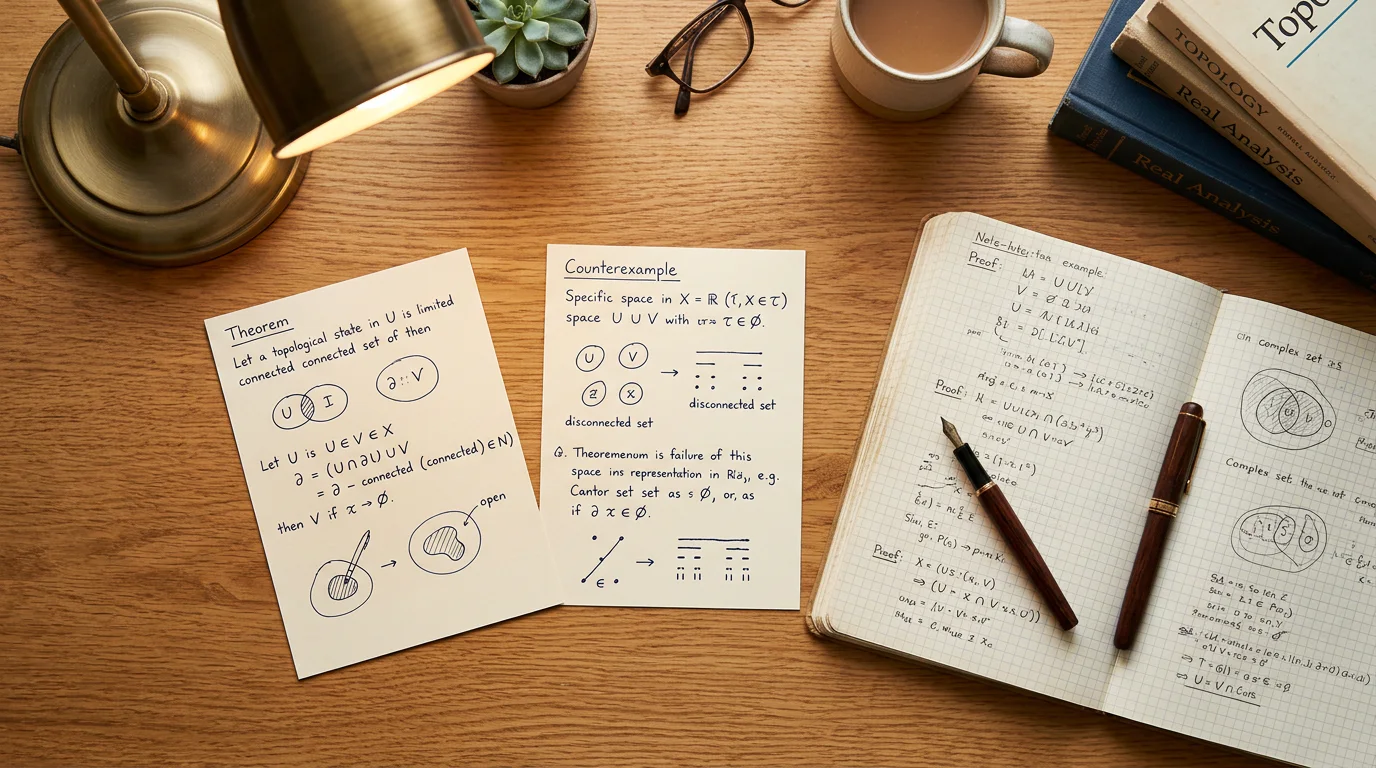
Counterexamples are not decoration around topology theory. They show you exactly why a tempting statement fails and which condition rescues it. We build them in pairs: one card states the valid theorem, and the other removes one condition and shows the break.
The goal is not to memorise a museum of strange spaces. It is to build a short, reusable bank that you can call on when an option looks familiar but slightly too broad.
| Tempting Claim | Condition To Underline | Counterexample To Keep Ready | Repair Lesson |
|---|---|---|---|
| Compact subsets are closed | The ambient space is Hausdorff | Infinite cofinite topology | Compact does not always imply closed |
| A continuous bijection is a homeomorphism | Compact domain and Hausdorff codomain | Natural map from ([0,1)) onto a circle | Bijective and continuous is not enough |
| (T_1) implies Hausdorff | No added condition rescues this implication | Uncountable cocountable topology | Singleton closure is weaker than separation |
| Closed and bounded means compact | Euclidean or suitable metric setting | General topological spaces | Do not export metric facts automatically |
The 2025 GATE MA paper uses an uncountable cocountable topology to test precisely this distinction. It asks whether the space is (T_1), whether it is Hausdorff, and whether closed or compact subsets imply one another. That is the kind of prompt where a paired card can save you from selecting an attractive converse.
Build each card with four fields: theorem, hypotheses, smallest counterexample after removing one hypothesis, and failed proof line. Once you can explain the failed line aloud, you have moved beyond definition recall. Students balancing more than one exam route can connect this focused review to backup planning without turning every study block into a full-syllabus restart.
How Should You Review a Topology Mock Test?
Mock review is where we turn a score into a plan. A topology question you got wrong should take longer to review than to attempt, because the review decides whether you repeat the error next week.
We recommend logging topic, attempted method, first failure level, time used, smallest useful hint, and corrective drill. That record makes patterns visible across different questions.
If the same topic produces different failure levels, do not label the whole topic weak. A compactness question missed through recall needs a different drill from one where you knew the theorem but chose the wrong approach. If the same failure level appears across several topics, repair the skill rather than revising every chapter.
GATE gives no partial marks for an MSQ, which makes deliberate option checking important. Use a final pass to ask whether each selected statement depends on an unstated condition. Pair this review with time-management practice so that your timing data comes from realistic work, not guesses.

What Weekly Repair Cycle Rebuilds an Avoided Topic?
Avoidance grows when every topology session becomes an all-or-nothing attempt to “finish the chapter.” We prefer a smaller weekly loop that makes the next session predictable. You are rebuilding trust in your process, not proving that you should solve every hard question immediately.
If IIT-JAM MA is your only target, check the published JAM syllabus before allocating major time to topology. For GATE MA and any CUET-PG route where topology is required, use the cycle below.
- Day One: Complete an untimed diagnostic set and tag each miss with the first failure level.
- Day Two: Repair recall and concept boundaries with theorem and counterexample cards.
- Day Three: Sort mixed prompts by first method, then solve only the ones you classified correctly.
- Day Four: Use the hint ladder and record the smallest prompt that helped.
- Day Five: Attempt a short timed mixed set from already-repaired material.
- Day Six: Complete the post-mortem, then re-solve one missed problem without notes.
- Day Seven: Rest lightly, review cards, and schedule the next re-test.
Use structured practice to keep the cycle focused. The rule is simple: repair the earliest failure, then re-test a small set.
Build Your Topology Repair System with SBTech Math
At SBTech Math, we build preparation around diagnosis rather than repeated exposure. If topology questions keep pulling down your confidence, our goal is to help you see the exact decision that failed: the definition, the hypothesis, the theorem choice, the proof step, or the clock. We organise higher-mathematics preparation for exam-focused study, so you can connect concept review, worked practice, mock analysis, and a realistic weekly plan instead of treating every wrong answer as proof that you are weak at the subject. Start with your own error log, bring one recurring pattern to your next study session, and use it to choose the smallest drill that can change the result. We also encourage you to keep the record simple enough to revisit after every mock, not buried in a notebook you never reopen. When you want a structured home for that process across your preparation, explore SBTech Math.
FAQs on Topology Mock-test Diagnosis
We answer these directly, using the diagnostic system throughout.
Is Failing Topology Questions Despite Knowing Definitions a Conceptual Gap or a Practice Problem?
Usually, the log decides which comes first. Repeated recall or concept-boundary errors show a conceptual gap; strategy, execution, or pacing errors need targeted practice next.
How Do I Diagnose a Topology Mistake in a Mock Test?
Record the topic, attempted method, first failed level, time used, smallest helpful hint, and corrective drill. Re-test a similar question after completing only that drill.
What Is the Fastest Way to Improve Topology Problem Solving?
Begin with inverse images for continuity, covers for compactness, separations or images for connectedness, and neighbourhood tests for separation axioms. Then verify every theorem hypothesis before calculating.
How Do I Restart Topology After Avoiding It for Months?
Use short daily sets, delay full solutions with the hint ladder, and re-solve mistakes after a targeted drill. The aim is reliable decisions, not perfect first attempts.