CSIR-NET Math Coaching Focused on Exam Strategy (Not Syllabus Rehash): What to Look For
Find CSIR-NET Math Coaching Focused on Exam Strategy using mock ratios, Part A/B/C pacing, error analysis, and timed speed drills.

By Sunil Bansal, Founder · Updated 11 Oct 2026

In this article
CSIR-NET Mathematical Sciences is not only a content test. The official scheme gives candidates three hours to work across three parts for 200 marks, so choosing which questions to attempt matters as much as knowing the underlying mathematics.
Yes. CSIR-NET Math Coaching Focused on Exam Strategy exists, but the label alone proves little. Look for a published mock-to-lecture ratio, Part A, B, and C pacing drills, reviewed error logs, and timed mini-tests. A syllabus course adds content; a strategy course measures, diagnoses, and improves decisions under time pressure.
This guide shows what those features look like in practice, which claims deserve scrutiny, and how to compare programs before you commit your time and money.
What Exam Strategy Focus Means
A strategy-first course teaches the decisions that sit between knowing a theorem and earning marks from it. It should train you to recognize a high-confidence question, leave a time sink without panic, return to marked items with purpose, and learn from a miss that keeps repeating. A large video library can support preparation, but it is not evidence of exam-technique coaching on its own.
The official Mathematical Sciences model paper is a useful planning reference, though candidates should always check their own exam cycle. It contains 120 questions, with 20 in Part A, 40 in Part B, and 60 in Part C, while candidates answer 15, 25, and 20 respectively. That is 60 selected questions in 180 minutes, or an average of three minutes per selected question before review time. The official model paper also shows why selection matters: Part C questions carry 4.75 marks each in that model.
A serious program therefore builds four habits:
- Question Selection: Classify items as solve now, return later, or leave alone.
- Pacing: Use time checkpoints and stop-loss rules instead of trying to give every question equal time.
- Error Correction: Separate concept gaps from misreads, method errors, calculation slips, and slow execution.
- Speed Transfer: Rebuild fluency through timed practice on the precise question type that caused delay.
Those habits work best alongside a wider study strategy, not as a substitute for a sound mathematical foundation.
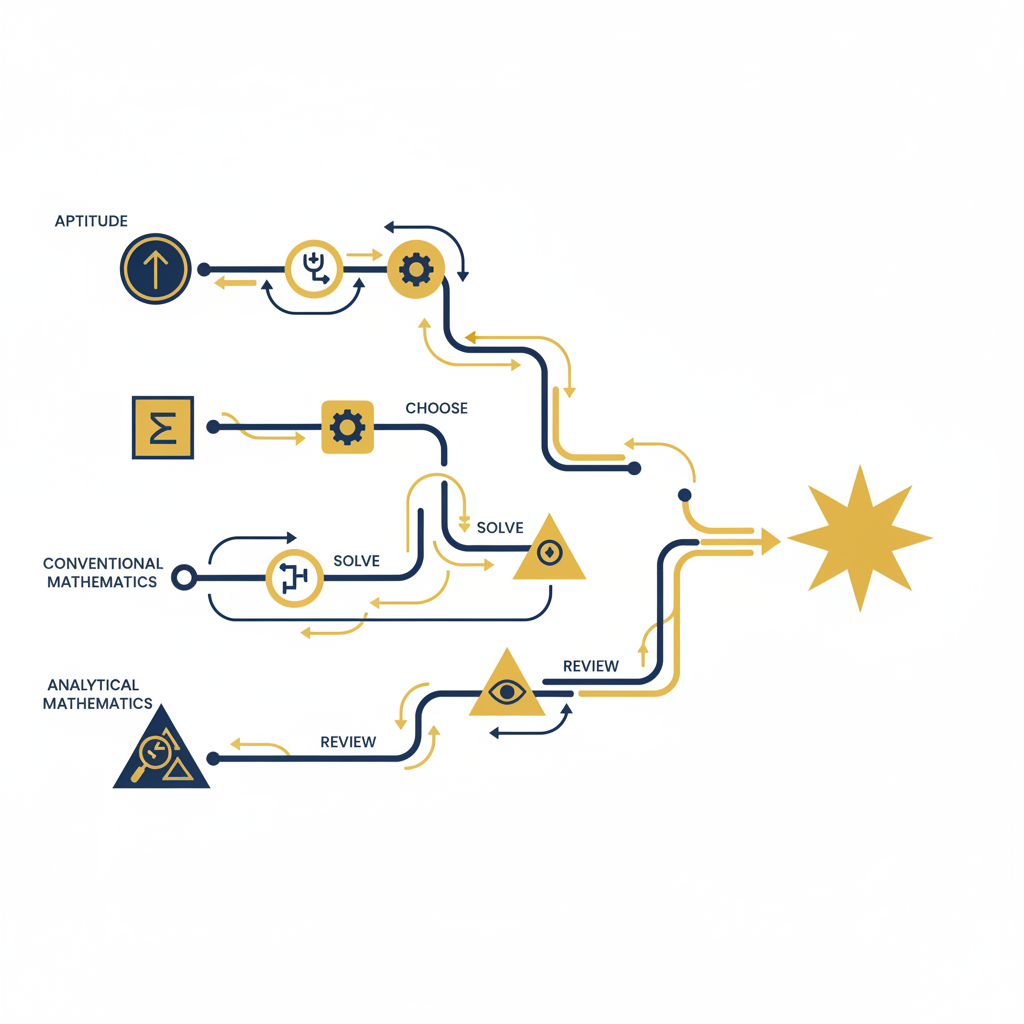
How to Evaluate CSIR-NET Math Coaching Focused on Exam Strategy
The quickest way to test a program’s promise is to ask for its operating system, not its slogan. A course can accurately say it includes mocks, mentoring, practice, and strategy, yet still reserve nearly all timed work for the end. Ask what happens between the first lecture and the final mock.
A Published Mock-To-Lecture Ratio
A program should state how many full, timed simulations occur, when they happen, and whether each one receives an instructor-led debrief. Count a full mock cycle only when it includes the timed attempt, a section-level report, and a correction session. Chapter quizzes are useful, but they are not substitutes for exam-length decision practice.
As an editorial screening rule, look for at least one full mock-and-debrief cycle for every 12 to 15 lecture hours once the learner has a working foundation. This is not an official CSIR-NET requirement or a score guarantee. It is a practical way to distinguish recurring feedback from a final-week mock bundle.
Part-Specific Time Allocation Training
Good coaching does not prescribe one rigid minute-by-minute split for every student. Instead, it teaches a first pass, a return pass, and a stop-loss rule for each part. Students should learn how to record attempts, accuracy, negative-mark losses, and median time, then use that information to decide what to change on the next test.
A useful demonstration lesson will show how a student decides whether to continue, mark, or skip an item. If the lesson contains only worked solutions after unlimited thinking time, it is content instruction, not time-management training. You can begin testing this distinction with free practice material before comparing paid options.
Error-Pattern Workshops
A score report says what happened. An error-pattern workshop explains why it happened and assigns the next corrective action. The report should identify at least concept gaps, question misreads, wrong method choices, algebra slips, option-elimination errors, over-attempts, and time-outs.
This approach has a sound learning rationale. A 2021 retrieval review screened nearly 2,000 abstracts and coded 50 experiments involving 5,374 learners; 57% of reported effect sizes showed medium or large benefits from retrieval practice. That research is not CSIR-NET specific, but it supports repeated practice with feedback over passive review alone.
Measured Speed-Building Protocols
“Improve speed” is too vague to evaluate. A credible program sets a baseline, assigns a short timed drill for the relevant question family, reviews the cause of delay, and retests. Its target should pair faster work with an accuracy safeguard, because rushing into more negative marks is not progress.
| Ask For | Strategy-Focused Evidence | Syllabus-Rehash Substitute |
|---|---|---|
| Full mocks | A dated calendar of three-hour tests and debriefs | A large undifferentiated mock count |
| Pacing training | First-pass rules, checkpoints, and review decisions | General advice to practise more |
| Error review | Error codes that trigger assigned drills | Answer-key discussions only |
| Speed work | Baseline, timed drill, retest, and accuracy floor | A promise to become faster |
Red Flags and Green Flags
The most revealing details are often missing from the sales page. Look past broad phrases such as “exam-oriented,” “complete preparation,” or “smart strategy,” then ask whether the program can show the actual test rhythm and feedback loop a learner will experience.
| Red-Flag Indicator | Green-Flag Indicator |
|---|---|
| Strategy is mentioned, but no timed curriculum is published | A dated mock calendar with test duration and review sessions |
| All tests are counted together | Full mocks, section drills, and chapter quizzes are clearly separated |
| Reports show only marks or rank | Reports show attempts, accuracy, time, negative marks, and error type |
| Mocks appear only after syllabus completion | Mock-and-correction cycles run during preparation |
| Speed is the sole target | Speed and accuracy are tracked together |
| Solution videos are the only review method | Repeated error patterns lead to targeted drills and retests |
Realism also matters. Official question papers and final answer keys are available through the paper archive, so a provider should be able to explain how its practice reflects recent Mathematical Sciences formats without claiming that every question will repeat.
Use a value checklist to record evidence rather than relying on first impressions. The strongest option is not automatically the one with the largest library. It is the one that makes its practice, feedback, and progress measures visible.
What a Strategy-Focused Course Schedule Looks Like
A strategy layer should begin before the final month. Early diagnostics give students time to change habits, while recurring short drills make weak decisions visible before they become fixed. The exact calendar can vary by learner, but the progression should be easy to inspect.

Baseline and Diagnosis
The course starts with a timed diagnostic or section-level test. The goal is not to predict a final result. It is to identify whether the primary constraint is selection, conceptual recall, calculation accuracy, or pace. That diagnosis should produce an individual practice plan, not a generic instruction to revise everything.
If you are deciding between a test-oriented course and a larger curriculum, browse our available course options before judging how much of the timetable is devoted to realistic practice.
Repeating Practice Cycles
After each teaching block, learners should complete a timed exercise, examine its report, correct the underlying mistake, and retest. For a strategy-focused layer of 60 lecture hours, the 12 to 15 hour screening rule implies roughly four to five full mock-and-debrief cycles, plus shorter drills between them.
Final Calibration
Near the exam, practice becomes less about adding topics and more about applying proven decision rules under realistic conditions. Students should rehearse navigation, timing, question selection, and review discipline while protecting the study time needed for revision.
| Strategy-Focused Schedule | Syllabus-Rehash Schedule |
|---|---|
| Early timed diagnostic | Early sequential topic lectures |
| Practice cycle after teaching blocks | Untimed worksheets after lectures |
| Error codes and corrective drills | General solution reviews |
| Full mocks distributed through preparation | Full mocks clustered near the end |
| Retests tied to measurable weak points | More content added after a low score |
When batch timing is part of the decision, use a batch-format comparison to check whether the course calendar leaves room for repeated testing rather than only content completion.
Questions to Ask Before You Enrol
A short call or demo can reveal more than a long feature list. Ask questions that require a specific document, schedule, or report. If the answers remain broad, the strategy claim has not been verified.
- Mock Calendar: How many full three-hour mocks occur, and on which dates?
- Debrief Process: Who reviews the mock, and what happens after a recurring error?
- Part-Level Analytics: Can you see attempts, accuracy, negative marks, and time separately for Parts A, B, and C?
- Speed Metric: What baseline and retest measure will show faster work without lower accuracy?
- Personal Support: If a learner repeatedly loses time on one type of problem, what changes in the next week’s plan?
The goal is not to demand a perfect answer or a one-size-fits-all pace. It is to confirm that the program has a repeatable method for turning performance data into a new assignment. Students who need closer accountability can also compare how a mentorship guide defines tracking, intervention, and follow-up.
Choose with SBTech Math
At SBTech Math, we believe students should be able to see how a preparation experience handles timing, mock analysis, and correction before they commit to it. Our aim is to help you judge learning support by the evidence that matters: a clear practice rhythm, feedback you can act on, and progress you can inspect rather than guess at. If you are comparing options, start by writing down the questions in this guide and use the same scorecard for every course you review. Then choose the format that matches your timetable, current foundation, and need for accountability. We want our resources to make that comparison more transparent, whether you begin with a focused study plan or a broader preparation path. Explore our available learning paths and decide what gives you the clearest next move for your next exam at SBTech Math
FAQs on CSIR-NET Math Coaching Focused on Exam Strategy
These answers clarify what to verify before joining a course. Focus on observable practice systems, not broad claims about motivation, coverage, or results.
Are There CSIR-NET Math Programs That Teach Strategy?
Yes. The useful distinction is evidence: scheduled timed mocks, separate pacing practice for every part, error analysis, and corrective retests, rather than another complete lecture sequence.
How Many Mocks Should a Strategy-Focused Program Include?
Ask how many full three-hour mock cycles include a debrief after teaching begins, then divide that total by lecture hours. A published schedule beats an unlabeled count.
Should Time Management Differ Across Parts a, B, and C?
Yes. The paper parts differ in purpose, attempt limits, mark value, and negative-marking exposure. Candidates need selection rules and review habits that suit each part.
What Should a CSIR-NET Mock-Test Report Show?
It should show attempts, accuracy, negative marks, median time, and error type by section. It should then assign the next drill or retest from that pattern.
Can a Demo Class Prove That Coaching Is Strategy-Focused?
Ask for the upcoming test calendar, a sample section report, and one corrective assignment. Clear evidence distinguishes structured practice from broad marketing language before you enrol.