Why Do I Keep Missing Topology Questions? A Topology Mock-Test Diagnosis


TL;DR
We use a topology mock-test diagnosis to separate definition, strategy-selection, and proof-execution misses for IIT-JAM, GATE, and CUET-PG preparation. Our guide shows how to test definitions, read theorem cues, choose proofs, log mock errors, and decide whether independent practice or feedback is the right next step.
Topology can feel disproportionately punishing because a short question often tests definition recall, theorem selection, and proof control at once. In IIT-JAM, the 60-question JAM format gives you limited room to discover a weak method halfway through an attempt.
If you know the definitions yet miss topology questions, your usual problem is not lack of effort. It is a failure to match the question’s structure to the right definition or theorem, or to execute a sound proof cleanly. A topology mock-test diagnosis sorts the miss, then assigns the smallest repair drill.
We will build that diagnosis, map common wording to topology tools, and turn every wrong mock answer into a specific next practice task.
How Does a Topology Mock-Test Diagnosis Find the Real Gap?
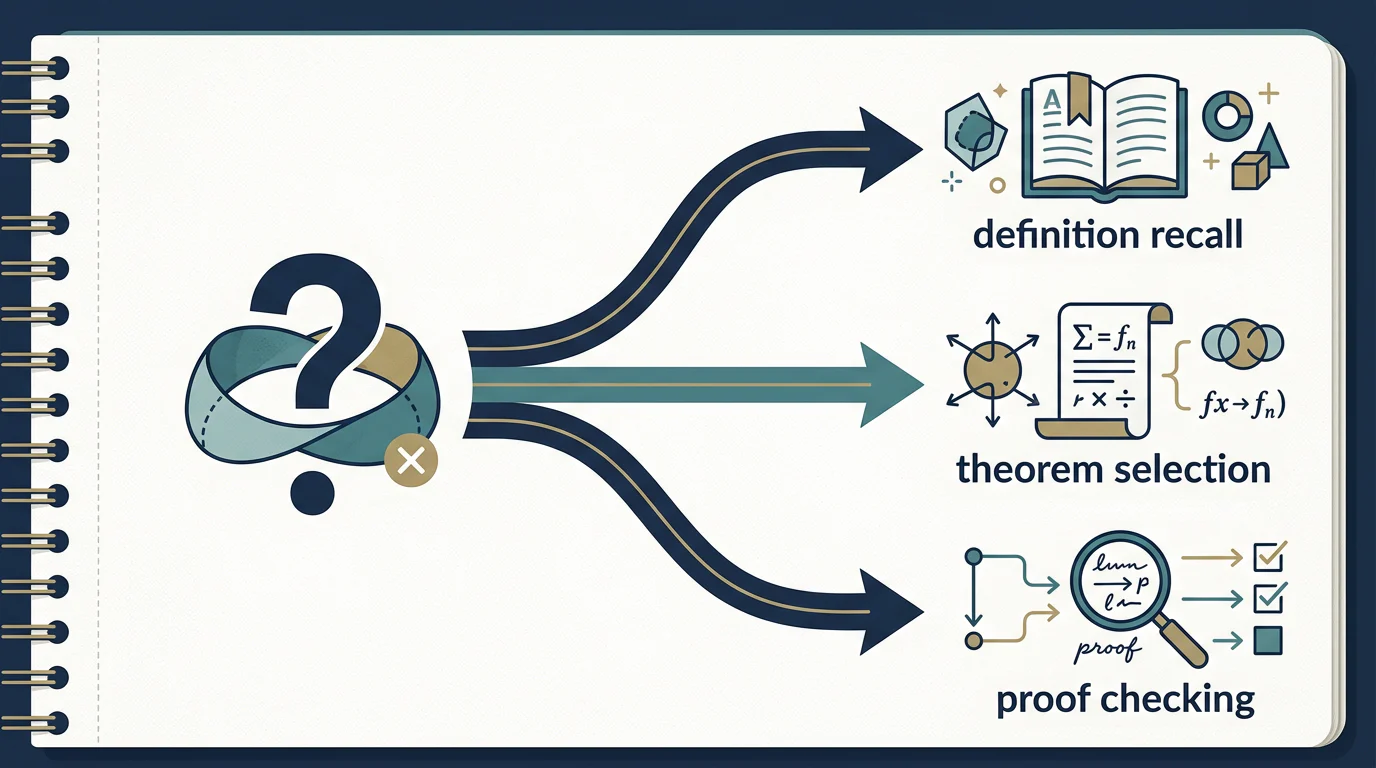
A missed question is useful only when you can name why it was missed. We divide errors into three classes: definition failure, strategy-selection failure, and execution failure. That distinction keeps you from rereading a chapter when the real problem is choosing a theorem, or doing fifty more questions when the real issue is one missing hypothesis.
For GATE Mathematics, the subject portion sits inside a 180-minute examination, so the goal is not to recreate a textbook proof from memory. It is to notice the right route quickly and make it rigorous under pressure, as the GATE exam pattern makes clear. Use the ten minutes below after each topology miss, then compare patterns across a full mock with our mock calibration.
| What You Can Do in 60 Seconds | Likely Gap | Smallest Repair Drill |
|---|---|---|
| State the definition, but cannot decide whether it applies | Definition failure | Write one example, one non-example, and one boundary case |
| Identify the topic, but do not know how to begin | Strategy-selection failure | Label unsolved stems by theorem or construction only |
| Choose a sound method, but the proof still fails | Execution failure | Rewrite the argument with every hypothesis and quantifier visible |
Mini-Diagnosis: Definition Failure
Suppose (Y=[0,1)) has the subspace topology from (\mathbb{R}), and a question asks whether ([0,\frac12)) is open in (Y). If you answer no because it is not open in (\mathbb{R}), the problem is definition control. The repair is to write ([0,\frac12)=Y\cap(-1,\frac12)), then make two more subspace examples yourself.
Mini-Diagnosis: Strategy-Selection Failure
Suppose (f:X\to Y) is continuous and (X) is connected. If you know both words but freeze, the wording should trigger the continuous-image theorem. You do not need to rebuild connectedness from first principles unless the question specifically asks for it. Your drill is ten stems where you name the first theorem without solving.
Mini-Diagnosis: Execution Failure
Suppose you try to prove that a continuous bijection is a homeomorphism. If you write that conclusion without checking compactness of the domain and Hausdorffness of the codomain, you chose a familiar route but skipped its conditions. Your repair is not more continuity questions. It is a hypothesis audit before the final line of every proof.
Do You Actually Understand the Definition?
Knowing a definition means more than being able to recite it after seeing its heading. We expect you to use it in three directions: recognise an example, reject a non-example, and explain the boundary case where an intuitive shortcut stops working.
Try this before you call a topic weak. Cover your notes and state the definition exactly. Then create an example that satisfies it, a near-miss that fails, and a condition that would make the near-miss work. If you cannot complete one of those moves, revise the definition. If you can complete all three but still miss questions, shift your attention to method selection.
For subspaces, products, quotient spaces, compactness, and connectedness, concise prompts are more useful than another long summary. Build your own definition cards alongside a foundation bridge, especially if topology was postponed while you prioritised differential equations or linear algebra.
What Should Each Topology Cue Trigger?
Question wording often tells you what to try first. The aim is not to reduce topology to a bag of tricks. It is to recognise the construction or property the examiner has placed in front of you, then verify that its hypotheses hold.
Use this table as a pre-solution drill. Read the cue, cover the final two columns, and say the first move aloud. The product-space rows matter because an infinite product uses basic open sets that restrict only finitely many coordinates, a distinction explained in the Cornell topology notes.
| Topic | Common Cue | First Trigger | Check Before You Commit |
|---|---|---|---|
| Bases | “Generated by,” “basis,” “neighbourhood” | Express the set as a union of basis elements | Verify the basis intersection condition |
| Subspaces | “Open in (A),” “(A\subseteq X)” | Write the set as (A\cap U) | Name the ambient space |
| Products | Coordinates, projections, infinite families | Use projections or basic product opens | Restrict only finitely many coordinates |
| Quotients | Glue, identify, equivalence classes | Pull the set back through the quotient map | Test openness through the preimage |
| Compactness | Cover, finite subcover, continuous map | Start from an open cover or use a continuous image | Check the setting before using sequences |
| Connectedness | Separation, clopen set, image | Rule out a separation or use a continuous image | Do not equate connected with path-connected |
| Separation Axioms | Distinct points, disjoint neighbourhoods | Write the exact separation axiom | Identify the requested level |
| Homeomorphisms | Topological equivalence, preserved property | Test continuity, inverse, or an invariant | Do not trust a visual resemblance |
A trigger map becomes valuable only when you retrieve it under uncertainty. Take ten old questions, hide the options or solution, and write one line: “This is a quotient-map question,” or “This asks for an open-cover argument.” Then solve only after you have classified the stem. Use reliable practice materials for the next layer, but keep the error label beside each attempt.
Which Proof Method Fits the Question?
A topology proof gets shorter when its method matches the structure already supplied. Open covers are the natural language of compactness in general spaces. Continuous images transfer properties. Counterexamples test converses and missing hypotheses. Contradiction is useful when assuming the opposite produces a forbidden cover, separation, or neighbourhood configuration.
Sequences are powerful, but only when the setting permits them. In metric spaces, compactness and sequential compactness are equivalent, as the Harvard topology notes explain. That does not make a sequence proof an automatic replacement for an open-cover proof in every topology question.
| If the Question Gives You | Start With | Typical Goal | Common Wrong Turn |
|---|---|---|---|
| An open cover | Open-cover argument | Find a finite subcover | Switching to sequences without justification |
| A continuous map | Continuous-image theorem | Transfer compactness or connectedness | Reproving the result from definitions |
| A claimed converse | Counterexample | Show one hypothesis matters | Searching only in familiar Euclidean spaces |
| A separation or clopen set | Contradiction or direct definition | Prove disconnectedness or connectedness | Treating a picture as proof |
| A bijective continuous map | Homeomorphism criterion | Establish continuous inverse indirectly | Forgetting compact or Hausdorff conditions |
When you finish a proof, pause before the conclusion and ask two questions: “Which hypothesis did I use?” and “Could the converse fail?” That habit protects you from the most expensive topology error, a polished argument that proves a statement different from the one asked. For timed work, pair this check with a speed-building guide, not with frantic rereading.

Which Topology Traps Keep Reappearing in Mocks?
Most recurring errors are not random. They are predictable shortcuts that work in a familiar setting and then fail when the topology, construction, or hypothesis changes. A checklist is useful because it catches the mistake before you spend more time on an invalid proof.
- Hidden hypotheses: Write every condition beside the theorem before using it.
- Invalid converses: Treat “if” and “only if” as separate claims until you prove both.
- Ambient versus subspace topology: Ask “open in which space?” before deciding whether a set is open.
- Unjustified intuition: Replace “it looks connected” or “it is clearly continuous” with the relevant definition or theorem.
- Sequence overreach: Check whether the problem states a metric-space or otherwise suitable setting.
- Product confusion: In infinite products, do not quietly use box-topology reasoning.
- Homeomorphism shortcuts: A continuous bijection alone is not automatically enough.
Do not merely tick the item that went wrong. Add it to your error log in the language of the question. For example, record “used closed and bounded without a valid setting,” not “compactness mistake.” After two or three mocks, that phrasing reveals whether you need a concept review or a proof-control drill. Compare your set quality with a test-series realism guide, but keep your diagnosis tied to your own written work.
How Do You Run a Seven-Step Mock Post-Mortem?
A post-mortem should take less emotional energy than a fresh attempt. Its purpose is not to relive the mock. Its purpose is to convert one missed question into a retrievable cue, a corrected argument, and a scheduled reattempt.
Record the Miss Before Reading a Solution
- Record the topic and the exact wording cue.
- Label the failure as definition, strategy-selection, or execution.
- Write the method you attempted.
- Name the missing trigger or skipped hypothesis.
- Write the corrected argument in three to six lines.
- Create one adjacent example, non-example, or counterexample.
- Set a delayed reattempt date and place the question in a mixed timed set.
Keep the first draft of your own reasoning visible. If you read the solution first, you lose the evidence that tells you whether the gap was recognition, method, or proof control.
Run the Repair Loop
Start with classification drills: take unsolved questions and identify only the definition or theorem cue. Next, solve a small representative set of the same failure type. Reattempt after a delay, then mix topology with differential equations and other weak topics under time limits. Research on retrieval supports this approach because an unsuccessful attempt followed by corrective information can strengthen later learning, as the 2009 retrieval study found.
Past questions belong at the final stage, when you can explain the trigger you used and the condition that made it valid. Use a previous-year-paper guide to keep that practice diagnostic rather than repetitive.
Decide Whether Feedback Is Needed
Independent practice is enough when you can classify eight of ten fresh stems, state the relevant definition without notes, and correct the same mistake on a delayed reattempt. Seek feedback when the same misconception survives two repair cycles, when a proof repeatedly loses an unstated condition, or when you cannot explain why your own counterexample works.
When Should You Use SBTech Math for Feedback?
At SBTech Math, we built our preparation approach for students who need to turn a vague weak area into next-session work. We help you separate recall problems from method-selection and proof-control problems, then choose problems that test the missing move rather than repeat a familiar one. That matters when topology sits beside differential equations, algebra, and analysis in an already crowded plan. Our feedback can focus on the first broken line of a proof, the hypothesis you skipped, or the cue you failed to notice, so revision remains specific. If you are already classifying errors accurately and correcting them on delayed attempts, independent work may be enough. If the same gap repeats after two honest repair cycles, a second set of eyes can save weeks of random practice without letting frustration choose the task for you. Build your next repair loop with SBTech Math.
FAQs on Topology Mock-test Diagnosis
Why Do I Keep Getting Topology Questions Wrong?
You likely recognise the definition but do not map the wording to a usable theorem, construction, or hypothesis check. Classify the miss before practising more.
Is It a Conceptual Gap or a Practice Gap in Topology?
It is conceptual when you cannot state a definition, produce examples, or identify boundary cases. It is a practice gap when selection is too slow.
How Do I Improve Topology Problem Solving?
Classify unsolved stems before solving, practise one proof method at a time, reattempt after a delay, then use mixed timed sets to test method selection.