
Glossary
Sylow Theorems
Sylow theorems: for each prime p, a finite group has subgroups of the largest p-power order dividing it; their number divides the remaining factor and leaves remainder 1 on division by p.

By Sunil Bansal, Founder · Updated 27 Oct 2026
On this page
- 01Definition
- 02Quick facts
- 03What do the Sylow theorems say about a finite group?
- 04Same order, different counts
- 05How do you find the possible number of Sylow subgroups, n_p?
- 06How often does the n_p table alone settle a group order?
- 07Possible n_p for common exam orders
- 08What do you do when the table leaves several values?
- 09Which Sylow mistakes cost marks?
- 10Which related terms get confused with Sylow subgroups?
- 11Do the GATE, CSIR-NET and CUET PG syllabi include the Sylow theorems?
- 12How SBTech Math handles it
- 13Example
- 14Related terms
- 15Frequently asked
What are the Sylow theorems?
The Sylow theorems are results in finite group theory that guarantee, for each prime dividing a group's order, subgroups of the largest prime-power order, and restrict how many there are.
Key takeaways
- A Sylow p-subgroup always exists, all of them are conjugate, and their number n_p divides |G|/pᵏ and is congruent to 1 mod p.
- The n_p table lists possible values, not the actual one; when only n_p = 1 survives, that subgroup is normal.
- For 117 of the 139 non-prime-power orders from 2 to 200 (84%), the table alone forces a normal Sylow subgroup.
- Twelve more orders fall to a coset-action test, and ten need a case-specific argument such as element counting.
Quick facts
- Applies to
- Finite groups, for each prime dividing the group order
- Order of a Sylow p-subgroup
- pᵏ, the highest power of p dividing |G|
- Counting condition
- n_p divides |G|/pᵏ and n_p ≡ 1 (mod p)
- Syllabus
- Named in the GATE 2027 Mathematics and CSIR-UGC NET Mathematical Sciences syllabi, as of October 2026
Lagrange's theorem tells you which subgroup orders are impossible. It never tells you which ones exist, and the group A₄ (the even permutations of four objects, order 12) has no subgroup of order 6, even though 6 divides 12. Sylow's theorems give a partial converse for prime powers, using arithmetic on a single number: the order of the group.
The standard uses are counting how many subgroups of a given order a group can have, and deciding whether a group of a given order can be simple. Both start from a short table of possible values, and both go wrong in the same few places. For order 15, for instance, the table forces both the subgroup of order 3 and the subgroup of order 5 to be unique.
What do the Sylow theorems say about a finite group?
A Sylow p-subgroup of a finite group G is a subgroup whose order is the highest power of the prime p dividing |G|. Write |G| = pᵏ·m with p not dividing m. Then Sylow p-subgroups have order pᵏ: in a group of order 12, that is order 4 for p = 2 and order 3 for p = 3 (Conrad).
Here n_p is the number of Sylow p-subgroups of G. Two subgroups P and Q are conjugate when Q = gPg⁻¹ for some g in G, and a subgroup is normal when it equals all its conjugates. The statement n_p ≡ 1 (mod p) means n_p leaves remainder 1 on division by p.
- Sylow I (existence): a Sylow p-subgroup exists for every prime p, and every subgroup of p-power order lies inside one.
- Sylow II (conjugacy): any two Sylow p-subgroups are conjugate.
- Sylow III (counting): n_p divides m and n_p ≡ 1 (mod p).
- Sylow III*: n_p equals the index of the normaliser N(P), the set of g with gPg⁻¹ = P.
Same order, different counts
A normal subgroup is its own only conjugate, so by Sylow II a Sylow p-subgroup is normal exactly when n_p = 1.
A₄ has one subgroup of order 4 and four of order 3, while the dihedral group of order 12 has three of order 4 and one of order 3 (Conrad). The theorems restrict the counts. They do not decide them.
How do you find the possible number of Sylow subgroups, n_p?
List the divisors of m = |G|/pᵏ and keep those that leave remainder 1 when divided by p. What survives are the possible values of n_p.
Finding possible n_p, step by step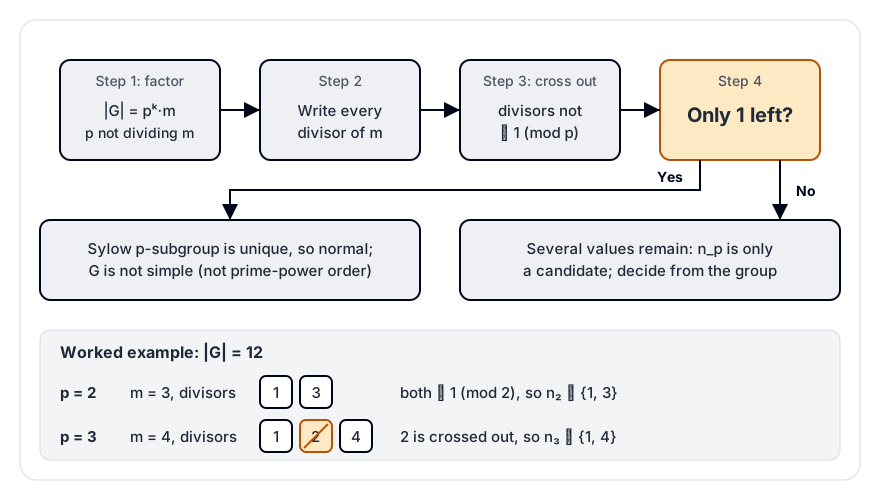
- Factor |G| = pᵏ·m with p not dividing m.
- Write every divisor of m.
- Cross out each divisor that is not ≡ 1 (mod p).
- If only 1 remains, the Sylow p-subgroup is unique, hence normal, and G (with order not a prime power) is not simple. A simple group has no normal subgroups except the trivial one and itself.
For |G| = 12 with p = 2: m = 3, divisors 1 and 3, both odd, so n₂ ∈ {1, 3}. With p = 3: m = 4, divisors 1, 2, 4, and 2 fails, so n₃ ∈ {1, 4}.
How often does the n_p table alone settle a group order?
For 117 of the 139 orders from 2 to 200 that are not prime powers (84%), the table forces a normal Sylow subgroup. This count, run in October 2026, covers every order n from 2 to 200 that is not a prime power (for a prime power the Sylow subgroup would be the whole group, as Wikipedia notes).
The computation uses the Sylow III conditions (n_p divides m, n_p ≡ 1 mod p) to build the allowed n_p list for each prime dividing n, then two tests:
- Level 1: some prime allows only n_p = 1.
- Level 2: a simple non-abelian group of order n with n_p > 1 needs n to divide n_p!/2. If, for some prime, no allowed n_p > 1 passes, the order is excluded as non-simple. This refines the coset-action argument in Math3ma.
Orders excluded at Level 2 up to 200: 12, 24, 36, 48, 72, 80, 96, 108, 112, 150, 160 and 192. The survivors resist both tests and need a case-specific argument.
- Range
- 2 to 100
- Non-prime-power orders
- 64
- Level 1
- 53 (83%)
- Level 2
- 7
- Survivors
- 30, 56, 60, 90
- Range
- 2 to 200
- Non-prime-power orders
- 139
- Level 1
- 117 (84%)
- Level 2
- 12
- Survivors
- 30, 56, 60, 90, 105, 120, 132, 144, 168, 180
Possible n_p for common exam orders
The counts say which orders can be finished by table. They say nothing about which groups exist. The table below shows common exam orders.
- Order
- 15
- Possible n_p
- n₃ = 1, n₅ = 1
- Normal Sylow subgroup forced by the table
- Sylow 3-subgroup and Sylow 5-subgroup
- Order
- 20
- Possible n_p
- n₂ ∈ {1, 5}, n₅ = 1
- Normal Sylow subgroup forced by the table
- Sylow 5-subgroup (n₅ = 1)
- Order
- 21
- Possible n_p
- n₃ ∈ {1, 7}, n₇ = 1
- Normal Sylow subgroup forced by the table
- Sylow 7-subgroup (n₇ = 1)
- Order
- 42
- Possible n_p
- n₂ ∈ {1, 3, 7, 21}, n₃ ∈ {1, 7}, n₇ = 1
- Normal Sylow subgroup forced by the table
- Sylow 7-subgroup (n₇ = 1)
- Order
- 12
- Possible n_p
- n₂ ∈ {1, 3}, n₃ ∈ {1, 4}
- Normal Sylow subgroup forced by the table
- None; both primes leave two candidates
- Order
- 30
- Possible n_p
- n₂ ∈ {1, 3, 5, 15}, n₃ ∈ {1, 10}, n₅ ∈ {1, 6}
- Normal Sylow subgroup forced by the table
- None; all three primes leave several candidates
- Order
- 56
- Possible n_p
- n₂ ∈ {1, 7}, n₇ ∈ {1, 8}
- Normal Sylow subgroup forced by the table
- None; both primes leave two candidates
What do you do when the table leaves several values?
Use a second argument: count elements, let the group act on its Sylow subgroups, or compare the intersection of two Sylow subgroups.
- Situation
- Sylow subgroups of prime order
- Move
- Distinct subgroups of prime order p meet only in the identity, so n_p of them hold n_p(p − 1) elements of order p (Conrad). Order 30: n₃ = 10 and n₅ = 6 together would need 20 + 24 = 44 elements of prime order, more than 30. So n₃ or n₅ is 1.
- Situation
- n_p small against |G|
- Move
- Let G act on the Sylow subgroups. Order 36: a Sylow 3-subgroup has index 4 and 36 > 24 = |S₄|, so the kernel is non-trivial (Math3ma).
- Situation
- Two Sylow subgroups overlapping heavily
- Move
- Show the intersection is normal. Order 108: two Sylow 3-subgroups meet in order 9 (Math3ma).
Which Sylow mistakes cost marks?
The costliest is forcing the maximum counts. For order 42, taking n₂ = 21 and n₃ = 7 gives 6 + 21 + 14 + 1 = 42 elements, so it seems both are forced. That is false: Z/42 has n₂ = n₃ = 1 and Aff(Z/7) has n₂ = n₃ = 7, because some elements have other orders (Conrad). Use element counts only to rule combinations out when they exceed |G|.
- Reading the table as the answer. The table gives candidates only; decide the actual n_p from the specific group.
- Conjugate subgroups versus conjugate elements. In A₄, ⟨(123)⟩ and ⟨(124)⟩ are conjugate, but (123) and (124) are not; conjugate (123) to (142) instead (Conrad).
- Over-extending Sylow II. In a group of order 100, the subgroups of order 4 and of order 25 are conjugate; those of order 2 or 5 need not be (Conrad).
Do the GATE, CSIR-NET and CUET PG syllabi include the Sylow theorems?
The GATE and CSIR-NET syllabi name them; the Common University Entrance Test for Postgraduate admissions (CUET PG) syllabus does not. The GATE 2027 Mathematics syllabus lists "Sylow's theorems and their applications" in Section 6, Algebra (Indian Institute of Technology Madras).
The CSIR-UGC NET Mathematical Sciences syllabus on the Council of Scientific and Industrial Research Human Resource Development Group (CSIR HRDG) site lists "Sylow theorems" in its algebra topics, as of October 2026 (CSIR HRDG).
The CUET PG Mathematics (SCQP19) syllabus does not name Sylow theorems; its group theory stops at Lagrange's theorem, homomorphisms and quotient groups (National Testing Agency, NTA).
How SBTech Math handles it
Vivek Sir teaches Abstract Algebra within SBTech Math's CSIR-NET and GATE Mathematics course. SB Sir designs the test series and Core Concept Diagnostic, and the 2027 CSIR-NET and GATE Mathematics course includes continuous doubt support and weekly doubt sessions or personal mentoring.
The abstract algebra course guide sets out what each exam needs, and the CSIR-NET algebra weakness diagnostic helps find weak topics. Start with the free demo classes and PDF Drive resources. To ask which modules cover group theory, use the contact form, call +91 81265 45455 or email sbtechmath@gmail.com, 9am to 7pm Monday to Saturday.
Example
Take a group of order 21 = 3·7. For p = 7, m = 3, whose divisors are 1 and 3; 3 leaves remainder 3 on division by 7, so n₇ = 1. The Sylow 7-subgroup is therefore normal, and the group is not simple. For p = 3 the table leaves n₃ ∈ {1, 7}.
Frequently asked
Not on their own. They give a list of possible values for n_p. To choose one you need extra information, such as an explicit group, an element count, or a second argument. For order 12 the list for n₃ is {1, 4}, yet n₃ = 1 in the cyclic group of order 12 (Conrad).
Sources
- 1.The Sylow Theorems, Keith Conrad, University of Connecticut
- 2.Consequences of the Sylow Theorems, Keith Conrad, University of Connecticut
- 3.Sylow theorems, Wikipedia
- 4.4 Ways to Show a Group is Not Simple, Math3ma
- 5.GATE 2027 Mathematics (MA) syllabus, IIT Madras
- 6.CSIR-UGC NET Mathematical Sciences syllabus, CSIR HRDG
- 7.CUET PG Mathematics (SCQP19) syllabus, National Testing Agency