
TL;DR
We translate the CSIR NET Mathematical Sciences syllabus into a preparation map: the Part A, B, and C rules, four official units, dependency order, and five-state completion check. We also show how to balance sections and decide whether self-study, focused help, testing, or comprehensive instruction fits the gap.
The CSIR-UGC NET Mathematical Sciences paper carries 200 total marks, so vague syllabus coverage is not enough to guide serious preparation.
The CSIR NET Mathematical Sciences syllabus tells you what can be tested in Parts B and C, but it does not turn those topics into a study plan. We translate it into one: build Part A aptitude maintenance, Part B subject recall, and Part C analytical application around every official topic, then prove progress with practice, timed testing, and revision.
Below, we map the paper structure, four units, prerequisite order, completion standard, time balance, and the right level of preparation support.
How Do Parts a, B, and C Turn the Syllabus into a 200-Mark Paper?
The paper is one exam, but its three sections demand different kinds of readiness. Part A rewards accurate general aptitude work, Part B checks whether you can retrieve and use core mathematical knowledge, and Part C asks you to apply that knowledge precisely when more than one option may be correct.
| Part | What It Tests | Questions Shown | Maximum Attempts | Marks Per Correct Answer | Wrong-Answer Rule | Maximum Marks |
|---|---|---|---|---|---|---|
| Part A | General Science, Quantitative Reasoning and Analysis, Research Aptitude | 20 | 15 | 2 | Minus 0.5 | 30 |
| Part B | Subject-related conventional MCQs | 40 | 25 | 3 | Minus 0.75 | 75 |
| Part C | Analytical mathematical application, with multiple correct options | 60 | 20 | 4.75 | No negative marking, but all correct options are required and there is no partial credit | 95 |
Part A and Part B both penalise inaccurate guessing. Part C does not deduct marks for an incorrect response, but it does require an exact set of correct options. That changes the work: Part C practice should include checking every option, not just finding one plausible answer.
Our exam strategy approach starts by separating these tasks. A student who knows the syllabus but has not practised selection, accuracy, and option verification has not yet prepared for the paper as it is scored.
Which Official Units Make up the CSIR NET Mathematical Sciences Syllabus?
The official syllabus groups Part B and Part C content into four units. We use the subject clusters below to make that official scope easier to plan, not to create unofficial topic weightages.
| Official Unit | Recognisable Subject Clusters | Representative Official Scope | Preparation Output |
|---|---|---|---|
| Unit I | Analysis and Linear Algebra | Real analysis, metric spaces, Lebesgue theory, vector spaces, matrices, eigenvalues, canonical forms, quadratic forms | Definitions, theorem use, proof-aware problem solving |
| Unit II | Complex Analysis, Algebra, and Topology | Analytic functions, residues, conformal maps, groups, rings, fields, Galois theory, compactness, connectedness | Structural reasoning, calculations, counterexamples |
| Unit III | Differential Equations and Applied Mathematics | ODEs, PDEs, numerical analysis, calculus of variations, integral equations, classical mechanics | Method selection and multi-step applications |
| Unit IV | Probability, Statistics, and Operations Research | Probability, stochastic processes, inference, regression, sampling, design, reliability, linear programming, queueing | Modelling, distributional reasoning, statistical methods |
What Belongs in Unit I?
Unit I combines foundational analysis with linear algebra. Sequences, continuity, integration, metric spaces, linear transformations, eigenvalues, and inner-product spaces are not isolated chapters. They supply language and tools that recur elsewhere in the syllabus.
What Belongs in Unit II?
Unit II brings together complex analysis, abstract algebra, and topology. It ranges from contour integration and residues to groups, rings, fields, and topological properties such as compactness and connectedness. It rewards careful definitions as much as computational fluency.
What Belongs in Unit III?
Unit III is the methods-heavy area: ordinary and partial differential equations, numerical methods, variational methods, integral equations, and classical mechanics. Students need to recognise which method fits a problem, then carry it through accurately.
What Belongs in Unit IV?
Unit IV covers probability and statistics in depth, then extends into sampling, experimental design, reliability, linear programming, and queueing. The official document expects all students to answer Unit I questions, mathematics students to answer additional Unit II and III questions, and statistics students to answer additional Unit IV questions.
Use free study content to fill a clearly identified gap, but keep the official document as the final authority on scope. Historical question-frequency analysis can help prioritise practice, yet it cannot become official weightage or a reason to delete listed topics from your plan.
CSIR-HRDG also issued a consultation notice on a proposed revised syllabus in April 2026. Before the exam, check the current bulletin and official pages rather than relying on an old checklist.
What Should Students Study First, and Which Units Depend on It?
A syllabus is not a flat to-do list. Starting with dependent topics before their foundations often creates the familiar pattern of recognising a method in class but being unable to use it under test conditions.
| Build First | What It Strengthens Later | Why The Dependency Matters |
|---|---|---|
| Limits, continuity, sequences, and integration | Metric spaces, uniform convergence, measure and integration | These ideas build the language of rigorous analysis |
| Linear algebra | ODE systems, numerical linear systems, quadratic forms, mechanics | Matrices and transformations become working tools |
| Calculus and linear ODEs | PDEs, variational methods, numerical ODEs | Solution methods become easier to interpret |
| Analysis and metric-space ideas | Normed-space and functional-analysis work | Abstract definitions need concrete analytical intuition |
| Probability basics | Stochastic processes, inference, sampling | Unit IV concepts accumulate rather than reset |
We recommend studying analysis before more abstract functional-analysis work, and calculus before differential equations, because the later material repeatedly assumes the earlier tools. This is a learning order, not a claim about official topic importance.
A strong preparation guide lets you move forward once you can use the prerequisite in standard questions. Waiting for perfect mastery can delay practice, but skipping the foundation makes advanced practice inefficient.
When Is a Syllabus Topic Actually Complete?
Watching a lecture or reading a chapter is the first state of learning, not the finish line. We use a five-state syllabus checklist because it makes progress visible and prevents a completed resource from being mistaken for exam readiness.
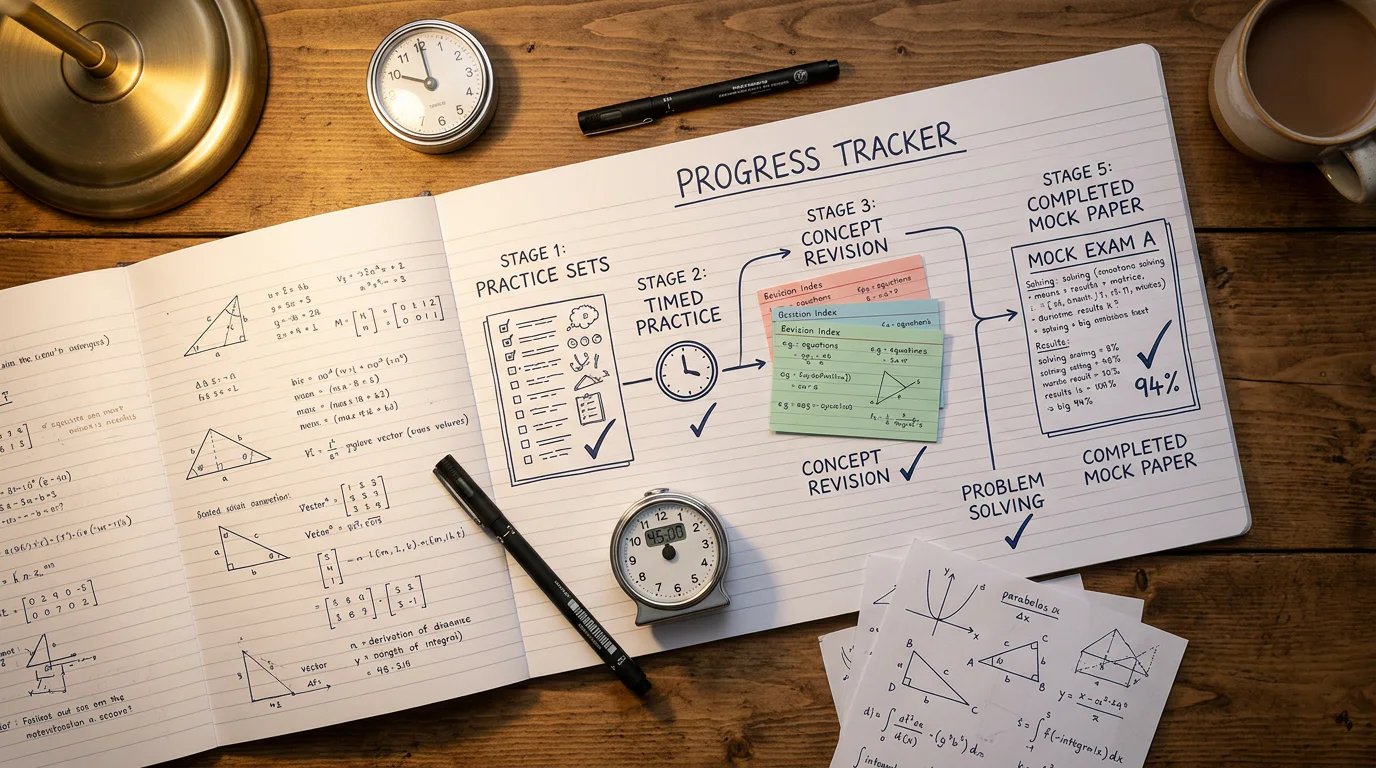
| State | Minimum Evidence | Next Action |
|---|---|---|
| Learned | You can explain the definition, result, or method without copying notes | Solve standard problems |
| Practiced | You can solve familiar problems untimed without notes | Mix the topic with adjacent topics |
| Tested | You have attempted timed PYQs or mock questions and logged mistakes | Identify the knowledge, method, or selection gap |
| Revised | You have revisited notes and representative errors after a delay | Re-test under time |
| Exam-Ready | You can select, solve, and verify suitable questions under section rules | Maintain with spaced mixed practice |
The important distinction is between knowing a result and choosing it in a problem. For example, a student may remember a theorem from analysis but still need Part B recall practice, Part C application practice, and timed selection work before calling that topic ready.
Our mock analysis framework should classify each miss before prescribing a fix. A forgotten definition, an incorrect method, an unspotted condition, and a poor attempt decision are different problems.
How Should Students Balance Part a with Part B Knowledge and Part C Application?
Part A is worth 30 marks, Part B 75 marks, and Part C 95 marks. That does not justify abandoning aptitude work, but it does mean Part A should be maintained efficiently while most subject-study time builds durable knowledge and higher-order application.
The official December 2025 result notice states that there is no separate cut-off for Parts A, B, and C. For Mathematical Sciences, the UR cut-offs were 42.000% for JRF and 37.800% for Assistant Professor eligibility, so cumulative performance matters more than treating any one section as optional.
-
Part A maintenance: Keep regular short aptitude sessions focused on accuracy, speed, and avoiding negative marks.
-
Part B knowledge: Build recall through definitions, theorems, standard methods, and mixed conventional MCQs.
-
Part C application: Reserve time for multi-step questions, option checking, and recognising when a theorem or method applies.
-
Review discipline: Record why a wrong answer happened before adding more material to your schedule.
Use a Part C allocation guide when your plan swings too far toward broad topic collection or too far toward difficult applications without enough syllabus coverage.
What Does a Syllabus-Gap Diagnosis Say About Self-Study Versus Structured Support?
The right support level depends on the type of gap, not on how many resources you already own. Structured help becomes worth paying for when it supplies a missing capability that you cannot reliably create alone, such as sequencing, feedback, error diagnosis, or accountability.
| Diagnostic Outcome | Evidence Pattern | Best Next Step | When Structured Help Is More Justified |
|---|---|---|---|
| Self-Study | Isolated gaps, consistent review, and clear self-correction | Keep one resource stack and an error log | Progress is already measurable independently |
| Topic Support | One or two recurring prerequisite or method bottlenecks | Get focused teaching or doubt support | Deliberate practice has not cleared the bottleneck |
| Test Series | Broad coverage is present but timing, selection, or Part C accuracy fails | Use timed papers with detailed review | Feedback changes specific exam decisions |
| Comprehensive Instruction | Multiple foundation gaps, weak sequencing, and no effective review loop | Follow structured teaching, practice, and assessment | Self-study has repeatedly stalled across several units |
For someone who has self-studied for a year and scores around 40 to 45 raw marks, the first step is a full timed diagnostic using the actual attempt limits. A low total alone does not identify the remedy. If the error log shows several unfinished foundations and no stable study sequence, comprehensive instruction may fit. If it shows one recurring Unit I or Unit II bottleneck, focused support is usually the better decision.
Take our support diagnostic before paying for more structure. The useful question is not whether support sounds reassuring. It is whether it will fix a named, repeatable problem that your current process has failed to solve.
Build Your Map with SBTech Math
At SBTech Math, we build preparation around evidence, not the illusion that a completed playlist equals exam readiness. Our useful role begins after you can name the gap: a missing prerequisite, an application problem, an inaccurate Part A habit, or a mock-review process that produces no change. We help students turn the official syllabus into a visible working system, with topic sequencing, practice milestones, previous-year-question review, and decisions that match the rules of the paper. If you need a focused resource stack, start by checking what you can already diagnose alone. If you need structure, use it to create better feedback and stronger follow-through, rather than simply collecting more material. Our aim is straightforward: help you see what to study next, why it matters, and how to prove that the topic is ready. Explore the preparation map at SBTech Math
FAQs on CSIR NET Mathematical Sciences Syllabus
What Are Parts a, B, and C?
Part A assesses general aptitude, Part B tests conventional subject knowledge, and Part C tests analytical application with multiple correct options. Each needs a different practice routine.
How Many Questions Can Students Attempt?
Candidates may attempt 15 of 20 Part A questions, 25 of 40 Part B questions, and 20 of 60 Part C questions, for 60 attempts total.
Does the Official Syllabus Give Topic-Wise Weightage?
The official document defines scope, not topic-wise weightage. Historical paper analysis may guide practice, but it cannot establish future distribution or make any listed topic safely optional.
What Does Exam-Ready Mean on a Syllabus Checklist?
A topic is exam-ready when you can recall it, solve standard and application questions, review mistakes, and make sound attempt decisions under timed section rules.
How Should Students Choose Preparation Support?
Choose self-study for isolated gaps, topic help for recurring bottlenecks, a test series for execution gaps, and comprehensive instruction for broad, persistent foundation and feedback problems.