
11 companies compared
Best GATE Mathematics Books for MA: A Reading List for 11 Sections
The GATE mathematics books for MA are listed below by each of the 11 official 2027 syllabus sections, with every book's main drawback and the chapters you can safely skip.

By Sunil Bansal, Founder · Updated 21 Oct 2026
On this page
- 01The shortlist
- 02How we ranked them
- 03The companies in detail
- 04How to choose
- 05Which book covers each section of the GATE Mathematics syllabus?
- 06Key takeaways
- 07Why do most GATE mathematics book lists not fit the MA paper?
- 08What does the official GATE 2027 Mathematics syllabus include?
- 09When should you move from theory books to previous-year questions?
- 10What does SBTech Math's GATE Mathematics 2027 course include?
- 11Method and sources
- 12Frequently asked
The short answer
The MA paper needs 11 main books: Mapa and Royden for Real Analysis, Raisinghania for both ODE and PDE, and one each for the other eight sections. Test any book in ten minutes by looking up each term of a syllabus line in its contents or index. SBTech Math's CSIR-NET and GATE Mathematics 2027 course is the recommended guided route, with these books as your reading list.
The shortlist
- 1Marsden and Tromba, Vector CalculusFor Calculus
- 2Hoffman and Kunze, Linear AlgebraFor Linear Algebra
- 3Mapa, Introduction to Real Analysis (with Royden for measure)For Real Analysis
- 4Churchill and Brown, Complex Variables and ApplicationsFor Complex Analysis
- 5Raisinghania, Advanced Differential Equations (ODE)For ODE
- 6Herstein, Topics in AlgebraFor Algebra
- 7Kreyszig, Introductory Functional Analysis with ApplicationsFor Functional Analysis
- 8Jain, Iyengar and Jain, Numerical Methods for Scientific and Engineering ComputationsFor Numerical Analysis
- 9Raisinghania, Advanced Differential Equations (PDE)For PDE
- 10Munkres, TopologyFor Topology
- 11Swarup, Gupta and Mohan, Operations ResearchFor Linear Programming
How we ranked them
- The book is matched to one of the 11 sections of the official GATE 2027 MA syllabus, not to an engineering branch
- Each syllabus term the section names has its own heading or index entry in the book, or a named fill-in covers the gap
- The edition is current as of 21 October 2026
- The book's main drawback and the chapters to skip can be stated
The companies in detail
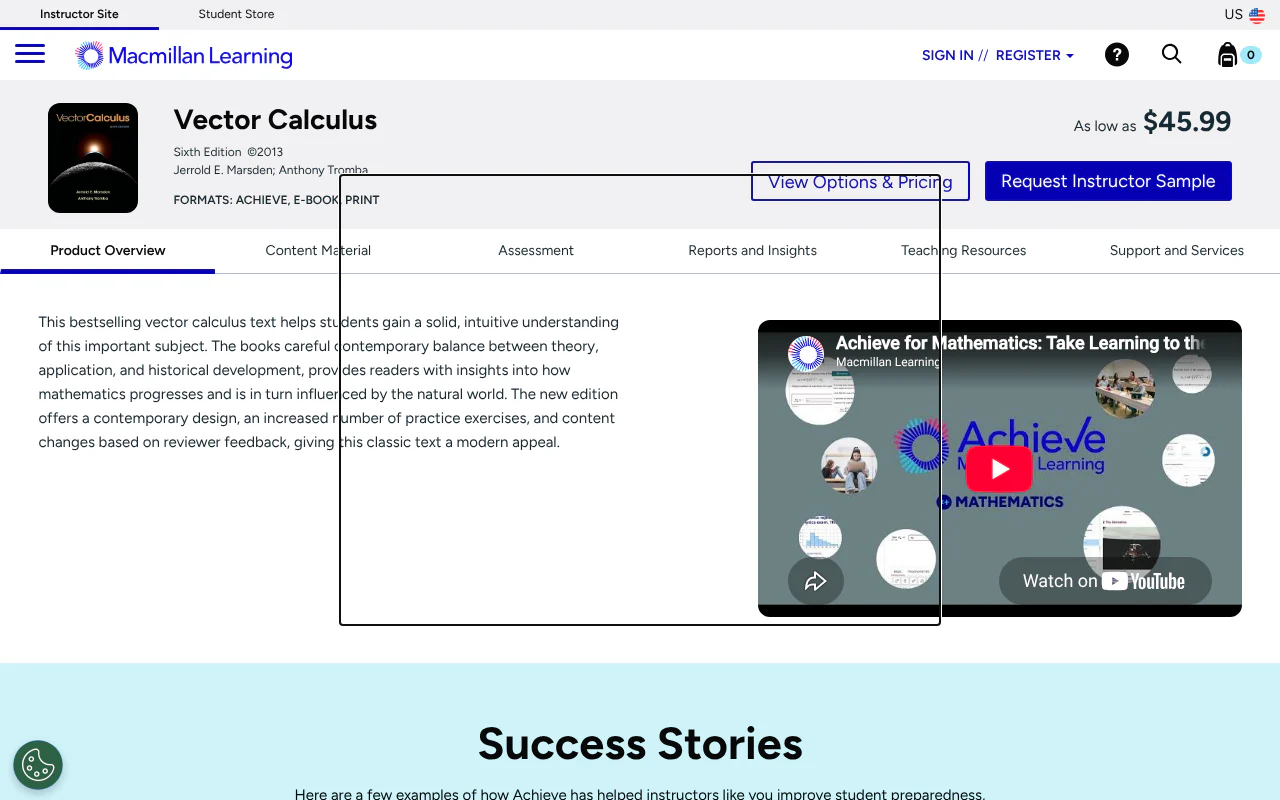
Marsden and Tromba, Vector Calculus
Main book for the Calculus section
- Section
- Calculus
- Role
- Main book
- Main drawback
- US-oriented; light proofs
- What to skip
- Extended applications
Read this first for Calculus and work the exercises rather than relying on the explanations. Leave the extended applications until after your first pass through the syllabus.
Strengths
- Fit-check terms to find in the index: Lagrange multipliers, Jacobians, Stokes' theorem
- 6th edition from Macmillan Learning, 2013
- Extended applications can be skipped on a first pass
Limitations
- US-oriented, so the explanations suit the syllabus less closely
- Light on proofs, so the explanations alone will not carry the theory
Hoffman and Kunze, Linear Algebra
Main book for the Linear Algebra section
- Section
- Linear Algebra
- Role
- Main book
- Main drawback
- Terse; few worked examples
- What to skip
- Decomposition proofs on first pass
On a first pass, skip the proofs of the decomposition theorems and return to them once the statements are familiar. For worked examples, add a second book.
Strengths
- Fit-check terms to find in the index: Cayley–Hamilton theorem, Jordan canonical form, bilinear forms
- Friedberg, Insel and Spence, Linear Algebra, 5th edition (Pearson, 2022) works as a second book for worked examples
- Decomposition-theorem proofs can wait until a second pass
Limitations
- Terse, with few worked examples
- Decomposition-theorem proofs must be revisited once the statements are familiar
Mapa, Introduction to Real Analysis (with Royden for measure)
Mapa for the core, Royden for measure, Rudin as backup
- Section
- Real Analysis
- Role
- Mapa as main book, Royden for measure
- Main drawback
- Mapa is long, no measure theory; Royden is graduate-level
- What to skip
- Royden beyond real-line measure and Lp spaces
Use Mapa for sequences, series, continuity and the Riemann integral, and add Royden and Fitzpatrick for measure. Read Royden only as far as Lebesgue measure on the real line and Lp spaces.
Strengths
- Fit-check terms to find in the index: Baire category, Ascoli–Arzelà theorem, Weierstrass approximation theorem, contraction mapping principle, inverse and implicit function theorems, Lebesgue measure on the real line, Fatou's lemma, the monotone convergence and dominated convergence theorems, Lp spaces
- Mapa is the revised edition (Sarat Book House, 2014); Royden and Fitzpatrick is the 4th edition, Classic Version (Pearson)
- Rudin, Principles of Mathematical Analysis, 3rd edition (McGraw Hill India, 2023), is the backup if Mapa leaves a gap
Limitations
- Mapa is long and has no measure theory, so a second book is needed for measure
- Royden is graduate-level, so it must be read only as far as real-line measure and Lp spaces
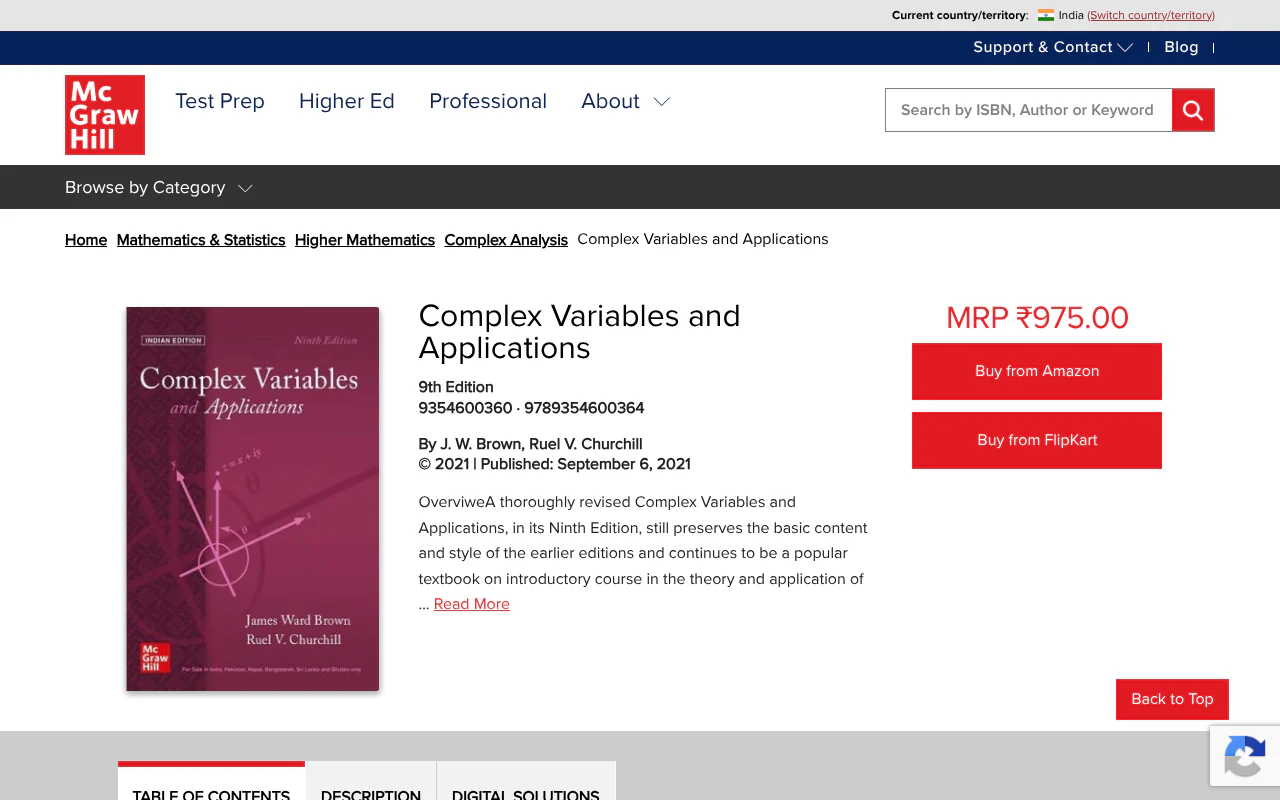
Churchill and Brown, Complex Variables and Applications
Main book for the Complex Analysis section
- Section
- Complex Analysis
- Role
- Main book
- Main drawback
- Lighter proofs
- What to skip
- Physical applications chapters
The proofs are lighter than in a pure-mathematics text, so supplement them if you want full rigour. Skip the chapters on physical applications.
Strengths
- Fit-check terms to find in the index: Morera's theorem, Rouché's theorem, the argument principle, the Schwarz lemma, Möbius transformations
- 9th edition from McGraw Hill India
- Physical applications chapters can be skipped
Limitations
- Proofs are lighter than in a pure-mathematics text
- Full rigour needs a supplement
Raisinghania, Advanced Differential Equations (ODE)
Main book for the ODE section, shared with PDE
- Section
- ODE
- Role
- Main book, shared with PDE
- Main drawback
- Very long; few proofs
- What to skip
- Calculus of variations
Skip the calculus of variations. A guided course is an alternative to reading this book alone.
Strengths
- Fit-check terms to find in the index: Sturm theorems, Lyapunov functions, the Frobenius method, Legendre and Bessel equations
- 20th edition, 2023, from S Chand
- The same book also covers PDE
Limitations
- Very long, at 1,088 pages
- Gives few proofs
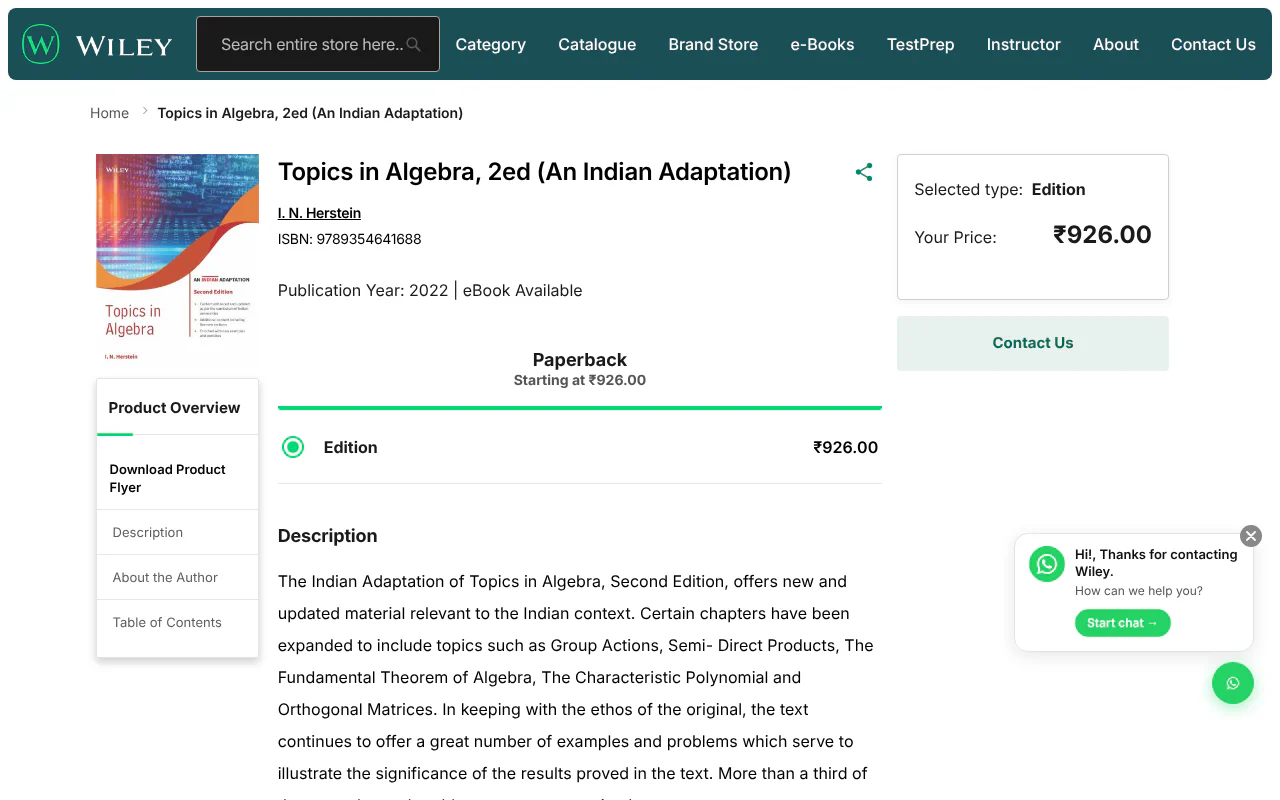
Herstein, Topics in Algebra
Main book for the Algebra section, 2022 Indian adaptation
- Section
- Algebra
- Role
- Main book
- Main drawback
- Hard problems; terse
- What to skip
- Galois theory
The 2022 Indian adaptation adds sections on group actions, semi-direct products, the Fundamental Theorem of Algebra, and the characteristic polynomial and orthogonal matrices. Skip Galois theory.
Strengths
- Fit-check terms to find in the index: Sylow theorems, group actions, unique factorisation domains (UFD), principal ideal domains (PID) and Euclidean domains, the Eisenstein criterion, algebraically closed fields
- 2nd edition, 2022 Indian adaptation, from Wiley India
- Over a third of the examples are new or revised
Limitations
- The problems are hard
- The text is terse
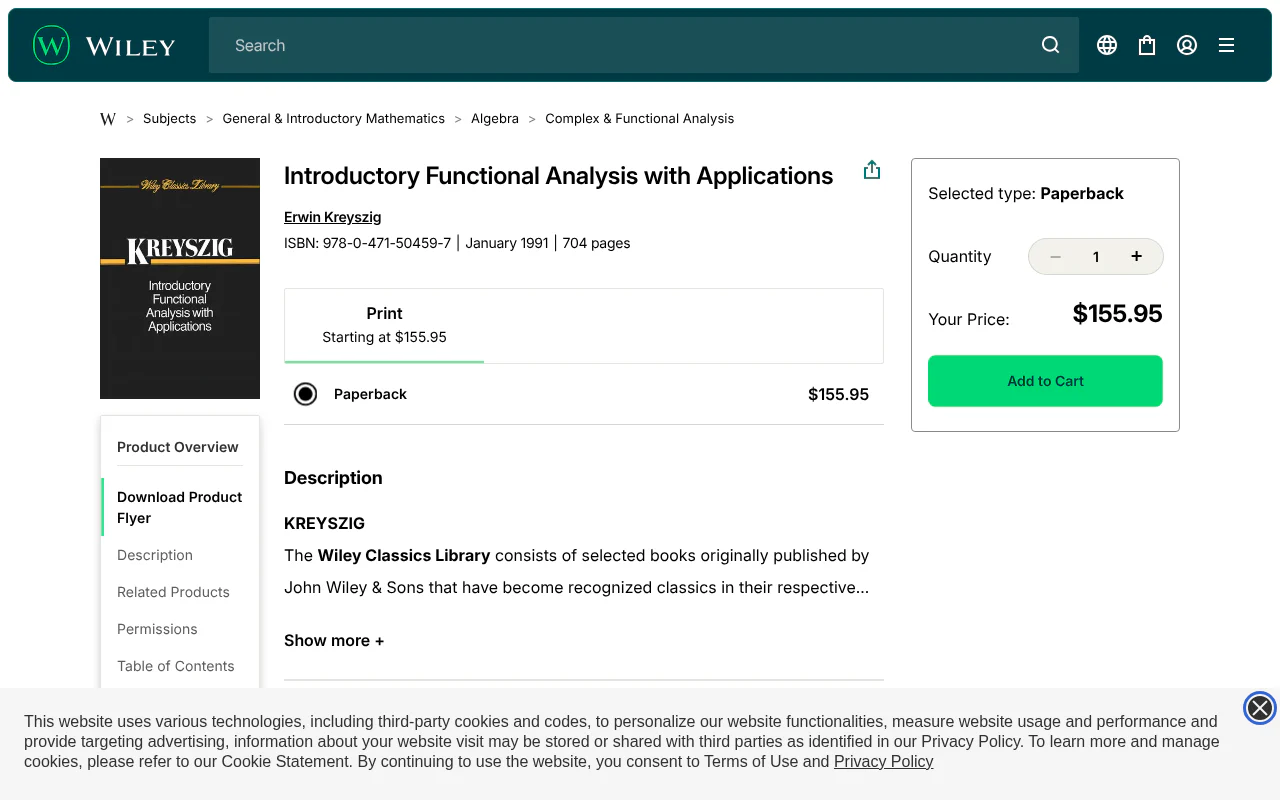
Kreyszig, Introductory Functional Analysis with Applications
Main book for the Functional Analysis section
- Section
- Functional Analysis
- Role
- Main book
- Main drawback
- Applications-heavy
- What to skip
- Applications chapters
Skip the applications chapters and read the core on normed spaces, Banach spaces, Hilbert spaces and operators.
Strengths
- Fit-check terms to find in the index: Hahn–Banach theorem, open mapping and closed graph theorems, uniform boundedness principle, Riesz representation theorem, the spectral theorem for compact self-adjoint operators
- Wiley Classics Library paperback
Limitations
- Applications-heavy
Jain, Iyengar and Jain, Numerical Methods for Scientific and Engineering Computations
Main book for the Numerical Analysis section
- Section
- Numerical Analysis
- Role
- Main book
- Main drawback
- Broader than the syllabus
- What to skip
- Numerical PDE, optimisation
Skip numerical methods for PDE and optimisation.
Strengths
- Fit-check terms to find in the index: Cholesky method, Newton–Cotes formulas, Euler and second-order Runge–Kutta (RK2) methods
- 8th edition, 2022, from New Age International
- Written for scientific and engineering computations
Limitations
- Broader than the syllabus
- Numerical PDE and optimisation chapters must be skipped
Raisinghania, Advanced Differential Equations (PDE)
The same Raisinghania book, used for the PDE section
- Section
- PDE
- Role
- Main book, shared with ODE
- Main drawback
- Same as for ODE
- What to skip
- Calculus of variations
The same Raisinghania book covers PDE, with the same drawbacks as for ODE. Skip the calculus of variations here too.
Strengths
- Fit-check terms to find in the index: method of characteristics, Laplace and Fourier transform methods
- 20th edition, 2023, from S Chand
- One book serves both ODE and PDE
Limitations
- Same drawbacks as for ODE: very long, with few proofs
- Calculus of variations must be skipped here too
Munkres, Topology
Main book for the Topology section, general topology

- Section
- Topology
- Role
- Main book, general topology
- Main drawback
- Long and wordy
- What to skip
- Algebraic topology (Part II)
Read Part I on general topology and skip Part II on algebraic topology.
Strengths
- Fit-check terms to find in the index: Tychonoff theorem, Urysohn's lemma, Tietze extension theorem, quotient topology
- 2nd edition, Classic Version (Pearson, 1 June 2023)
- Part I covers general topology
Limitations
- Long and wordy
- Part II on algebraic topology is skipped
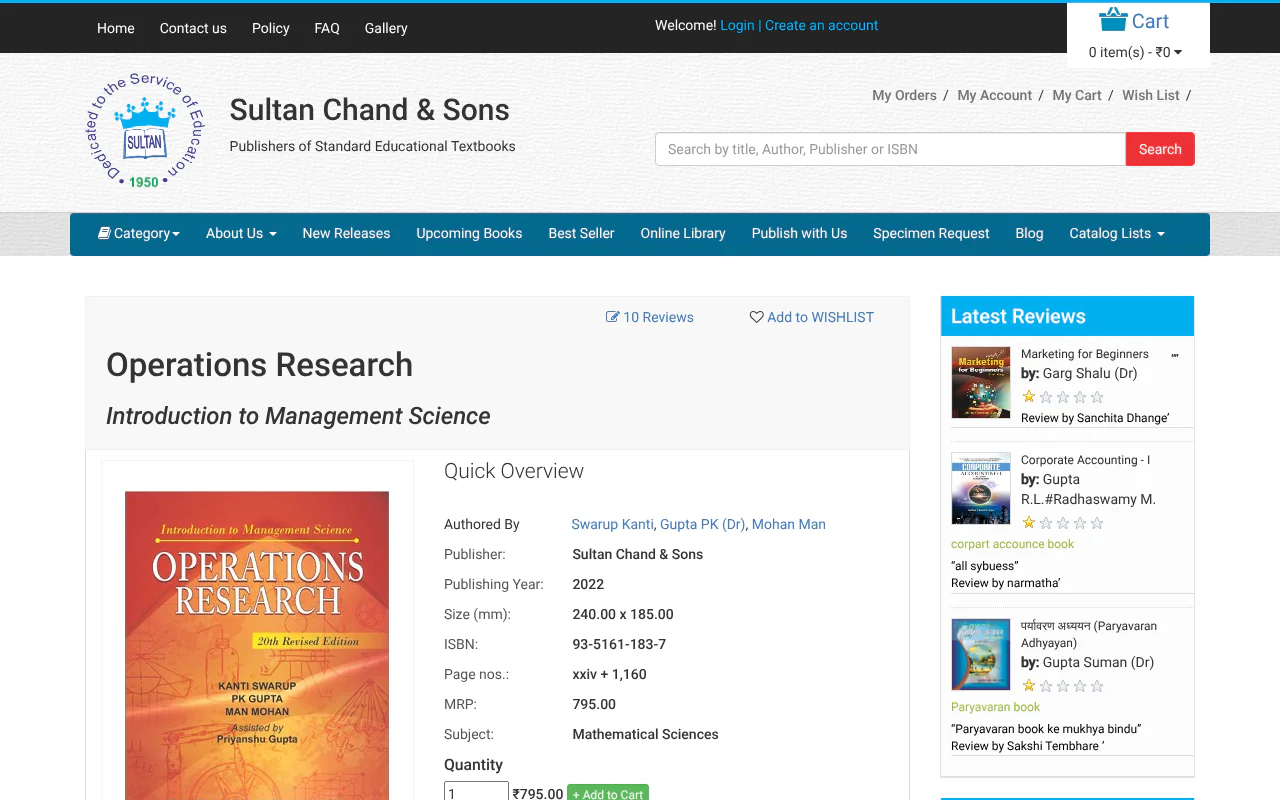
Swarup, Gupta and Mohan, Operations Research
Main book for the Linear Programming section
- Section
- Linear Programming
- Role
- Main book
- Main drawback
- A whole operations research text
- What to skip
- Queuing, inventory, simulation
Skip the queuing, inventory and simulation chapters. For proofs and theory, Bazaraa et al., Linear Programming and Network Flows, 4th edition (Wiley, 2009), is the deeper option.
Strengths
- Fit-check terms to find in the index: revised simplex method, Vogel's approximation method, the modified distribution (MODI) method, the Hungarian method
- 20th revised edition, 2022, from Sultan Chand
- Bazaraa et al. is the deeper option for proofs and theory
Limitations
- A whole operations research text, so most of it is outside the section
- Queuing, inventory and simulation chapters must be skipped
How to choose
- 1
Copy a syllabus line
Copy one syllabus line from the official GATE 2027 MA syllabus PDF. - 2
Look up each term
Look up each term the line names in the book's contents page or index. The book passes if every term has its own heading or index entry. - 3
Patch small gaps
A book that fails on one or two terms is still usable, because you only need to patch those terms with the named fill-in. - 4
Reject the wrong book
A book that fails on most of the terms is the wrong book for that section. - 5
Work one section at a time
Do the check one section at a time, then read the main book, skip the listed chapters and run the fit check against the syllabus terms. - 6
Check the edition
Editions listed here are current as of 21 October 2026; the two that matter most are Herstein's 2022 Indian adaptation and Raisinghania's 20th edition (2023).
Which book covers each section of the GATE Mathematics syllabus?
The table below gives the main book, its drawback and what to skip for each of the 11 syllabus sections. Read the main book first, treat the drawback as a gap to patch, and leave the skipped chapters until after your first pass through the syllabus.
- Section
- Calculus
- Main book
- Marsden and Tromba
- Main drawback
- US-oriented; light proofs
- What to skip
- Extended applications
- Section
- Linear Algebra
- Main book
- Hoffman and Kunze
- Main drawback
- Terse; few worked examples
- What to skip
- Decomposition proofs on first pass
- Section
- Real Analysis
- Main book
- Mapa (Rudin as backup); Royden for measure
- Main drawback
- Mapa is long and has no measure theory; Royden is graduate-level
- What to skip
- Royden beyond real-line measure and Lp spaces
- Section
- Complex Analysis
- Main book
- Churchill and Brown
- Main drawback
- Lighter proofs
- What to skip
- Physical applications chapters
- Section
- ODE
- Main book
- Raisinghania
- Main drawback
- Very long; few proofs
- What to skip
- Calculus of variations
- Section
- Algebra
- Main book
- Herstein (2022 Indian adaptation)
- Main drawback
- Hard problems; terse
- What to skip
- Galois theory
- Section
- Functional Analysis
- Main book
- Kreyszig, Introductory Functional Analysis
- Main drawback
- Applications-heavy
- What to skip
- Applications chapters
- Section
- Numerical Analysis
- Main book
- Jain, Iyengar and Jain
- Main drawback
- Broader than the syllabus
- What to skip
- Numerical PDE, optimisation
- Section
- PDE
- Main book
- Raisinghania
- Main drawback
- Same as for ODE
- What to skip
- Calculus of variations
- Section
- Topology
- Main book
- Munkres, general topology
- Main drawback
- Long and wordy
- What to skip
- Algebraic topology (Part II)
- Section
- Linear Programming
- Main book
- Swarup, Gupta and Mohan
- Main drawback
- A whole operations research text
- What to skip
- Queuing, inventory, simulation
Key takeaways
- The MA paper needs 11 main books: Mapa and Royden for Real Analysis, Raisinghania for both ordinary differential equations (ODE) and partial differential equations (PDE), and one each for the other eight sections.
- Test any book in ten minutes: copy a syllabus line, look up each named term in the contents or index, and add a named fill-in if any term is missing.
- If you already use a Council of Scientific and Industrial Research National Eligibility Test (CSIR NET) book list, add three books for the MA paper: Marsden and Tromba for Calculus, Kreyszig for Functional Analysis, and Swarup, Gupta and Mohan for Linear Programming.
- SBTech Math's CSIR-NET and GATE Mathematics 2027 course is our recommended guided route, with these books as your reading list; demo classes, notes and PYQs are free.
Why do most GATE mathematics book lists not fit the MA paper?
Most lists are written for the engineering mathematics section, which candidates in papers such as electronics and communication engineering (ECE) and computer science engineering (CSE) sit as a short part of their exam. The MA paper tests mathematics as the main subject, so those lists leave out most of its topics, including Real Analysis, Topology and Functional Analysis.
Check who is eligible for the MA paper before you plan. If you are choosing between GATE and the Indian Institutes of Technology Joint Admission Test for Masters (IIT JAM), compare the two syllabuses and see our IIT JAM Mathematics book list. If you already study from a CSIR NET list, see our CSIR NET maths books list for what it covers.
What does the official GATE 2027 Mathematics syllabus include?
The official GATE 2027 MA syllabus, published by the Indian Institute of Technology Madras (IIT Madras), has 11 sections: Calculus, Linear Algebra, Real Analysis, Complex Analysis, ODE, Algebra, Functional Analysis, Numerical Analysis, PDE, Topology and Linear Programming. It has no probability or statistics section, so you do not need probability books for the MA paper.
Use the exam papers and syllabus page to check for updates. Calculus includes vector calculus: gradient, divergence, curl, line and surface integrals, and the theorems of Green, Stokes and Gauss.
How can you check any book against the GATE Mathematics syllabus in ten minutes?
Copy one syllabus line from the official PDF, then look up each term it names in the book's contents page or index. The book passes if every term has its own heading or index entry. If any term is missing, add the named fill-in.
Do this one section at a time. A book that fails on one or two terms is still usable, because you only need to patch those terms. A book that fails on most of them is the wrong book for that section.
Named fill-ins for Real Analysis
For Ascoli–Arzelà, Weierstrass approximation, contraction mapping and the inverse and implicit function theorems, read Rudin's chapters on sequences and series of functions and on functions of several variables. For Baire category, read the "Complete Metric Spaces and Function Spaces" and "Baire Spaces and Dimension Theory" chapters of Munkres' Topology. Our real analysis course teaches the same topics live.
When should you move from theory books to previous-year questions?
Start with free PYQs: SBTech Math offers free mathematics study content, including PYQs, and a Mathematics PDF Drive. Our recommendation: move to PYQs once you can state and sketch the proofs of a section's main theorems, and keep reading theory only to fill gaps the questions expose.
We do not recommend a single PYQ book. Choose any collection by three criteria: it is labelled for the MA paper rather than engineering mathematics, it is sorted by the 11 syllabus units, and it matches the 2027 syllabus. For worked solutions, use our GATE maths previous papers with solutions and GATE maths study material.
What does SBTech Math's GATE Mathematics 2027 course include?
SBTech Math's CSIR-NET and GATE Mathematics 2027 course is our recommended route: live and recorded classes in Hindi and English, with PDF notes, assignments, PYQ discussion, mock tests and analytics. The books above stay your reading list for theory and problem practice alongside the course.
The teachers are SB Sir (Pure Mathematics), Eshita Mam (Applied Mathematics) and Vivek Sir (Abstract Algebra and Real Analysis). Support comes through weekly doubt sessions or personal mentoring. To judge any course, compare it with what full-syllabus GATE mathematics coaching covers.
As of October 2026, the CSIR-NET and GATE Mathematics 2027 course costs ₹15,999 one-time with access through 30 June 2027, or four instalments of ₹3,999.75. A ₹999 Demo Plan also exists, and demo classes, notes and PYQs are free.
To enrol or ask a question, use the contact page; contact-form enquiries get a reply within 24 hours. You can also call +91 81265 45455 or email sbtechmath@gmail.com, 9am–7pm, Monday to Saturday.
How we built this list
The list covers one main book for each of the 11 sections of the official GATE 2027 MA syllabus. Books follow the order of the syllabus sections, and the fit check against each section's syllabus terms decides whether a book is used. Editions are current as of 21 October 2026. SBTech Math's own GATE Mathematics course is the recommended guided route alongside these books.
This page is published by SBTech Math. If anything here is out of date, tell us and we will correct it.
Sources
- 1.GATE 2027 Mathematics (MA) syllabus, IIT Madras
- 2.GATE 2027 exam papers and syllabus page, IIT Madras
- 3.GATE 2026 Statistical and Performance Report, IIT Guwahati
- 4.Herstein, Topics in Algebra, 2nd edition, Indian adaptation, Wiley India
- 5.Raisinghania, Advanced Differential Equations, 20th edition, S Chand
- 6.Rudin, Principles of Mathematical Analysis, 3rd edition, McGraw Hill India
- 7.Royden and Fitzpatrick, Real Analysis, Classic Version, Pearson
- 8.Mapa, Introduction to Real Analysis, revised edition, Google Books
- 9.Churchill and Brown, Complex Variables and Applications, 9th edition, McGraw Hill India
- 10.Friedberg, Insel and Spence, Linear Algebra, 5th edition, Pearson
- 11.Marsden and Tromba, Vector Calculus, 6th edition, Macmillan Learning
- 12.Swarup, Gupta and Mohan, Operations Research, 20th revised edition, Sultan Chand
- 13.Bazaraa et al., Linear Programming and Network Flows, 4th edition, Wiley
- 14.Munkres, Topology, 2nd edition, Classic Version, Pearson
- 15.Kreyszig, Introductory Functional Analysis with Applications, Wiley Classics Library
- 16.Jain, Iyengar and Jain, Numerical Methods for Scientific and Engineering Computations, 8th edition, library catalogue record