
TL;DR
For GATE Mathematics (MA), use one current syllabus, one concept source per topic, solved examples, official PYQs, timed mock tests and an error log. Treat notes as revision tools, not complete preparation. Build the stack topic by topic, then use PYQs and full-format mocks to decide what to revise.
For GATE Mathematics (MA), you need five connected materials: the current syllabus, one concept source, solved examples, official PYQs, and timed mocks with an error log. The MA paper has 11 subject sections and 15 marks of General Aptitude within a 100-mark paper. Official MA syllabus Official paper format
Notes alone are for recall. They cannot show whether you can select a method, handle MCQ, MSQ, and NAT questions, or finish the exam in three hours.
The Five Materials You Need
Build one stack that moves from learning to proof of performance. Our study rule is simple: each resource must do one job.
| Stage | Material | Finish With | Add Next |
|---|---|---|---|
| Coverage | Current MA syllabus | 11 sections plus General Aptitude | 12-row tracker |
| Learning | One concept source | Definitions and methods understood | Worked examples |
| Application | Solved examples | 5 fresh attempts without notes | Official PYQs |
| Recognition | Official MA PYQs | Tagged missed questions | Timed unit test |
| Accuracy | Unit tests | Wrong and slow answers logged | Mixed practice |
| Stamina | Full-format mocks | 65 questions in 180 minutes | Error review |
| Revision | Error log | Weak skill retested | Next mock |
The table prevents a common waste: using three lecture series, four PDFs, and no material that tests performance.
Make a 12-row tracker. Give one row to General Aptitude and one row to each MA section:
- Calculus: use a full source for multivariable calculus, multiple integrals, Jacobians, and vector calculus.
- Linear Algebra: use examples that include vector spaces, linear maps, canonical forms, and quadratic forms.
- Real Analysis: keep definition notes, theorem conditions, and counterexamples together.
- Complex Analysis: practise method selection for integration, singularities, residues, and mappings.
- Ordinary Differential Equations: sort examples by equation type before solving them.
- Algebra: connect groups, rings, ideals, fields, and extensions in one dependency map.
- Functional Analysis: record theorem hypotheses beside each result.
- Numerical Analysis: practise method choice and arithmetic under time pressure.
- Partial Differential Equations: identify equation class and conditions before choosing a method.
- Topology: pair every definition with an example and a non-example.
- Linear Programming: practise model setup, feasibility, simplex, duality, transportation, and assignment problems.
- General Aptitude: schedule it separately. It is worth 15 marks. Official paper format
Start with the Current MA Syllabus
The phrase “GATE maths” often leads to engineering-mathematics material. GATE MA is a separate Mathematics paper, so start with the current official MA document.
The 2027 syllabus was revised. Download the official MA syllabus, then write these tracker columns beside every topic:
- Primary concept source
- Worked examples completed
- PYQs attempted
- Unit-test result
- Error pattern
- Next revision date
Use the syllabus as a filter. Keep a PDF only when you can point to the exact syllabus row it supports.
An engineering graduate should build mathematical language before advanced analysis or topology. Start with sets, functions, definitions, theorem conditions, and proof-style reasoning, then move into calculus and linear algebra. Our engineer-to-MA preparation guide explains that starting bridge.
Give Notes, Books, Lectures, and Examples Different Jobs
Choose one primary concept source for each topic. That source can be a textbook, a lecture course, or a structured class. Do not run two full sources in parallel unless the first one leaves a specific syllabus gap.
Use notes after learning, not instead of learning. Good notes contain definitions, theorem conditions, one decisive example, and your own common trap. A formula sheet cannot teach why a compactness condition or a residue method applies.
Use solved examples to learn method selection. A useful solution should show:
- The syllabus skill being tested
- The theorem or method chosen
- The condition that permits its use
- The decisive calculation or logical step
- A check on the final answer
- The likely trap
Use a book when you need depth. Use a lecture when you need a guided explanation. Use examples when you need to convert understanding into decisions under pressure.
Use GATE Mathematics PYQs in Two Passes
Official PYQs are the material that shows how GATE has actually framed MA questions. The official GATE portal provides a 2007 to 2026 paper archive, including recent Mathematics papers and answer keys.
Use them in two passes.
First, solve PYQs by topic after finishing that topic’s concept work. A Real Analysis question belongs beside your Real Analysis notes, not in an anonymous “PYQ folder.”
Second, solve mixed papers under time pressure. Mixed practice trains the switch from topology to numerical methods, or from algebra to General Aptitude.
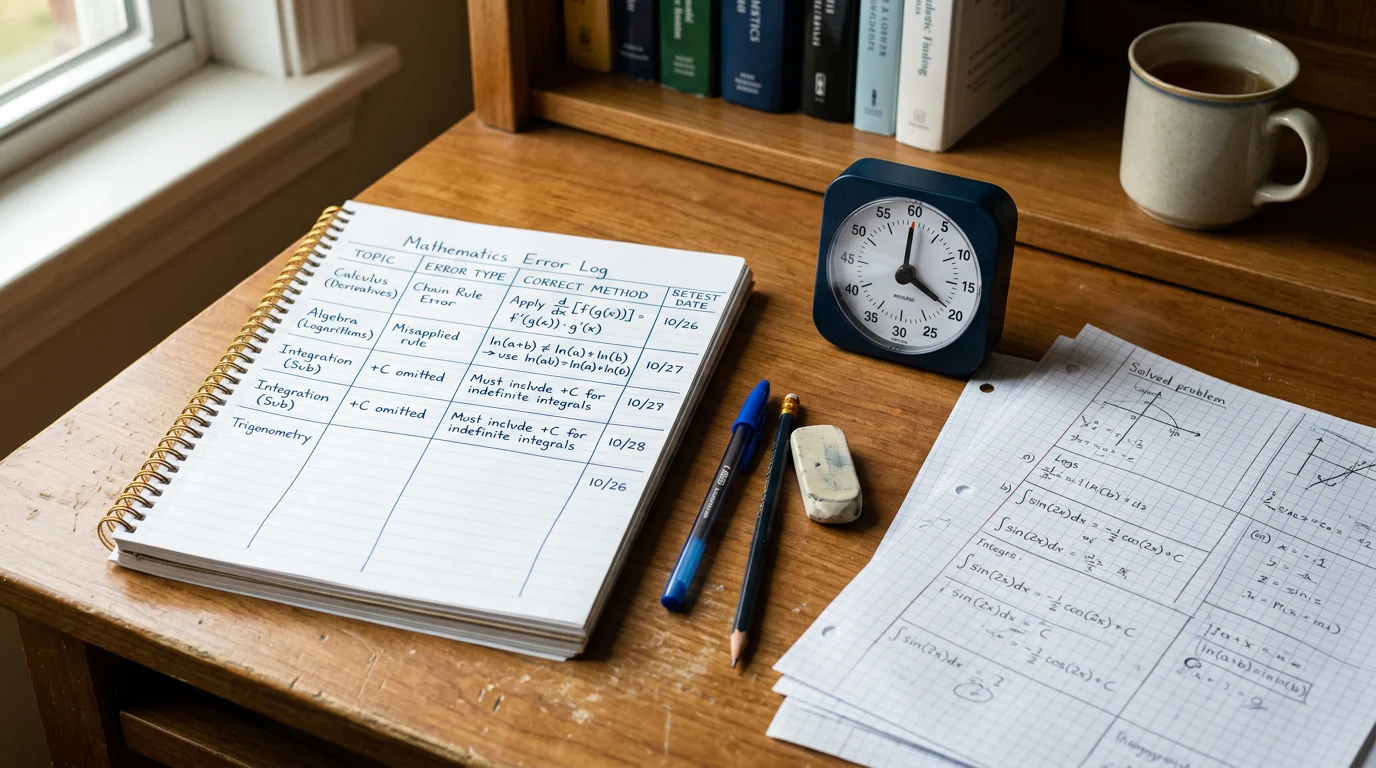
For every missed question, log one of four causes:
- Concept gap: you did not know the definition or theorem.
- Method gap: you knew the topic but chose the wrong approach.
- Execution gap: algebra, arithmetic, or notation caused the error.
- Time gap: you could solve it, but too slowly.
Your next task should match the cause. Rewatch a concept lesson for a concept gap. Solve fresh method-selection examples for a method gap. Redo the calculation cleanly for an execution gap. Set a shorter timed drill for a time gap.
Start Mocks After You Can Diagnose Mistakes
Start a topic test after you have completed lessons, worked examples, and a first PYQ pass for that topic. Start full mocks when your tracker has coverage across the full paper.
A GATE mock should reflect the actual format: 65 questions, 180 minutes, and MCQ, MSQ, and NAT responses. Wrong MCQs have negative marks. Wrong MSQs and NATs do not. Official marking rules
After every full mock, divide the paper into three piles:
- Wrong: learn the missed concept or method.
- Slow correct: build a shorter route or faster recognition cue.
- Skipped: decide whether the next action is learning, practice, or deliberate selection.
Do not retake the same mock as your only review. Build a 20 to 30 minute revision task from the error log, then retest that precise weakness with fresh questions.
Choose a Course Only If It Completes the Stack
A course should replace resource hunting with a visible learning path. Before paying, ask one clear question: how does the course map the current MA syllabus to teaching, examples, PYQs, assignments, tests, solutions, and revision?
A useful course also includes General Aptitude practice. It gives you timed assessments, not only notes. It explains PYQs, rather than only displaying answers.
Use our full-syllabus course audit to compare a course page against the current MA syllabus. Ask once for the PYQ year range, question counts, mock schedule, and access terms if the page does not show them.
At SBTech Math, we suit learners who want one structured path instead of separate notes, lectures, tests, and doubt support. Our GATE 2027 Recorded package costs ₹9,999 and includes recorded classes, test series, doubt sessions, assignments, practice questions, handwritten notes, PYQ explanations, and paper analysis.
Our CSIR-NET + GATE Mathematics 2027 Live Batch costs ₹15,999 as a one-time payment, or ₹3,999.75 per month for 4 months. It includes live and recorded classes, assignments, practice questions, PYQ discussions, full-length mocks, performance analysis, weekly doubts, mentorship, and handwritten notes.
Build One Connected Weekly Routine
Use the same sequence for every MA topic:
- Read the syllabus row.
- Learn from your one concept source.
- Solve worked examples without reading the answer first.
- Attempt topic-wise official PYQs.
- Take a timed unit test.
- Log wrong, slow, and skipped questions.
- Revise the logged weakness.
- Retest with fresh questions.
This routine gives every resource a place. It also tells you when you need more material: only when a specific syllabus row lacks concept learning, examples, PYQs, or timed practice.
Start with our free mathematics study content if you need a first concept source. When you want a connected course, mock, and support system, browse SBTech Math courses.
FAQs
Can I Use Older GATE MA Papers After the 2027 Syllabus Revision?
Yes, use older MA papers when the tested topic remains in the current syllabus. Tag each question to the current syllabus before adding it to your topic practice. Skip questions that only test removed material.
Should I Use CSIR-NET PYQs for GATE Mathematics?
Yes, use CSIR-NET PYQs after GATE MA PYQs when you need deeper practice in a shared topic. Keep GATE MA papers as your main source for timing and exam-format decisions.
Do I Need Separate General Aptitude Study Material?
Yes. General Aptitude is a separate 15-mark section in GATE MA. Give it its own weekly practice block and include it in every full mock. Official MA format
Can I Begin GATE MA Preparation with Full Mocks?
No. Begin with a syllabus tracker, concept learning, worked examples, and topic-wise PYQs. A full mock becomes useful when it can reveal performance gaps across most of the paper.
What Should I Write in an Error Log?
Write the topic, question type, first method chosen, exact error, correct method, and next retest task. “Revise topology” is too vague. “Redo compactness counterexamples, then solve 5 fresh questions” gives you an action.