
Glossary
Cauchy-Riemann Equations
A function can satisfy both Cauchy-Riemann equations at a point and still have no derivative there.

By Sunil Bansal, Founder · Updated 25 Oct 2026
Also called CR equations
On this page
- 01Definition
- 02Quick facts
- 03What are the Cauchy-Riemann equations?
- 04Do the CR equations prove a function is analytic?
- 05Why do two equations cover every direction?
- 06How do you decide where a function is analytic?
- 07What is the CR test easily confused with?
- 08Where do CSIR NET and GATE Mathematics test this topic?
- 09How SBTech Math handles it
- 10Example
- 11Related terms
- 12Frequently asked
What are the Cauchy-Riemann equations?
The Cauchy-Riemann (CR) equations are two conditions on the real and imaginary parts of a complex function that must hold wherever the function has a complex derivative.
Key takeaways
- If the equations fail at a point, f is not differentiable there; if they hold, the continuity of the partials near the point decides the rest.
- Solving the equations gives the set S where f can be differentiable; f is analytic only where S contains an open disc.
- Analytic at a point needs differentiability on a whole open disc around it, so |z|² is differentiable at 0 and analytic nowhere.
- On a whole open set, continuity plus existing partials plus the equations everywhere gives holomorphic (the Looman–Menchoff theorem); existing partials alone are never enough.
Quick facts
- Equations
- u_x = v_y and u_y = −v_x
- Applies to
- f(z) = u(x, y) + i·v(x, y), with z = x + iy
- Polar form
- u_r = v_θ / r and v_r = −u_θ / r
- Wirtinger form
- ∂f/∂z̄ = 0
- Syllabus
- CSIR NET mathematical sciences and GATE 2027 Mathematics (MA)
It can also have a derivative at one point and be analytic nowhere. Both facts catch students out, and both appear in questions that ask where a function is differentiable or analytic. In |z|², the equations hold at 0 alone, yet f′(0) = 0 exists; in z⁵/|z|⁴ they hold at 0 and no derivative exists.
The equations are the first tool taught for that question, so the usual habit is to solve them, find where they hold, and stop. That habit handles the easy cases and fails the awkward ones.
Below you will find a plain definition, the condition that decides when the equations are enough, a four-step routine, and a table of standard functions. The CSIR NET (Council of Scientific and Industrial Research National Eligibility Test) syllabus names the equations. The GATE (Graduate Aptitude Test in Engineering) Mathematics syllabus lists the ideas around them.
What are the Cauchy-Riemann equations?
Write f(z) = u(x, y) + i·v(x, y), with z = x + iy. The equations are u_x = v_y and u_y = −v_x, where a subscript means a partial derivative.
They come from letting the step h in the derivative shrink along the real axis, which gives f′ = u_x + i·v_x. Then let it shrink along the imaginary axis, which gives f′ = v_y − i·u_y. Equating the two gives the equations.
In polar form, with z = r·e^(iθ), they read u_r = v_θ / r and v_r = −u_θ / r (Wikipedia).
Do the CR equations prove a function is analytic?
No. They are necessary for a derivative to exist, but sufficient only with an extra condition. If u and v have continuous partial derivatives near a point and satisfy the equations at it, then f is complex-differentiable at that point (Wikipedia).
A function is analytic at a point when it is differentiable at every point of some open disc (all points within some distance r of the centre) around it. That is stronger than differentiable at one point.
On a whole open set (a set that contains a disc around each of its points), the Looman–Menchoff theorem gives a second route. If f is continuous, its partials exist everywhere there, and the equations hold everywhere there, then f is holomorphic (analytic on an open set). Existing partials alone are never enough: f(x, y) = √|xy| satisfies the equations at the origin and is not differentiable there (Wikipedia).
Why do two equations cover every direction?
Two equations are enough because a real-differentiable function (one whose 2×2 matrix of partials approximates the function near the point) has a derivative that acts as a 2×2 real matrix, and the equations force that matrix to be multiplication by a single complex number. With a = u_x and b = v_x, the matrix [[u_x, u_y], [v_x, v_y]] becomes [[a, −b], [b, a]], which is multiplication by a + ib.
A multiplication by one complex number turns every direction in the same way. The missing condition is real differentiability, which is what continuous partials supply.
It also shows why the real and imaginary parts are not independent: the equations tie the slopes of v to the slopes of u. If u is constant on a disc, both equations give v_x = v_y = 0, so v is constant there too.
How do you decide where a function is analytic?
Solve the equations for the set where they hold, then test that set. Four steps, each with a pass or fail:
Four steps to decide where f is analytic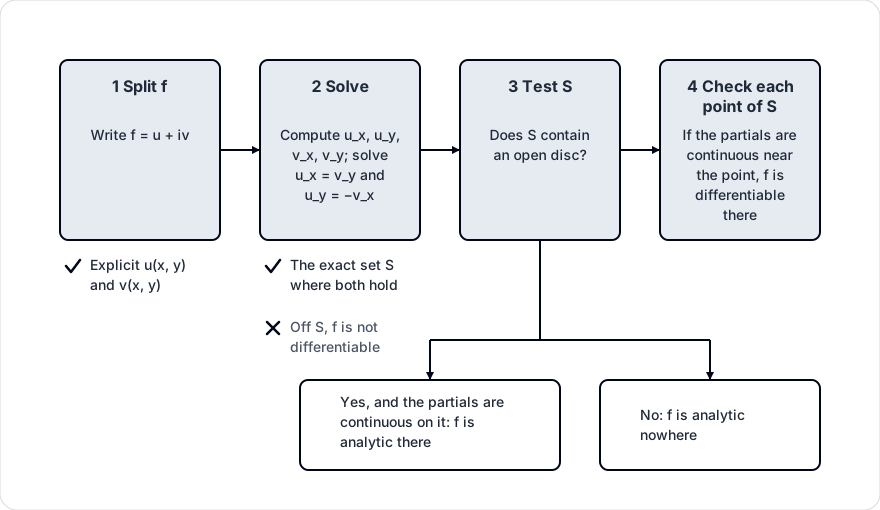
- Split f. Write f = u + iv. Pass: you have explicit u(x, y) and v(x, y).
- Solve. Compute u_x, u_y, v_x, v_y and solve u_x = v_y and u_y = −v_x. Pass: you have the exact set S where both hold. Off S, f is not differentiable.
- Test S. Pass: S contains an open disc and the partials are continuous on it, so f is analytic there. Fail: S contains no open disc, so f is analytic nowhere.
- Check each point of S. If the partials are continuous near a point of S, f is differentiable there. If the partials are not continuous near z₀, compute the limit of (f(z) − f(z₀))/(z − z₀) as z → z₀. Fail: two directions (for example the real axis and z − z₀ = r·e^(iπ/4)) give different values, so f is not differentiable at z₀. Pass: the limit exists and is the same along every path, which you must prove, for example by bounding |f(z) − f(z₀) − c(z − z₀)| / |z − z₀| → 0.
Each verdict in the table follows from solving the equations for that function.
- Function
- z², e^z, cos z
- Equations hold
- Everywhere
- Differentiable
- Everywhere
- Analytic
- Everywhere
- Function
- 1/z
- Equations hold
- For z ≠ 0
- Differentiable
- For z ≠ 0
- Analytic
- On z ≠ 0
- Function
- z̄ (conjugate), Re z
- Equations hold
- Nowhere
- Differentiable
- Nowhere
- Analytic
- Nowhere
- Function
- |z|², z|z|, x² + i·xy
- Equations hold
- Only at 0
- Differentiable
- Only at 0
- Analytic
- Nowhere
- Function
- √|xy|, z⁵/|z|⁴ (0 at 0)
- Equations hold
- At 0
- Differentiable
- Not at 0
- Analytic
- Not at 0
- Function
- e^(−1/z⁴) (0 at 0)
- Equations hold
- At 0 and elsewhere
- Differentiable
- Not at 0
- Analytic
- Not at 0
What is the CR test easily confused with?
Three neighbouring ideas get mixed up with it:
- Differentiable at a point and analytic. Differentiable at a point means the derivative exists there. Analytic at a point means differentiable on a whole open disc around it. On an open set, analytic and holomorphic mean the same thing. |z|² is differentiable at 0 but analytic nowhere.
- Harmonic functions. When f = u + iv is analytic, u and v each satisfy Laplace's equation, u_xx + u_yy = 0. A harmonic conjugate of u is a function v that makes the pair satisfy the Cauchy-Riemann equations. Two harmonic functions are not conjugates unless the equations link them.
- The Wirtinger form. With ∂/∂z̄ = ½(∂/∂x + i·∂/∂y), the two equations collapse into ∂f/∂z̄ = 0. It is the same test written on one line.
Where do CSIR NET and GATE Mathematics test this topic?
The CSIR NET syllabus for mathematical sciences lists "Analytic functions, Cauchy-Riemann equations" under Complex Analysis (CSIR Human Resource Development Group syllabus). The GATE 2027 Mathematics (MA) syllabus lists "continuity, differentiability, analytic functions, harmonic functions" (IIT Madras). Neither document says how often it asks about them.
Questions usually take the form "at which points is f differentiable, and where is it analytic?". The four-step routine answers them, finishing by testing the points the equations leave open.
How SBTech Math handles it
SBTech Math teaches complex analysis in its CSIR-NET and GATE Mathematics 2027 course, which runs as live online classes with recorded lectures and includes weekly doubt sessions or personal mentoring. Its Pure Mathematics combo lists "Analytic functions, Cauchy-Riemann equations" in its complex analysis module, and SB Sir teaches Pure Mathematics. Demo classes and a PDF Drive of previous-year questions are free. As of October 2026, the course costs ₹15,999 one-time or four instalments of ₹3,999.75.
Example
Take f = |z|², so u = x² + y² and v = 0. The equations read 2x = 0 and 2y = 0, so they hold only at the origin, and the partials are continuous, giving f′(0) = 0. Now take f(z) = z⁵/|z|⁴ with f(0) = 0: on the real axis f(x) = x and on the imaginary axis f(iy) = iy, so both equations hold at 0. But for z = r·e^(iπ/4), f(z)/z = e^(iπ) = −1 while along the real axis the quotient is 1, so there is no derivative.
Frequently asked
With z = r·e^(iθ), they read u_r = v_θ / r and v_r = −u_θ / r. These are the same two conditions as u_x = v_y and u_y = −v_x, written for polar coordinates.
A harmonic conjugate of u is a function v that makes the pair satisfy the Cauchy-Riemann equations, so you solve v_y = u_x and v_x = −u_y for v. Here u and v are the real and imaginary parts of f = u + iv.