
GATE Mathematics Coaching for Engineering Graduates Switching to Pure Math
GATE Mathematics coaching for engineering graduates: build proof foundations, master MA, practise under time, and prepare for research interviews.

GATE MA is not the small mathematics component attached to an engineering paper. In the official format, General Aptitude accounts for 15 marks before the subject questions begin.
For an engineering graduate, GATE Mathematics coaching should start with a diagnostic bridge into proof-based undergraduate mathematics, then move through the official syllabus, timed problem solving, and oral mathematical explanation. We treat GATE score preparation and IIT research-interview readiness as separate stages because fast exam accuracy is not the same as explaining definitions, examples, counterexamples, and reasoning aloud.
We cover the readiness check, pure-math bridge, syllabus sequence, doubt support, practice structure, and the boundaries between exam coaching and later research preparation. The goal is a credible path for career switchers, not a promise that an engineering background automatically covers the prerequisite work.
How Does GATE Mathematics Coaching for Engineering Graduates Begin?
We begin by identifying what you can already do, not by assuming that a strong engineering transcript translates directly into proof-based mathematics. An engineering graduate can choose a GATE paper around an admission plan, but the admitting programme still decides its own academic requirements, as the GATE FAQ makes clear.
Our readiness check scores five inputs: logical notation, proof writing, calculus reasoning, linear-algebra structure, and timed problem solving. A low score is not a verdict on potential. It simply means the foundation phase should come before advanced analysis, algebra, or topology.
| Engineering Mathematics Experience | Pure-Math Requirement for GATE MA | Productive Bridge |
|---|---|---|
| Matrix operations and eigenvalue calculations | Vector spaces, linear maps, bases, and proof of results | Move from computation to definitions and short proofs |
| Formula-based calculus | Limits, convergence, continuity, and rigorous hypotheses | Rebuild calculus through quantifiers and examples |
| Differential-equation methods | Existence, uniqueness, and qualitative reasoning | State assumptions before applying a method |
| Optimisation techniques | Abstract algebra, topology, and functional analysis | Practise structures, examples, and counterexamples |
A learner who scores 0 to 8 out of 20 should complete the full bridge first. At 9 to 14, we combine selected bridge work with early syllabus units. At 15 to 20, we can begin the structured MA sequence while continuing proof practice. For a deeper view of the starting difference, use our engineer comparison.
Which Foundations Turn Engineering Maths into Pure-Math Readiness?
The shift is mostly about language and habits. Pure mathematics asks you to distinguish an example from a proof, identify hidden assumptions, and explain why a result holds instead of only applying it.
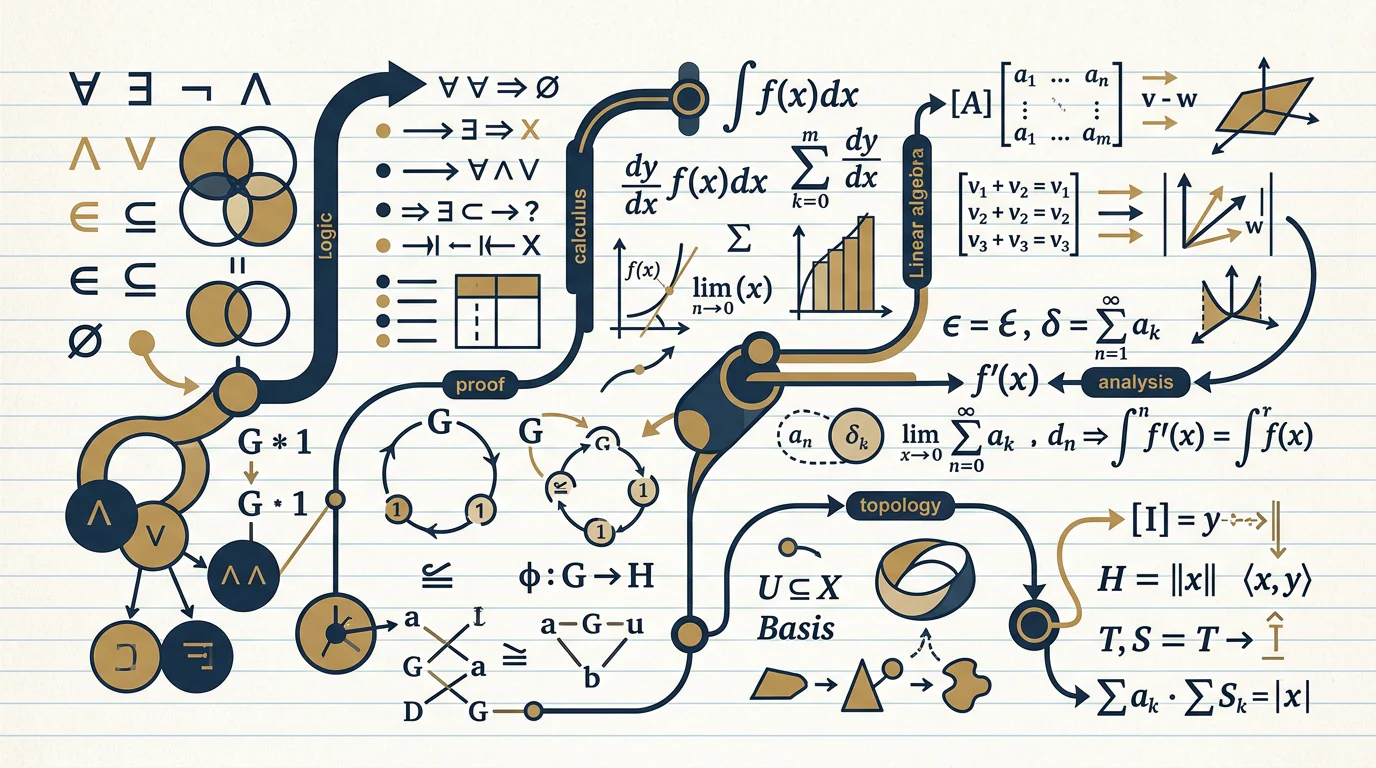
We build the bridge in dependency order:
Logic, Sets, Functions, Quantifiers
            ↓
Direct Proof, Contradiction, Contrapositive, Induction
            ↓
Calculus And Linear Algebra Through Definitions
            ↓
Metric Spaces, Sequences, Linear Transformations
            ↓
Analysis, Algebra, Complex Variables, Differential Equations
            ↓
Topology, Functional Analysis, PDEs, Mixed Practice
Start with set notation, functions, relations, and quantified statements. Then practise direct proof, contradiction, contrapositive, and induction until notation no longer interrupts your thinking. Our foundation bridge helps place this work before the advanced units that depend on it.
The bridge should also include a definition notebook. For every new term, write the definition, one valid example, one non-example, and a short explanation of what changes between them. That habit later becomes useful in both topology questions and oral interview discussions.
Which GATE MA Topics Should You Study, and in What Order?
The official MA syllabus reaches far beyond introductory engineering mathematics. It includes real and complex analysis, algebra, functional analysis, numerical analysis, PDEs, topology, and linear programming, as shown in the MA syllabus.
We sequence those units by prerequisites instead of treating the syllabus as a flat checklist. That makes the path more manageable for an engineering graduate and reveals which gaps must be repaired before a difficult chapter turns into repeated memorisation.
Start with Calculus and Linear Algebra
Calculus, vector calculus, finite-dimensional vector spaces, linear transformations, eigenvalues, inner-product spaces, and canonical forms give later work a usable base. We focus on definitions and arguments alongside computations, because many later concepts reuse the same language.
Build the Analysis and Algebra Spine
Real analysis introduces metric spaces, compactness, completeness, uniform convergence, and integration. Abstract algebra then adds groups, rings, ideals, fields, and homomorphisms. Both areas reward learners who can state conditions precisely before beginning a solution.
Add Differential and Applied Units
Ordinary differential equations, numerical analysis, PDEs, and linear programming require strong technical practice. We place them after the relevant calculus and linear-algebra foundations, then use mixed questions to test method selection under time pressure.
Finish with Topology and Functional Analysis
Topology and functional analysis should not be rushed into the final revision window. Their definitions connect back to metric spaces, compactness, normed spaces, and inner-product spaces, so we return to prerequisite notes whenever a proof step breaks down.
| Official Area | Prerequisite Before Deep Practice | Evidence of Readiness |
|---|---|---|
| Real Analysis | Proof language, sequences, basic topology | Explain compactness and uniform convergence |
| Abstract Algebra | Sets, functions, equivalence relations | Work with homomorphisms and quotient structures |
| Complex Analysis | Calculus, limits, power series | Justify analyticity and use core theorems |
| ODEs And PDEs | Calculus, linear algebra, series | Select methods from equation structure |
| Topology And Functional Analysis | Metric spaces, linear maps | Define spaces and reason from hypotheses |
Our current learning material should be checked against this full matrix before enrolment, especially for topology and functional analysis. Use our exam-choice guide to keep the MA syllabus central when comparing preparation routes.
How Do Live Doubts and Timed Practice Build Exam Performance?
A recorded explanation can introduce a theorem, but it cannot always reveal why your proof failed. We use doubt support to locate the exact breakdown, whether it is a missing definition, an invalid implication, a misread hypothesis, or a calculation error.
Use a Four-Step Doubt Workflow
- Attempt first: Write the definition, theorem, and the step where your reasoning stopped.
- Submit precisely: Share the attempted proof or calculation, not only a request for the answer.
- Resolve live: Bring the named issue to the weekly doubt session or mentorship channel.
- Re-test immediately: Solve a nearby problem and add the correction to your error log.
Our listed batch includes live online classes, recorded revision access, assignments, PYQ discussions, full-length mocks, performance analysis, weekly doubt sessions, and mentorship. We do not claim a guaranteed response time or individual support level beyond what the active course details state, so use our live-doubt guide to judge the interaction model you need.
Practise in the Same Order You Learn
We start with untimed topic practice, then add General Aptitude drills, PYQs, short mixed sets, sectional tests, and full mocks. After every mock, classify errors as concept, proof logic, method choice, arithmetic, question reading, or time management.
A useful review produces a next action. If you missed a compactness question because the definition was vague, revisit the definition notebook. If you knew the method but chose it too slowly, use short selection drills before returning to a full mock.
Why Is Research-Interview Preparation a Separate Stage?
A GATE score can support an application, but it is not identical to research admission readiness. For example, IIT mathematics departments can add written screening and interviews, and one current department page requires candidates to answer questions across at least three areas in its interview syllabus.

The distinction matters because a timed GATE question rewards accurate, efficient execution. An interview can ask you to define a concept, supply an example, produce a counterexample, explain a theorem’s assumptions, or discuss why a line of reasoning fails.
| Preparation Dimension | GATE MA Stage | Research-Interview Stage |
|---|---|---|
| Main Goal | Score accurately under time constraints | Explain mathematical reasoning aloud |
| Evidence Of Progress | PYQs, timed sets, and mock review | Definitions, examples, proof sketches, oral responses |
| Typical Response | Efficient written solution | Verbal reasoning with conditions and alternatives |
| Coverage Focus | Official GATE MA syllabus and aptitude | Programme-specific depth and academic fit |
| Best Output | Error log and revision plan | Oral-definition bank and mock discussion notes |
Our listed course options are where you can review active batches, formats, access terms, and prices before deciding whether the sequence matches your readiness score. Use the course store to compare the current listing with the study time you can actually protect each week.
For the oral stage, we recommend building a definition bank, then practising short explanations without notes. Choose a theorem, state its hypotheses, give a simple example, describe one case where its conditions fail, and explain what changes. This work makes the transition from silent written solutions to technical discussion more deliberate.
Keep the first oral sessions narrow. Explain one definition in plain language, then use a second explanation that preserves the formal conditions. Record yourself only if that helps you notice omissions, and revise your answer after checking the relevant theorem or definition. Accuracy matters more than sounding rehearsed.
Next, practise linking topics that appear unrelated at first. For example, connect compactness to a result you have used in analysis, or connect an eigenvalue problem to a differential-equation method. This turns revision into usable mathematical conversation instead of a collection of disconnected facts.
We treat post-GATE work as a separate bridge: define core objects aloud, build example and counterexample sets, revisit weak syllabus areas, and practise short technical conversations. We do not currently list research-interview preparation or mock interviews as an included batch feature, so learners should plan that stage separately through our interview-prep guide.
Choose SBTech Math for a Structured Pure-Math Switch
SBTech Math is built for learners who want a structured route into higher mathematics, not a pile of disconnected videos. Our current CSIR-NET + GATE Mathematics batch lists live online classes, recordings for revision, weekly doubt sessions, assignments, PYQ discussions, full-length mocks, and mentorship. It is listed in Hindi and English, with an access date through 30 June 2027. Pricing, batch timing, and refund terms can change, so check the course page before paying.
Choose us when you want to diagnose proof gaps, practise under timed conditions, and keep your GATE work distinct from later research-admission preparation. We will be clear about what the active course includes and what still needs separate planning, especially interview practice. Start with the learning path that matches your actual preparation level, current schedule, and support needs today at SBTech Math.
FAQs on GATE Mathematics Coaching for Engineering Graduates
Can an Engineering Graduate Choose GATE Mathematics?
Yes. Eligible engineering graduates may choose GATE MA for their admission plan. However, each postgraduate or research programme applies its own degree, shortlisting, and selection requirements.
How Is the GATE MA Paper Structured?
The MA paper combines General Aptitude and subject questions in a computer-based examination. Wrong MCQs can attract negative marking, while incorrect MSQ and NAT responses do not.
Does GATE Qualification Guarantee an IIT PhD Seat?
No. A qualifying score can support eligibility, but departments may shortlist applicants using academic records, written screening, research fit, and an interview before offering admission.
Does the Current Course Include Research-Interview Preparation?
The public course details list classes, doubts, practice, mocks, and mentorship. They do not state that research interview preparation or mock interviews are included services.
What Should I Check Before Paying?
Confirm the active batch start, course-access end date, language, live-session schedule, listed price, payment method, and refund terms directly on the current course page first.