
Should GATE Mathematics Coaching Include CSIR-NET Preparation?
Should GATE Mathematics coaching include CSIR-NET? Compare syllabus overlap, course design, proof work, and IIT research readiness.

For GATE MA, 85 of 100 marks come from the subject paper, while 15 marks come from General Aptitude. That makes syllabus depth important, but it does not make every broader course a better choice.
GATE Mathematics coaching should include CSIR-NET preparation only when you need both exam routes and the course separates question styles, depth, and practice calendars. We use shared foundations for analysis, algebra, and differential equations, then map the distinct mocks, proof work, and interview preparation each route needs.
Should GATE Mathematics Coaching Include CSIR-NET Preparation?
We would not treat CSIR-NET as a free add-on to a GATE plan. The two exams overlap heavily, but they reward different decisions under time pressure. A GATE-only student needs a clean route through the MA syllabus, General Aptitude, and GATE question formats. A student pursuing research pathways through both exams needs a wider map, plus enough time to practise each exam on its own terms.
The case for integration is strongest when both exam routes genuinely matter to your admissions or fellowship plan. It is weaker when the extra material would take time away from your first priority. Our decision rule is simple: choose breadth only when it supports a real second pathway, not because it sounds safer.
CSIR-NET Mathematical Sciences uses Part A, Part B, and Part C, with different attempt limits and marking rules. Its Part C allows more than one correct option and awards credit only when all correct options are chosen, as the official CSIR pattern explains. That is a distinct assessment problem from GATE MA, even when the topic appears familiar.
For a wider decision framework, compare GATE-only choices before assuming that one large syllabus automatically creates two complete preparation plans.
Which GATE Mathematics Coaching Topics Overlap with CSIR-NET?
The overlap is real enough to justify a shared foundation. Linear algebra, real and complex analysis, algebra, topology, differential equations, and numerical methods belong in both conversations. The mistake is treating overlap as identity. A combined course should tell you where common teaching ends and where each exam requires its own practice branch.
What We Teach as the Shared Foundation
We would build the common layer around definitions, theorem use, structured problem-solving, and proof awareness. Analysis and algebra are especially useful shared domains because weak foundations in either one affect several later topics. We also recommend using concept revision across both exams, while keeping timed practice separate.
The official MA syllabus names 11 areas: Calculus, Linear Algebra, Real Analysis, Complex Analysis, Ordinary Differential Equations, Algebra, Functional Analysis, Numerical Analysis, Partial Differential Equations, Topology, and Linear Programming.
Where CSIR-NET Extends the Route
CSIR-NET adds or emphasizes areas that deserve explicit branches, including combinatorics and number theory, Galois theory, calculus of variations, integral equations, and classical mechanics. Its syllabus also includes a statistics and probability route. Students should not discover these additions only after finishing a supposedly integrated foundation.
Topic Overlap Matrix
| Topic Cluster | GATE MA Scope | CSIR-NET Scope | Depth And Assessment Decision |
|---|---|---|---|
| Analysis and calculus | Calculus, real analysis, functional analysis | Analysis and normed-space foundations | Share concepts, separate advanced question sets |
| Linear algebra | Full MA syllabus area | Core mathematical sciences area | Share teaching, use separate PYQs |
| Complex analysis | Full MA syllabus area | Core mathematical sciences area | Share theory, calibrate by exam pattern |
| Algebra | Groups, rings, fields | Adds number theory and Galois theory | Add a CSIR-specific extension |
| ODE, PDE, numerical analysis | Full MA syllabus areas | Core Unit 3 areas | Separate mocks and revision logs |
| Topology | Explicit MA area | Core topology foundations | Check required depth before practice |
| Variations, mechanics, integral equations | Not named as MA syllabus sections | Explicit CSIR branches | Add only for the CSIR pathway |
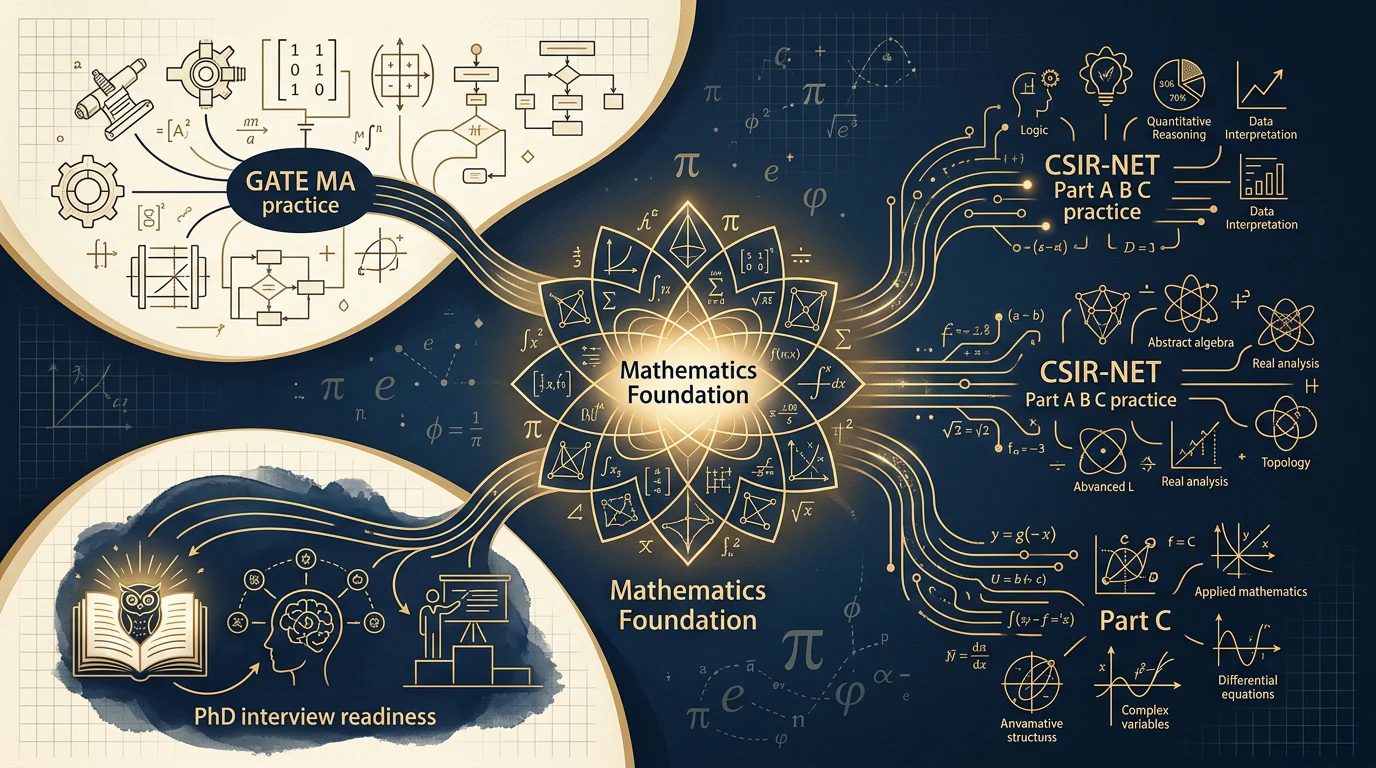
Use our syllabus comparison when you need to decide whether a topic gap belongs in your GATE plan, your CSIR plan, or both.
Why Do GATE and CSIR-NET Need Separate Mock Systems?
A shared lecture plan can be efficient. A shared mock system usually is not. GATE MA tests MCQ, MSQ, and Numerical Answer Type questions, with different negative-marking rules. CSIR-NET requires students to manage Part A aptitude, Part B subject questions, and higher-order Part C questions within its own attempt limits.
For GATE, we recommend a cycle of topic drills, mixed-format tests, previous-year questions, and full-length mock analysis. GATE also gives students a large official archive of past papers, which makes pattern-specific practice more useful than generic question volume.
For CSIR-NET, the revision system should track Part A, B, and C independently. A student who is solid in Part B may still need a different accuracy strategy for Part C. We would log not only incorrect answers, but also skipped questions, incomplete multi-correct selections, and topics that consume too much time.
- GATE review: Track format errors, calculation errors, and General Aptitude gaps.
- CSIR review: Track Part A speed, Part B recall, and Part C analytical selection.
- Shared revision: Revisit concepts once, then return to exam-specific practice.
A practical mock analysis should reveal whether the problem is knowledge, timing, question selection, or an avoidable accuracy loss.
Can Engineering Graduates Switch into Pure Mathematics Through This Path?
Yes, but we would begin with the mathematics gap, not the exam date. GATE 2026 allows candidates from government-approved undergraduate degrees across engineering, science, commerce, arts, and humanities, according to the GATE eligibility rules. That eligibility creates an opportunity, not instant readiness for advanced mathematics.
An engineering graduate moving toward pure mathematics usually needs a bridge before intensive test practice: proof language, logical implication, counterexamples, induction, abstract structures, and the habit of reading definitions precisely. Without that bridge, even familiar-looking calculus or linear algebra questions can become difficult once they require theorem-based reasoning.
We recommend a staged route. First, audit the undergraduate foundation. Next, build proof-writing fluency alongside real analysis and abstract algebra. Then introduce exam-specific questions only after the student can explain why a method works, not simply repeat a procedure. This approach also improves later research interviews, where mathematical conversation matters more than a timed answer choice.
Our engineering bridge explains how to sequence that transition without pretending that an engineering syllabus and a pure-mathematics foundation are interchangeable.
What Should an Integrated GATE and CSIR-NET Course Include?
A credible integrated course has one shared academic spine and two visible exam branches. If the course merely attaches extra recordings to a GATE schedule, it may broaden coverage without solving the actual preparation problem. We would look for a published map that states what is taught together, what is taught separately, and how progress is measured in each route.
A Shared Foundation with Named Branches
The core should cover the overlapping mathematics once, in enough depth to support both exams. After that, the plan should identify GATE-specific areas, CSIR-specific extensions, and the point where each student begins timed practice.
Separate PYQ, Mock, and Revision Calendars
Previous-year questions should be stored and reviewed by exam, not mixed into one undifferentiated bank. The same applies to mock tests, score tracking, error logs, and final revision. A combined plan can be efficient only when its measurement stays separate.
Proof Feedback and Advanced Problem-Solving
We would expect room for written reasoning, oral explanation, and difficult multi-step problems. Objective exams still reward conceptual clarity, and proof-writing exposes shallow understanding before it appears as a score plateau.
Live Doubt Support That Is Easy to Verify
Before paying, ask for the published doubt-clearing schedule, Mathematics subject coverage, response rules, and how proof-based questions are handled. Do not assume that a general live-support claim applies to advanced Mathematics. Our live doubt guide gives you a clearer checklist.
| Decision Factor | GATE-Only Course | Integrated Course |
|---|---|---|
| Best fit | One confirmed GATE MA priority | GATE MA plus a real CSIR-NET pathway |
| Syllabus | Full GATE MA and General Aptitude | Shared core plus named CSIR extensions |
| Practice design | GATE MCQ, MSQ, NAT, and PYQs | Separate GATE and CSIR practice systems |
| Research readiness | Add interview work separately | Add interview work separately, never assume it |
| Buying question | Does it prepare me for GATE MA well? | Does it protect quality in both pathways? |
Will Dual-Exam Preparation Also Prepare You for IIT Research Interviews?
Dual-exam preparation can strengthen the foundation for an interview, but it does not replace interview preparation. Research interviews test how you explain mathematics, defend a method, identify gaps in your knowledge, and connect your interests to the department. Those are different from completing a timed computer-based exam.
At IISc, Mathematics PhD applicants may qualify through GATE or Joint CSIR-UGC NET for JRF, among other routes, but shortlisted candidates still face an interview and selection is based on interview performance under the IISc admissions rules. We treat that as a clear reminder that an exam score can open a door without completing the admissions task.
IIT Madras similarly lists valid national qualifications alongside a mathematics background and describes test or interview questions from at least three broad mathematics areas. That makes mock interviews, oral proof explanation, faculty-area research, and research discussions sensible parts of preparation, not optional decoration.
We suggest students prepare three interview assets:
- Proof explanation: Explain a definition, theorem, or method aloud without relying on answer options.
- Research conversation: Discuss an area you want to explore and the questions you still want to learn.
- Foundation diagnosis: Revisit the core areas most likely to appear in an academic discussion.
For the score-to-interview gap, use our interview readiness guide before treating either exam result as the final stage.
Prepare with SBTech Math
At SBTech Math, we want your course choice to match the mathematics you need to learn and the route you intend to take after the exam. Use this page as a buying checklist, not as a reason to choose the broadest package. Before committing, compare the published syllabus map, confirm that GATE and CSIR assessments stay separate, ask how proof feedback is handled, and check whether interview discussions are actually scheduled. If you are an engineering graduate, start with the foundation gap rather than rushing into mock scores. If you need a single exam route, protect time for that route. If you need two, insist on two revision systems. We can help you turn those answers into a focused preparation plan and choose materials that fit it. Our aim is a clear decision rather than vague reassurance for you. Begin with SBTech Math.
FAQs on GATE Mathematics Coaching
Can One Course Prepare Me for GATE Mathematics and CSIR-NET?
Yes, when a course teaches shared concepts once, then keeps distinct GATE and CSIR PYQs, mocks, and revision plans. Generic schedules can hide exam-specific weaknesses.
Does GATE Mathematics Coaching Prepare Me for an IIT PhD Interview?
No. A qualifying score may open an application route, but interview selection can require oral mathematics, strong foundations, and a credible research discussion beyond objective questions.
What Should I Verify Before Choosing a Combined Course?
Verify the syllabus map, distinct PYQ and mock plans, proof feedback, doubt response schedules, and claimed interview support before paying for a combined preparation course.